
After last month’s Supreme Court ruling striking down President Joe Biden’s plan for broad student loan debt cancellation, borrowers and advocates are eagerly awaiting more details about Biden’s next plan to provide relief.
While newly announced actions like reducing discretionary income for income-based repayments and declining to report missed payments to credit bureau agencies for one year will certainly help some borrowers in the short term, what isn’t clear is whether the Biden-Harris administration’s plan to issue targeted relief under the Higher Education Act (HEA) will go as far as the president’s original program.

On June 30, the high court ruled that Education Secretary Miguel Cardona, under the HEROES Act, does not have legal authority to issue debt relief up to $10,000 for all borrowers making less than $125,000 and up to $20,000 for Pell Grant recipients. Hours later, Biden unveiled his Plan B girded in a different law (HEA), but with little details.
The Higher Education Act and the rule-making process
The Higher Education Act was signed into law by President Lyndon B. Johnson in 1965. The law grants the Department of Education broad power to strengthen educational resources for colleges and universities. Title IV of HEA authorizes programs that provide financial assistance for students in postsecondary and higher education.
The HEA also includes a provision that, in certain circumstances, requires the Secretary of Education to conduct “negotiated rulemaking” and “obtain advice and recommendations from specified individuals and groups,” according to the Congressional Research Service.
In the case of Biden’s new plan to explore other legal pathways to enact student debt relief, the Department of Education will have to conduct a negotiated rule-making process, which includes forming a committee of stakeholders to research and develop policy rules. The committee then works to reach a consensus and then sends a report back to the federal agency.
After the Department of Education receives the proposal, it will publish it in the Federal Register. The public will then have a period of time to provide comments on the proposed rule. After those steps have been completed, the department will issue a final rule after considering the comments received from the public.
What is the Biden administration saying?

Until the entire negotiated rule-making process is complete, student borrowers will not know much specifics about Biden’s debt relief program. The White House said last week during a press briefing call that the process will take “several months.”
In the meantime, the Department of Education is encouraging borrowers to prepare themselves for the payments to resume in October. Bharat Ramamurti, deputy director of the National Economic Council, stressed that borrowers who can make their payments in the meantime should do so because “interest will be accruing.”
Ramamurti also emphasized that not making payments means “you won’t get credit for programs like income-based repayment and public service loan forgiveness.” Biden’s decisions to not report missed payments to credit bureaus and reduce the discretionary income from 10% to 5% for qualified borrowers in the income-based repayment program are designed to provide immediate assistance.
They will also give borrowers some reprieve as they wait to find out if any additional relief sought through the Higher Education Act will amount to the kind of relief previously announced under the HEROES Act.
In addition to the ongoing rule-making and public comment process, Cardona said the Department of Education is analyzing the Supreme Court decision to determine “what the best pathway forward is.”
“We’re beginning a new process that’s going to change the rules to get us to as much debt relief, to as many people, as quickly as possible,” Cardona said during last week’s call. He said the “interpretation” of the court’s decision “will factor in how the Department of Education, the Department of Justice and the White House lawyers work together to move us forward to debt forgiveness.”
Ramamurti acknowledged that it may be “frustrating” to borrowers that the Biden-Harris administration can’t provide more information, like who exactly will get relief under this new process.
“Unfortunately, that’s the way it works,” he said.
Administration officials urged the public to visit StudentAid.Gov to learn more about the programs available to eligible borrowers.
What advocates are saying about President Biden’s new plan
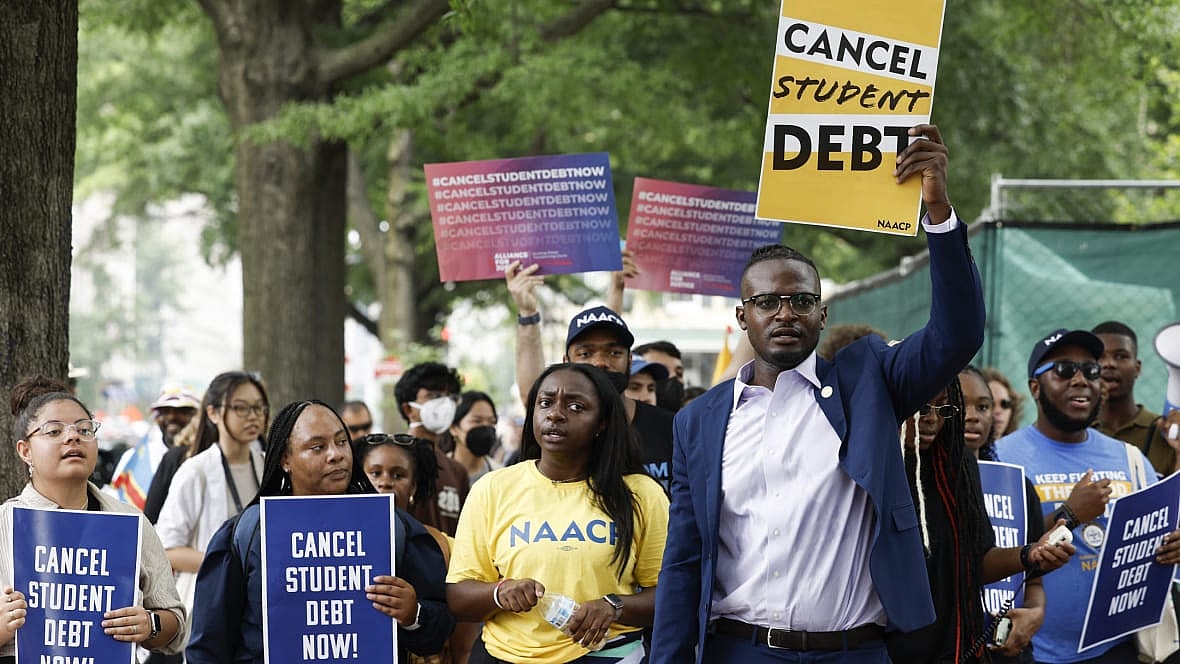
Student loan advocates say they welcome Biden’s newly announced programs after the Supreme Court’s ruling, however they are calling for the White House to issue relief “swiftly.”
Wisdom Cole, national director of NAACP’s Youth & College division, told theGrio that if borrowers have to resume payments without debt cancellation, it will have “devastating impacts” for Black households, including “folks potentially going into default.”
Cole said Biden’s on-ramp plan not to report missed payments to credit bureaus for 12 months is “not enough” as borrowers anticipated needed debt cancellation.
“That’s not what was promised when this plan was put into place, and so we really need to continue to push that this program actually gets implemented,” he said.
As the White House goes through its process, Cole said the NAACP’s policy and legal teams are currently working on their own strategies. He said any relief from the administration has to equal up to the $20,000 promised in Biden’s initial plan or more.
“That is the groundwork that was set by the president,” he noted.
When the Supreme Court handed down its decision in Biden v. Nebraska, Cole led a group of student demonstrators and advocates who marched from the steps of the court to the White House. He told theGrio that the NAACP will continue to make noise on the ground and work with partners in Congress to make sure the Biden-Harris administration hears their demands.
The NAACP previously called for the administration to cancel a minimum of $50,000 per student borrower. Cole noted that the civil rights organization’s advocacy and negotiation led to Biden issuing a more equitable plan for Pell Grant recipients, a significant number of whom are Black.
“We’re going to do everything in our power to ensure that we continue to amplify the stories of Black borrowers who are impacted by this decision,” he continued. “And we’re going to continue to ensure that we keep the administration accountable to this promise.”

Gerren Keith Gaynor is a White House Correspondent and the Managing Editor of Politics at theGrio. He is based in Washington, D.C.
TheGrio is FREE on your TV via Apple TV, Amazon Fire, Roku and Android TV. Also, please download theGrio mobile apps today!
