
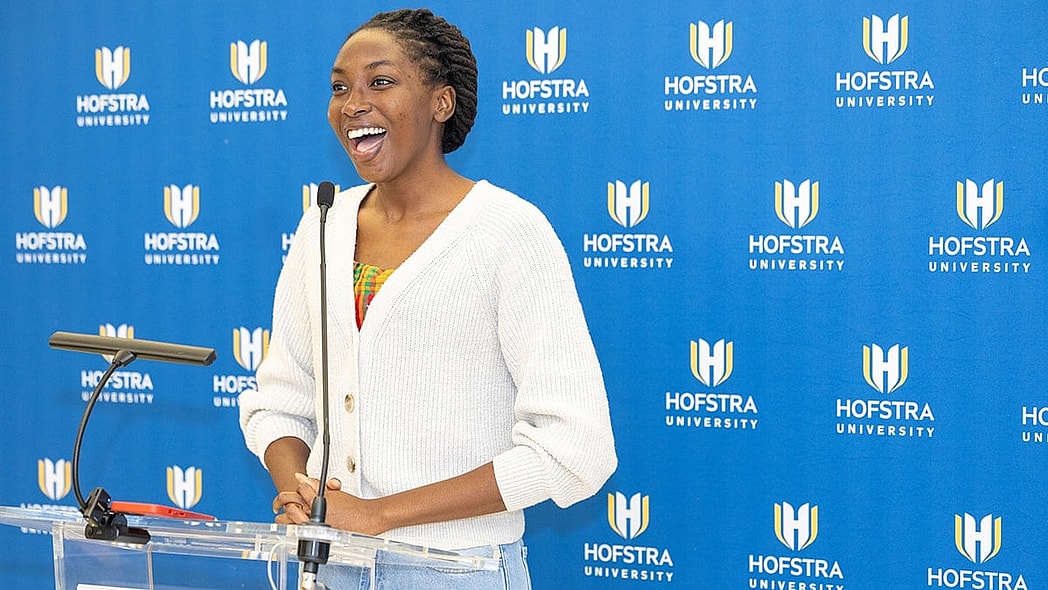
For communities, especially Black women, who are constantly faced with headlines spotlighting climbing unemployment rates and industries no longer deemed “professional” under this administration, a glimmer of good news is emerging from Hofstra University this month. The private university recently celebrated its first Rhodes scholarship recipient, and guess what? She’s Black!
Biology major Resa Nelson made university history as the first-ever Rhodes scholar and became the second student from Antigua to receive the award. Chosen from nine finalists representing the Commonwealth Caribbean, Nelson reportedly committed to solving complex problems on her island and beyond. Through her research the groundbreaking scholar explored ways to convert seaweed into bio-fuel with the assistance of Hofstra Biology Professor Dr. Javier Izquierdo.
“I would not be surprised if we’re talking about Resa becoming not only a Rhodes Scholar, but the president of a corporation or a Nobel Prize winner at some point,” he said, in a press release. “She’s someone who is dedicated to doing positive things for our world.”
Arriving at Hofstra, the graduating senior says she planned on going into medicine. However, those plans changed when she fell in love with “the act of discovery,” which for her reflects “the process of asking questions, and finding answers.”
“Afro-Caribbean people like myself don’t necessarily have the representation that we need in cell biology, in research,” Nelson shared. “I know what it’s like to grow up where your options feel limited. Having someone believe in you can make all the difference.”
Having also studied cancer immunology and neurobiology, Nelson is still exploring the details of her future. However, she does plan to embody “servant leadership,” a phrase her father taught her growing up.
“Jesus served people by washing their feet. My research is how I serve and how I plan to contribute to the world in a meaningful way,” she shared.
After graduation this spring, Nelson is heading to the University of Oxford in the U.K, and tells ABC 7 NY that she sees herself “developing the first Afro-Caribbean stem cell line.”
“That’s my big dream that we can take a stem cell and turn it into anything and then that can be used as a diagnostic tool,” she concluded.
