
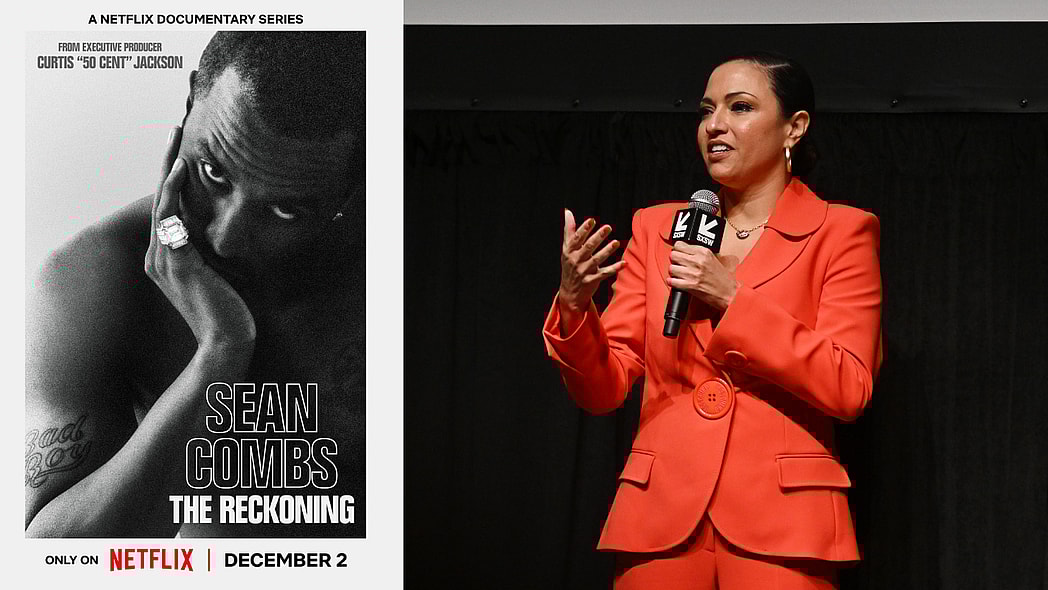
If you’ve been anywhere near a timeline this week, you already know Netflix’s newest documentary on Sean “Diddy” Combs has folks in a chokehold. “Sean Combs: The Reckoning” peels back the glossy, diamond-encrusted layers of the music mogul’s legacy, walking viewers through the moments leading up to his criminal trials, the long arc of his superstardom, and the allegations that ultimately landed him behind bars.
However, while the film digs into the man behind Bad Boy Records, and even highlights the depths of 50 Cent’s infamous “petty” streak, it’s just as essential to spotlight the Black woman who crafted the story: Alex Stapleton. An Emmy Award–winning documentarian, Stapleton’s portfolio spans intimate explorations of icons like Reggie Jackson to incisive examinations of how the energy industry has impacted Black families, as well as nuanced storytelling on LGBTQ+ civil rights and more. According to 50 Cent, who executive-produced the now viral documentary, Stapleton’s intentional storytelling was pivotal in the creation of “The Reckoning.”
“What you will see in the documentary, you have to credit all of that to Alex,” the rapper told Deadline.“She put it together through her pacing and her telling of the story. That’s why it doesn’t feel biased at all. It was important to us that [people] get their personal truths out, and for us to allow everybody to tell their story.”
“Being a Black woman making a film like this, I took the opportunity very seriously,” Stapleton added in a separate interview.” We wanted to make something for people like us, but that could also speak to a broader audience. With the viewership being what it is, it’s crossing barriers, which was our goal. I’m hearing reactions from people who say they didn’t know about a lot of the stuff we covered, or who even really knew much about who [Combs] is.”
“The Reckoning” arrives at a moment when Black women are increasingly forcing the world to face the violence, exploitation, and abuse that has long been normalized in entertainment. From survivors speaking out in courtrooms to publicly reclaiming their narratives, a cultural shift is happening, one that Stapleton is now a part of.
“There’s more to come,” she told the outlet. “More civil suits are coming down the line. I see this really as a new beginning in storytelling, going behind the curtain to understand what happened. My prediction is that there will probably be more storytelling after this.”
Her words echo a movement sparked years ago by Tarana Burke, whose founding of #MeToo created language and community around experiences many women had been forced to carry alone. And yet, for all the movement’s progress, it remains rare to see the abuses of powerful, culturally beloved Black men confronted with this level of depth and accountability.
Combs now joins a sobering list, including R. Kelly, Bill Cosby, and others who were once celebrated as icons but have now been confronted by public accountability as survivors come forward.
If you’re looking to keep the conversation going, here are other documentaries and films that dig into the experiences of women navigating abuse, power, and silence in Hollywood and beyond:
On the Record. Available on HBO Max.
A powerful account of former A&R executive Drew Dixon and other women of color’s allegations against hip-hop mogul Russell Simmons.
Blink Twice. Available on Prime Video, Apple TV
A fictional thriller by Zoe Kravitz that spotlights the very real dynamics of gendered violence and control.
The Rape of Recy Taylor. Available on Tubi, Prime Video, Apple TV
A vital historical documentary exposing the legacy of physical abuse of black women through the lens of Recy Taylor, a Black woman who was brave enough to identify her rapists and fight for justice in the Jim Crow South.
Surviving R. Kelly. Available on Prime Video
The groundbreaking docuseries amplifies the voices of survivors of singer R. Kelly, who have been ignored for decades.
