
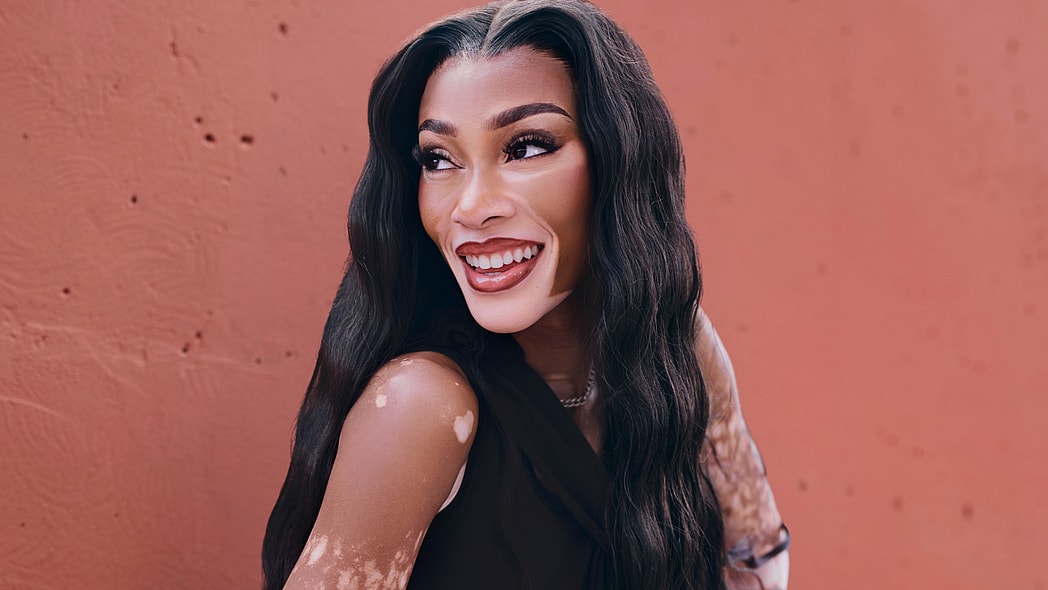
For Winnie Harlow, her skin is the last thing she thinks of, but ironically, one of the first things people notice about her. The 31-year-old Jamaican-Canadian supermodel has had to navigate the world while fielding the curious, sometimes uncomfortable stares of people trying to make sense of her layered complexion. Is it a birthmark? Was she injured? Why does it look like that?“
“Growing up with vitiligo, I often felt like I was the only person in the world like me,” Harlow explained in an interview. “Over time, I’ve learned that it isn’t just about what you see on the skin.”
That revelation hasn’t just shaped Harlow’s sense of self; it’s informed her career and fueled her latest partnership with Incyte’s “Power of Choice” campaign. Much like Harlow’s rise through beauty and fashion has shifted the public’s understanding of vitiligo, the campaign aims to expand awareness around the chronic autoimmune condition that causes pigment loss and the appearance of white patches on the skin.
Affecting an estimated 1.9 to 2.8 million adults in the U.S., the condition impacts not just how people look, but how they feel about themselves— and how others perceive them. Harlow, who revisits her childhood bedroom in the campaign to offer guidance to her younger self, says those insecurities didn’t come from within, but from the outside world.
“I remember earlier on in my career, a lot of questions were always about my vitiligo and [people] kind of framing it in this ugly duckling to swan type of idea, and it was a little frustrating for me,” she told theGrio. “Being asked so many questions about my childhood vitiligo [made me realize] that the way that the framing of the questions were other people’s perception and lived experience, and not mine.”
She continued, “It almost felt like their experience was being projected onto me, and I was expected to answer back in a way that was not true to me.”
Harlow was raised by a mother and grandmother who were intentional about never positioning her vitiligo as a flaw or something to “fix.” She said her confidence didn’t appear in one defining moment. Instead, it has been an ongoing evolution — one she’s still very much on.
That journey also inspired her debut children’s book, “Simply Winnie.” Thinking about what her younger self needed growing up, Harlow said her forthcoming book offers a form of visibility and inclusion without making vitiligo the center of her story because, as she noted, “so many things come before the fact that I have vitiligo.”
“I really wanted to create children’s books that maybe spoke to a different experience that kids have,” she explained “Kids are really curious, and I want to nurture that curiosity while creating a new norm, rather than putting a highlight on stigma, or creating a tokenism, or making it such a thing. It really shouldn’t be a thing to be different, because we’re all different.”
She continued, “Not that the story is about vitiligo, but I see myself just as myself, as a little girl…a little Black girl […] just a story about a little girl who looks like me and what she goes through in life as a whole.”
Just as Dr. Pearl E. Grimes, M.D., F.A.A.D., Director, Vitiligo and Pigmentation Institute of Southern California noted to Incyte, “people living with vitiligo are the experts of their own experiences” and managing it is a “lifelong process.” For Harlow, that process includes everything from consulting dermatologists to coaching makeup artists through her evolving glam routine as her complexion shifts
“I think as the evolution of representation has changed in the fashion industry, my idea of beauty has too. We had such a limited standard of beauty once upon a time, and now I feel like our eyes are open and we’re really diving into the idea that beauty is within the eye of the beholder, and I think that’s a really beautiful place to be and to continue getting to,” she shared reflecting on the industry. “I think that also comes with learning and being able to have education. Being able to learn yourself…what you love…what makes you confident and comfortable, I wish I even had the ability to learn more about myself when I was growing up.”
