
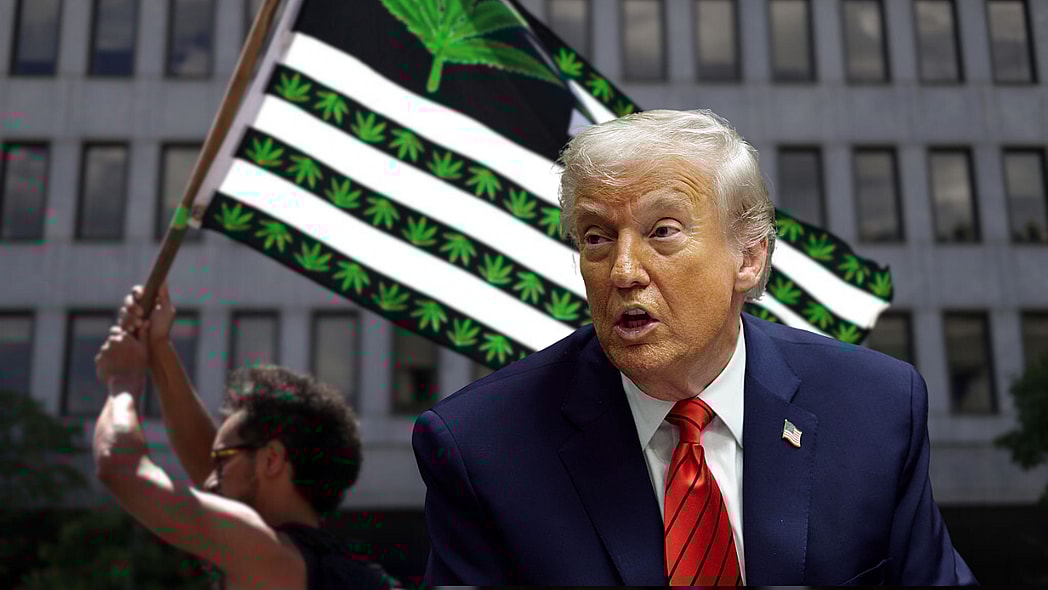
President Donald Trump is reportedly poised to issue an executive order directing federal agencies to ease restrictions on marijuana, potentially fulfilling a move the Biden White House was unable to complete before former President Joe Biden left office.
According to the Washington Post, Trump is prepared to push the federal government to reclassify marijuana as a Schedule III drugs under the Controlled Substances Act.
The president reportedly held a meeting at the White House on Wednesday with marijuana industry executives, Health Secretary Robert F. Kennedy Jr., and Centers for Medicare and Medicaid Services Administrator Mehmet Oz. The group was joined by Republican U.S. House Speaker Mike Johnson via phone, who reportedly expressed apprehension with the idea and cited studies for not making the move. However, the industry executives rebutted Johnson’s arguments for not loosening restrictions on marijuana, the Post reports.
Trump reportedly left that conversation prepared to move forward with his executive action; however, a White House official told the Washington Post that a final decision has not been made and that the president could possibly change his mind, as he often does.
A presidential push to reclassify marijuana under federal law would result in easing barriers to research and business practices for enterprises. The reclassification of marijuana from Schedule I, which includes substances like heroin, to Schedule III, would move the drug to the same category of prescription drugs like Tylenol with codeine, as well as certain steroid and hormone treatments.
As theGrio previously reported, advocates warn that without federal decriminalization or legalization, Black and Brown communities will continue to feel the brunt of criminal enforcement.
Organizations like the Drug Policy Alliance have over the years advocated for descheduling, decriminalizing and legalization of marijuana.
“A majority of Black Americans live in the south, like Texas and Florida and Georgia, where they’re continuing to bear the brunt of disparate harms,” explained Cat Packer, director of Drug Markets and Legal Regulation at Drug Policy Alliance. “I don’t know that without federal leadership, both in Congress and from a presidential administration, those types of harms will not only not be eliminated, but potentially exacerbated when large immigrant communities are under attack.”
In 2022, President Biden ordered the U.S. Department of Health and Human Services and U.S. Department of Justice to review of how marijuana is scheduled under federal law. However, that process ultimately remained stalled in the rule-making process at the Drug Enforcement Administration (DEA).
Then-Acting Director Derek Maltz accused Biden’s DOJ of “placing politics above public safety” with its decision to recommend the rescheduling of marijuana. Terry Cole, nominated by Trump, has repeatedly suggested marijuana poses a health risk to communities, particularly youth, despite studies also showing some medical benefits.
“If Trump initiated or directed a process, that’s likely the only way that this process will get prioritized and get done,” Packer told theGrio.
