
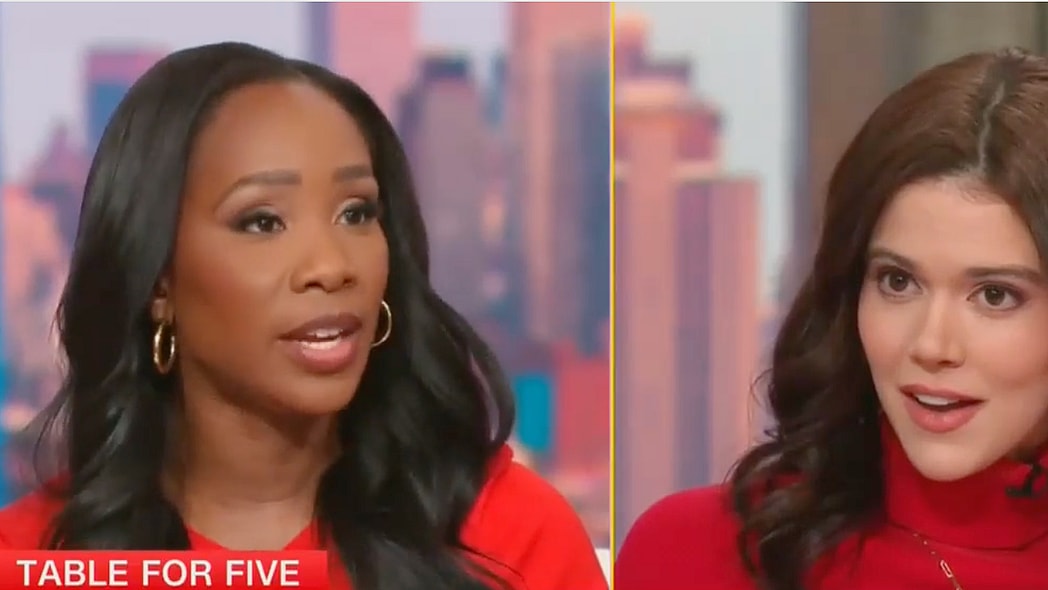
Things got heated on CNN’s “Saturday Morning: Table for Five” when, during what was meant to be a discussion about immigration, one panelist suggested that we acknowledge there are certain cultures that are not compatible with the U.S.
Anchor Abby Phillip confronted New York Post correspondent Lydia Moynihan after she argued that some cultures are “not compatible” with the United States and therefore should not be allowed into the country. Phillip repeatedly pressed Moynihan to clarify what she meant, forcing a national conversation about culture, immigration, and where we draw the lines without dehumanizing people who are fleeing violence, persecution, and extreme hardship.
The exchange came in the wake of renewed controversy tied to President Donald Trump’s inflammatory remarks about immigrants from what he called “filthy, dirty, disgusting” countries with high crime rates — explicitly naming Somalia. When Moynihan echoed arguments circulating on the right about cultural incompatibility and suggested that certain cultural norms are fundamentally at odds with American values, Phillip didn’t let her dodge straightforward questions.
“Which ones?” Phillip asked — not once, but multiple times — pressing her colleague to name specific cultures that she believed posed a problem. Moynihan referenced examples from Europe, citing troubling cases to argue there’s a “real question” about cultural clashes.
“Well, if we look at Europe, actually, there was a lawyer this week who argued that an Afghan immigrant who raped a woman shouldn’t be charged or shouldn’t have a penalty because his culture said that women weren’t free and equal. We’re seeing 77% of rapes in France are from migrants. So there is a real question that people on the right have about certain cultures,” Moynihan argued.
“What are the cultures?” Phillip asked.
“The cultures that are okay with that. The cultures that are okay with female genital mutilation,” Moynihan said, still struggling to define any one group directly, instead pointing to broad and harmful stereotypes about gender norms and practices like female genital mutilation
“So I mean, is it it Afghanistan? Is it Africans? What is it?” Phillip asked
“What about the people fleeing female genital mutilation? Are you gonna allow them in? Are they allowed in? I mean, if you are if you are Somali, if you are Somali and you’re a woman and you’re fleeing, you’re actually trying to leave,” Phillip said as Moynihan bit back.
“They’re bringing it with them,” Moynihan said.
“If you wanna leave another country, Afghanistan, because you want to be able to read, the United States says you are not allowed in because culturally not compatible with this country. How does that make sense?” Phillip asked the table.
The back-and-forth exposed a deep flaw in reducing complex human experiences to broad cultural judgments. At one point, Rep. Jared Moskowitz (D-FL), who was also on the panel, shared a personal story about his grandparents fleeing Europe during the Holocaust.
“My grandparents came from Germany and Poland to escape the Holocaust, ” Moskowitz said. “And before they got here the whole USS St Louis was turned away because Jewish culture was determined at that moment as non-compatible.”
“This is why vetting matters though,” Moynihan said.
“But I’m just saying that was not okay then and it’s not okay now,” Moskowitz responded.
In a country built on immigrant dreams and contributions, conversations about culture and value systems deserve depth, context, and reasoning that extends beyond generalities. As Phillip insisted again and again, if you’re going to make sweeping claims about people and place, you owe it to your audience to explain exactly what you mean and why it should matter.
GrioFam, what do you think about Moynihan’s claims?
