
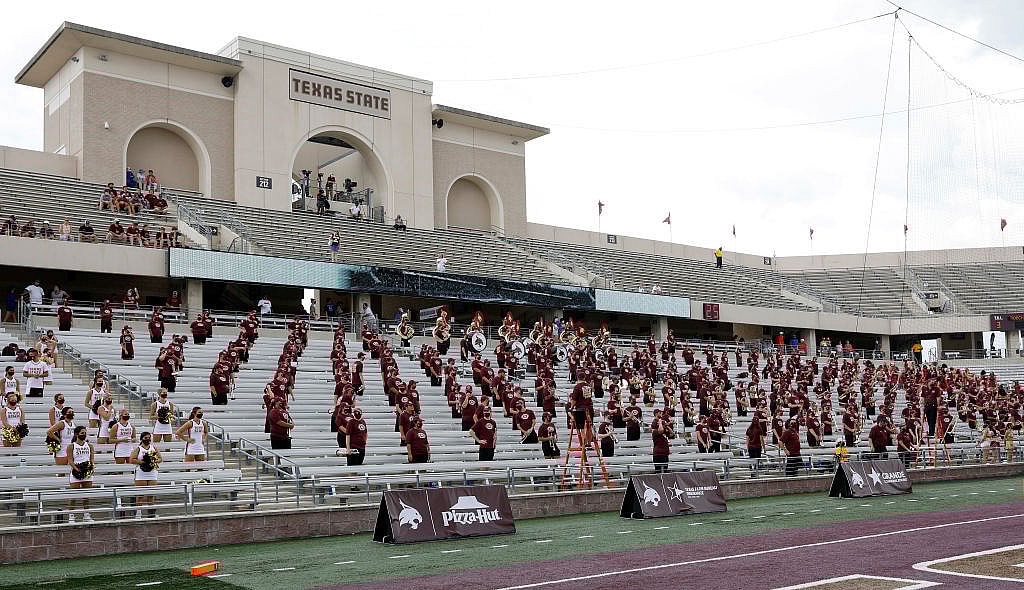
A mobile Black history exhibit was supposed to host an installation at Texas State University in honor of Black History Month. However, days after the university approached Khalid el-Hakim, the founder of Black History 101 Mobile Museum, to bring the exhibit to campus, Texas State University officials withdrew their request, citing the growing anti-DEI landscape.
“After reviewing this with supervisors and the leadership team, the Black History 101 Mobile Museum was not approved to be on campus … due to SB -17 [Senate Bill 17], the current climate of our State, and certain topics covered as part of the museum,” the university reportedly wrote in an email to el-Hakim, per Austin American-Statesman.
The Black History 101 Mobile Museum is a 30-year-old traveling museum that spotlights lesser-known aspects of Black history. El-Hakim, a middle school teacher, was inspired to create the museum after feeling excluded from the traditional K-12 education curriculum. Since then, he has collected 1,500 artifacts and has visited hundreds of institutions, from corporations to universities to elementary schools.
However, the founder and curator says this is the first time the exhibit has been uninvited from a school, which he attributes to the current “climate of suppression.”
“This is a part of that climate. It’s a form of censorship, it’s a form of denying basic constitutional rights of freedom of speech, at the bottom line, this is about academic freedom,” el-Hakim told the outlet. “This is a college campus, and this is where students should be learning about history. These are now considered things that make people feel uncomfortable, but at the end of the day, it’s nothing but American history.”
In light of the university’s rescinded invitation, civil rights organizations, including the American Civil Liberties Union of Texas, Intercultural Development Research Association, and the Legal Defense Fund (LDF), demanded that the university reissue an invitation to the museum in a letter stating “that canceling the exhibition misapplies state law, violates the First Amendment, and constitutes viewpoint discrimination.”
Shortly after the civil rights leaders sent their letter, Jayme Blaschke, a spokesperson for Texas State University, addressed the concerns raised. Blaschke stated that the university is reconsidering the Black History 101 Mobile Museum for future Black History Month programming. He also mentioned to the outlet that the decision to uninvite the Black history exhibition was made at the department level. Furthermore, he clarified that the official who emailed el-Hakim had “incorrectly” stated that the decision was based on Senate Bill 17, a 2023 anti-DEI law that exempts teaching and guest speakers.
Although Blaschke apologized for the error, he did not apologize to el-Hakim.
“The students should have the opportunity to see for themselves,” el-Hakim said, explaining how the university never shared which materials sparked concern. “If I remain silent in a situation or injustice like this, that is betraying the history that I go out and promote and that I’ve given my life to for the past 35 years now, This is not a time to be silent…Let them see what the university was concerned about.”
