
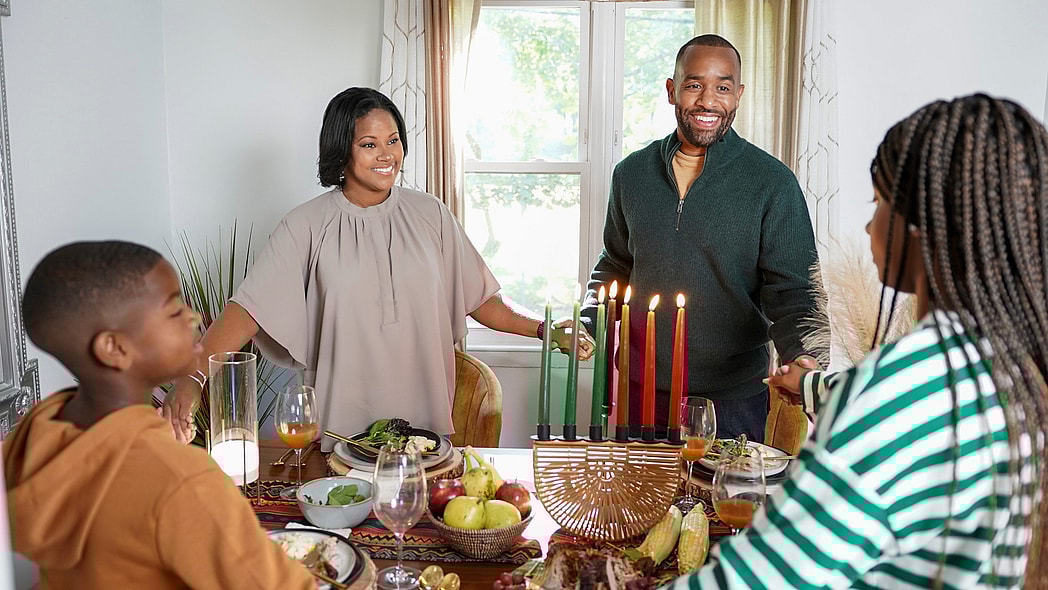
Kwanzaa might be the perfect holiday to walk away from one year and into another one.
In most cases, the last week of the year is when you mentally unplug. Work seems not as relevant compared to being around your community and tribe. It feels appropriate for realignment, reflection, and taking moments to exhale and remind yourself: You made it. As Kwanzaa approaches, beginning Friday (Dec. 26) through Jan. 1, the holiday built on connection and honoring African heritage, culture and tradition feels like the perfect moment to head into the new year with renewed energy and determination.
If you need a refresher on what Kwanzaa is (aside from having one of the better holiday songs around), the holiday was founded in 1966 by Dr. Maulana Karenga, who believed a “cultural revolution gives identity, purpose and direction.” Karenga built from the notion of connection for the African American and Pan-African holiday, though its celebrations are not limited to Black people. In short, a Kwanzaa celebration can bring forth all walks of life, all living in similar paths of the principles laid forth during the seven-day celebration.
Kwanzaa week holds several key traditions, similar to eating black-eyed peas on New Year’s Eve or snacking on grapes under the table. Cultural practices such as lighting the kinara, or candle holder, a big NYE feast and plenty of outreach and inner work. Family is paramount to any celebration and drawing closer not only to those who uplift you, but the inner voice that uplifts you, falls right in line.
The principles of Umoja (unity), Kujichaguila (self-determination), Ujima (collective work and responsibility), Ujamaa (cooperative economics), Nia (purpose), Kuumba (creativity) and Imani (faith) define the totems of Kwanzaa and its celebration of Black culture. And although 2025 has delivered its fair share of attacks on Black purpose, self-determination, faith, and creativity, it has also brought a renewed sense of self-belief.
When you think about it, the workings and principles of Kwanzaa are everywhere, especially in the days after the calendar flips to January—renewed purpose and energy toward a goal? That’s Nia. Tapping into the creativity that makes us unique? That’s Kuumba. Making an effort to do more within a chosen community, big or small? Sounds like Ujima to me.
In recent years, the concept of self-care has become more en vogue, for good reason. As the world pulls us in different directions, there is a greater call to tap into what we are feeling. What we’re concerned about and what we’re ready to let go of. Kwanzaa, in many ways, allows many to let that release happen and start anew. Many look forward to day six of the festivites, where the Karamu takes place and a wide range of foods can be cooked, from chicken to mac and cheese, catfish, black-eyed pea salad and more. But in total, it’s the build-up to that day and then on Jan. 1, where those who celebrate lean on the six previous principles and step out on faith.
Kwanzaa shouldn’t be cast aside as an exclusionary holiday. All are welcome to celebrate. The holiday plays a role in daily life, much like a self-help book or meditation guide. And right now, as 2025 winds down, its principles are ringing truer and louder every day.
