
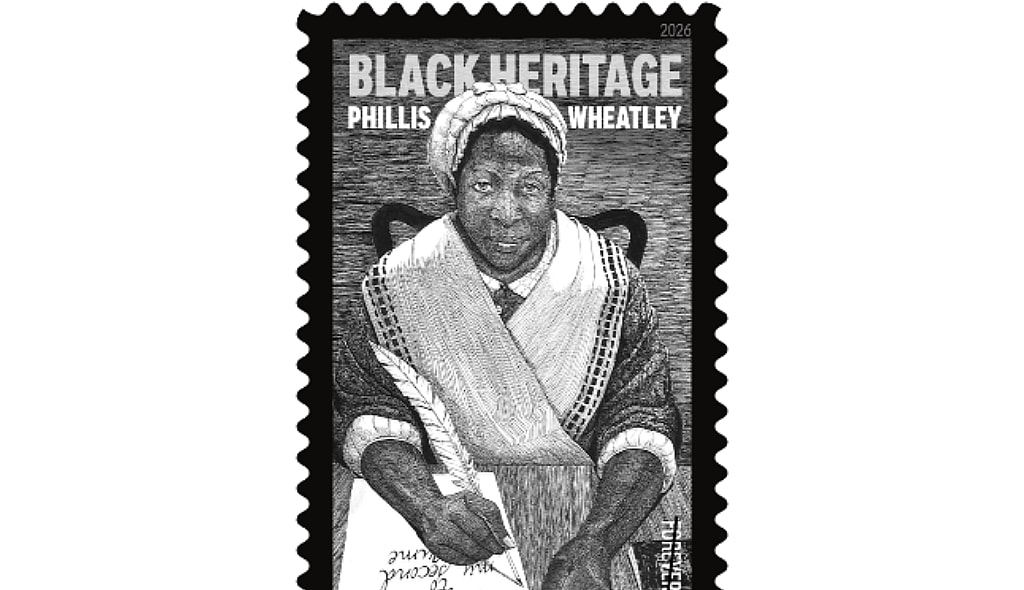
The United States Postal Service has unveiled that its new Black Heritage stamp will be of Phillis Wheatley, who is believed to be the first African American author to publish a book of poetry.
Wheatley will mark the 49th Black Heritage stamp in its series, which has also featured Booker T. Washington, who was the first African American person to appear on a postage stamp, Martin Luther King Jr., and Harriet Tubman. According to the Smithsonian National Postal Museum, Frederick Douglass was the first African American to be included in a “regular” stamp series for everyday postal use. As a part of USPS’s “forever” stamp series, Wheatley’s stamp will be sold at the same value as the current First-Class Mail 1-ounce price.
The USPS Black Heritage series began in 1940 and is the longest-running U.S. stamp series.
The designer for Wheatley’s stamp is USPS art director Antonio Alcalá, who used artist Kerry James Marshall’s portrait, whose technique often features multiple shades of the color black.
Wheatley lived from 1753 to 1784, and in her short life, she went from being captured and brought to Boston as a slave from West Africa to becoming an iconic literary figure in history, also known as the “mother of African American literature.” Though she was enslaved, she was uniquely taught how to read and write. According to the Poetry Foundation, she was just 13 when she published her first poem, which is called “On Messrs. Hussey and Coffin.”
At 20 years old, she published her first collection of poems, called “Poems on Various Subjects, Religious and Moral,” in 1773 in London, England, and was freed that same year.
Per the USPS press release, a ceremony for the new stamp will take place on January 29 in Boston at the Old South Meeting House, the historically famous organizing location for the Boston Tea Party revolution.
