
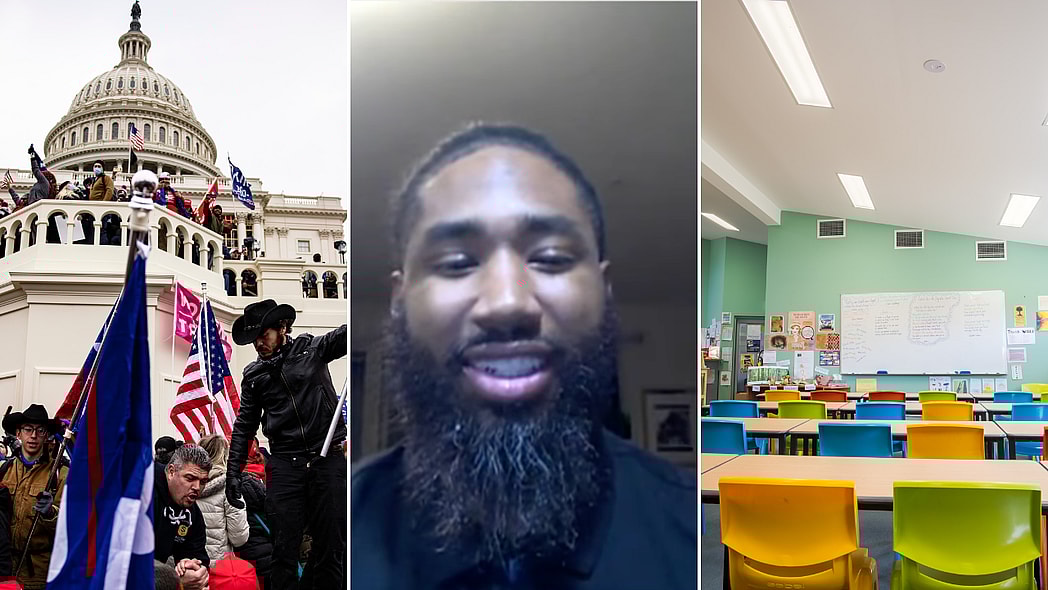
In 2021, Nathan Tate stood in uniform as a D.C. police officer, defending the U.S. Capitol during one of the nation’s most turbulent moments. Five years later, he finds himself working a new, but similar line of defense. Now a middle school social studies teacher, Tate has shifted from guarding institutions to shaping the minds of the generation that will inherit them.
Yesterday, as headlines and government officials shared their mixed recollections of the Jan. 6 riots, Tate used the day as an opportunity to have an honest conversation with his classroom at the Phoenix International School of the Arts in La Plata, Maryland. While preparing a lesson on the Boston Tea Party and protest, Tate told the Washington Post he was unable to ignore the weight of a far more urgent lesson.
Knowing that his students were likely hearing and seeing the fragmented accounts of what happened on Jan. 6 from President Trump referring to it as a “day of love,” to Democratic leaders like Hakeem Jeffries categorizing it as a “Trump-inspired crime spree,” Tate dared to confront the moment head-on with 23 students in his classroom.
“Let’s talk,” he said before diving into a cautious lesson showing the parallels between the Boston Tea Party and the Capitol riots. Making sure students understood terms like “patriotism” and “protest,” he reportedly explained how both the 1773 and 2021 incidents reflected US citizens’ feelings that the government no longer represented their wants.
Additionally, Tate, who joined the D.C. police force in 2018, showed a clip from a documentary on Jan. 6 that showed him fighting to protect democracy.
“I remember being surrounded, unable to see, gasping for air,” Tate said. “I kept fighting to hold the line beside my fellow officers, not out of anger, but out of duty and love for our country…I was defending your democracy.”
Despite having stepped away from the police force ahead of the election day, Tate says that he is still processing the physical and mental impact of that day. After Andrew Taake, a rioter who inflicted a “lifelong scar” on Tate, was sentenced to six years in prison and released seven months into his sentencing thanks to a Trump-endorsed presidential pardon, Tate explained experiencing a growing sense of betrayal.
“I knew after this situation that took place, this violent riot, that I could no longer continue as a police officer,” he told NBC 4 Washington. “It didn’t align with my spirit. So I took a leap of faith. And after I took a leap of faith, I became a US history teacher. While in the [police] department, I was able to complete my bachelor’s degree in Mass Communications, and I went straight into the teaching force.”
Now, while he still struggles to answer whether violence can ever be justified in the name of patriotism or protest, Tate is less concerned about telling students what to think, but more concerned about reaching them to make up their own minds by using facts and credible sources to support their claims.
