
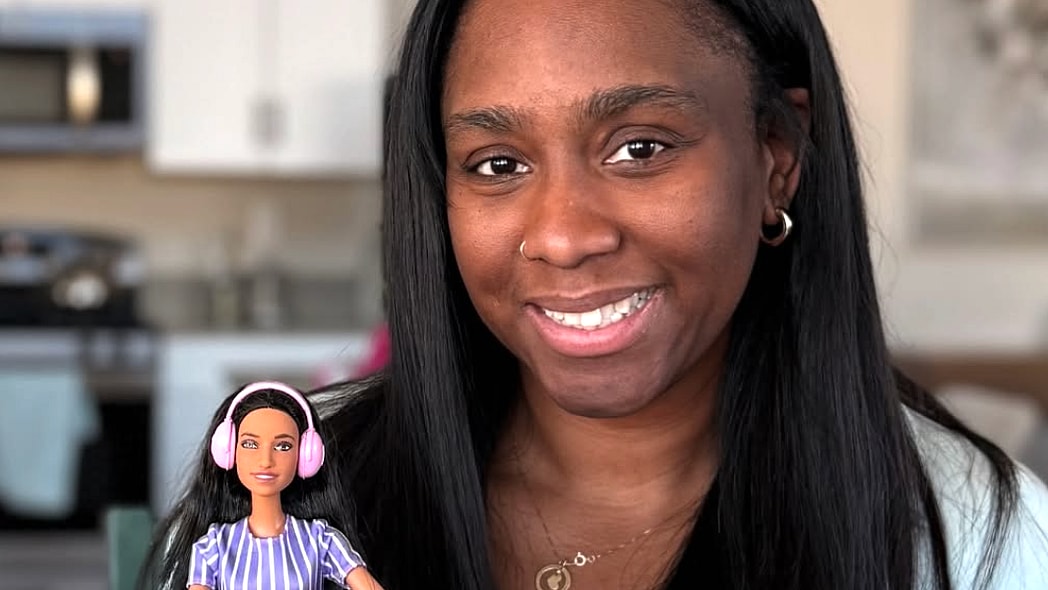
There’s a new Barbie on the block, and she’s helping girls and women with autism feel more seen.
On Monday, Mattel launched its latest Barbie, the first-ever Barbie with autism, and she’s already bringing joy to many families, including Black families.
Autism, or autism spectrum disorder (ASD), is a neurodevelopmental condition that impacts how people communicate, interact, process sensory input, and experience the world around them. According to Autism Speaks, autism impacts about 1 in 31 children in the United States, with boys nearly four times more likely to be diagnosed. And while historically Black children were underdiagnosed compared to their white counterparts, recent data indicate Black children are now diagnosed at higher rates.
“Barbie and ASAN (@autisticselfadvocacy) are proud to partner on the first-ever autistic Barbie, designed with connection and understanding at the core,” the toy giant wrote in the caption of an Instagram post announcing the doll. “Created with guidance from the autistic community to represent common ways autistic people may experience, process, and communicate about the world around them, this doll invites more children to see themselves represented in Barbie, and helps us all understand the many ways we each can experience the world.”
Dressed in a light purple pinstriped dress, the doll features thoughtful details meant to reflect autistic experiences, including a pink fidget spinner that actually spins, noise-canceling headphones to help reduce sensory overload, and a tablet to serve as an augmentative and alternative communication (AAC) device. Even her facial expression was designed to look slightly to the side, reflecting how some autistic people may avoid direct eye contact in certain situations.
Alongside the announcement, Mattel partnered with various women and girls on the autism spectrum to help introduce the doll and open up about life with autism, including Precious Hill, a 32-year-old mother from Las Vegas who discovered she was autistic during her 5-year-old daughter Mikko’s diagnostic journey.
“I didn’t know I was autistic growing up. I just knew I was different,” Hill wrote in an Instagram caption alongside a photo of herself holding the new Barbie.
Hill went on to explain that she spent much of her life feeling out of place and struggling to connect, often believing something was wrong with her. She said finally learning she was autistic was both life-changing and freeing, especially after experiences where she felt misunderstood and taken advantage of.
“So holding this Autistic Barbie today means more than representation. It feels like someone is finally listening. It reminds me and so many of us, that we are not broken objects in need of fixing. We are whole people with different nervous systems, different communication styles, and different ways of experiencing life,” she continued.
She noted how, of course, no one doll could ever fully represent every person on the entire autism spectrum.
“But this doll represents something powerful,” she expressed, especially during a time when harmful misinformation about the condition is being spewed by the highest office in the country. “Inclusion. Acceptance. Awareness. The acknowledgment that autistic lives, voices, and experiences matter.”
