
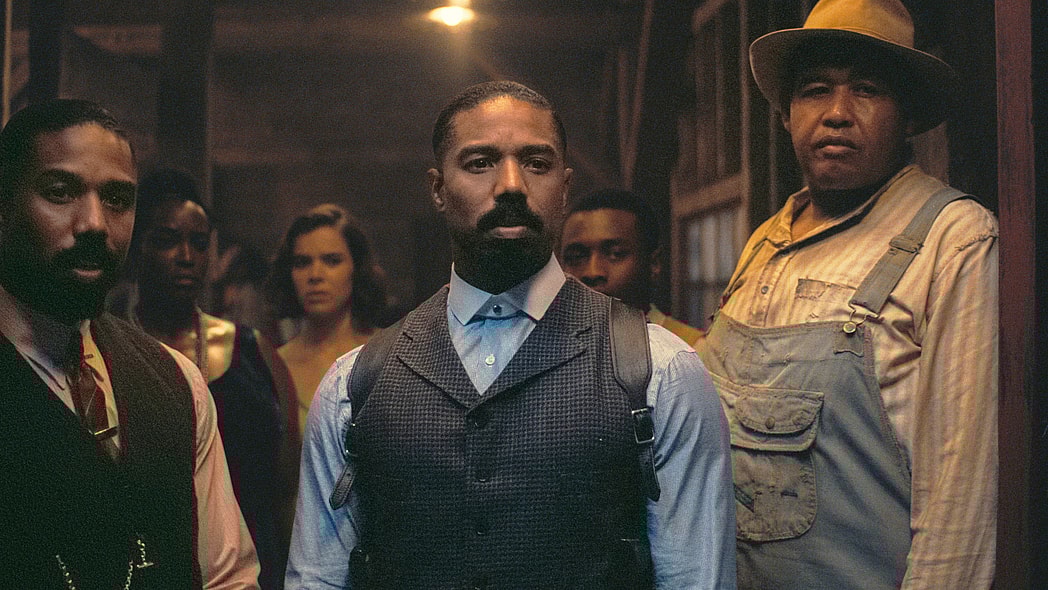
Because of its haunting themes and unforgettable scenes, “Sinners” has me in a chokehold.
I’ve watched the film more than 170 times and have stopped counting. Some days I don’t even start from the beginning–I fast-forward to the moments that hit hardest. There is a reason Sinners shattered Oscar nomination records this year. The film’s deep truths resonate with the souls of Black folks and the unfinished struggle of our journey in the United States.
In one scene, Sammie asks Stack why he and his brother left Chicago and returned to Clarksdale, Mississippi. Stack explains that they decided they would rather deal with “the devil we know.” That response is more than dialogue. It is a diagnosis of racism in America.
Racism, the metaphorical and real devil, is everywhere–not only in the South. It has remained persistent in the United States since Africans were first brought to this country. Whiteness continues to function as the default standard of power, belonging, and legitimacy. And when this nation experiences moments of racial progress, moments that inch us closer to equity and multiracial democracy, those gains are often met with swift backlash. The country “corrects” itself and restores whiteness as central–the devil we know.
“Sinners” captures this pattern with chilling clarity. Hogwood looks Smoke and Stack in the face and lies that the Ku Klux Klan no longer exists. That scene mirrors America’s favorite performance of proclaiming liberty and justice for all while denying the violence and systemic inequities that make those promises impossible. This explains why racial progress in the U.S. is so often temporary.
Consider the historical rhythm.
· Reconstruction regressed to Jim Crow laws and terror.
· Civil Rights regressed to mass incarceration of Black and Brown people.
· The Obama presidency regressed to the extreme “conservative” MAGA movement and policies.
· The 2020 racial reckoning regressed to Anti-CRT laws, book bans, and DEI rollbacks.
All of this is by design and is not coincidental. Each moment of progress gets framed as having gone “too far,” requiring a return to “common sense,” “law and order,” or “neutral standards.” But these phrases are rarely neutral. They are coded for white normalcy, white comfort, and white control. This is why J.D. Vance officially gave the charge to white people, “You don’t have to apologize for being White anymore”. Trump co-narrated by talking about discrimination against White people.
That is why I cry at the ending scene every time I watch “Sinners.” Stack, who is now a vampire, agrees with Sammie that before the sun went down, that one day was the best day of his life because “just for a few hours, they were free.” The truth of the just for a few hours breaks my heart.
“Sinners” represents Black folks’ yearning for freedom and uninterrupted connection to our cultures and histories. It also captures the cruel truth that Black people in America often have to steal moments of freedom, brief flashes of joy, community, music, love, and agency–only to have them hunted, policed, or destroyed. Even the juke joint is not allowed to remain sacred.
Vampires like Remmick swoop in, craving our joy and agency. The Greenwood Massacre in Tulsa is only one of countless examples of what happens when Black people build something beautiful and healing for our souls.
To be sure, some Black people still make the mistake of inviting vampires–believing that assimilation into whiteness is the pathway to liberty and justice for all. We give up our language, perform “respectably,” and try to make ourselves smaller with the hope of safety from vampires. We also make the mistake of conflating making more money with power and acceptance.
But the vampire does not reward compliance. The vampire rewards access and forcefully takes what it wants. In “Sinners,” some of the vampires are destroyed by Smoke and friends, and others by the sun (light). Yet, some survive and continue their plight. Stack emerges 60 years later, strong and still trying to seduce Sammie into his way of life.
“Sinners” reminds me that the events in 1932 and Clarksdale, Mississippi, are timeless. We know this devil—even when it rebrands itself.

Gloria Swindler Boutte, PhD, is a Distinguished Professor at the University of South Carolina and a Public Voices Fellow of the OpEd Project in Partnership with the National Black Child Development Institute.
