
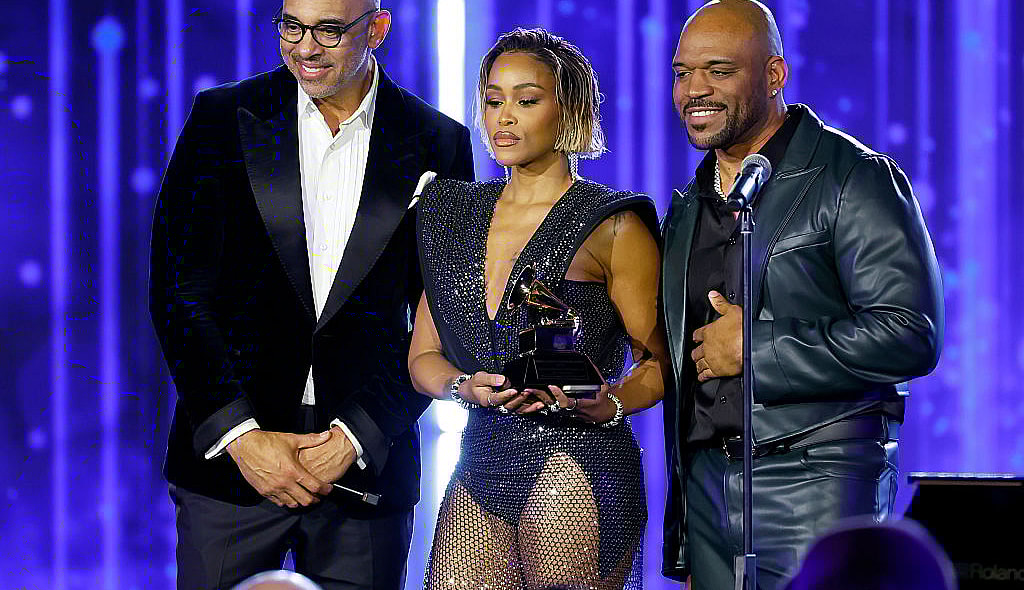
More than two decades after the song changed hip-hop and neo-soul, renewed attention on Eve’s role in “You Got Me” is reopening questions about credit, visibility, and who history remembers.
When “You Got Me” first hit the airwaves in 1999, it sounded like a moment you could feel in your chest. The song, released as the lead single from The Roots’ 1999 album, “Things Fall Apart,” paired the band’s signature live instrumentation with soul-leaning vulnerability and lyrical precision at a time when hip-hop was still negotiating its relationship with tenderness. It went on to earn a Grammy Award for Best Rap Performance by a Duo or Group in 2000. But for years, the story behind who actually made the song what it was has remained complicated, contested, and unfinished.
The official version of the track features Erykah Badu on the chorus, her voice instantly recognizable and undeniably central to the record’s success. Yet longtime fans and music historians have repeatedly pointed out that the song’s earliest incarnation was recorded with Jill Scott, then a relatively unknown poet and songwriter in Philadelphia. Several sources, including the artist herself, have confirmed that Scott co-wrote the song and originally sang the hook when MCA Records pushed for a more established name to anchor the single commercially. As a result, her vocals were replaced. While Scott retained songwriting credit, her voice never made it onto the radio version.
That same pattern of partial recognition extended to Eve, who delivered the track’s standout rap verse at the very beginning of her career. At the time, Eve was still largely unknown, operating under the name Eve of Destruction, and her contribution didn’t receive the same spotlight as her collaborators. She was not featured in the music video, rarely mentioned in early press about the song, and for years, her role was treated as a footnote rather than a foundational part of the record’s identity. Yet her verse, cool, confident, and conversational, helped ground the song in lived experience and gave it a voice that resonated far beyond its moment.
The moment took place at the 2026 Recording Academy Honors presented by The Black Music Collective, held during the 68th GRAMMY Awards on Jan. 29, in Los Angeles, footage shared by Hollywood Confidential.
In the audience, Brandy, who starred alongside Eve on the ABC drama “Queens,” appeared visibly pleased as the moment unfolded. As the camera panned, Brandy could be heard shouting, “Yas, Eve! Speech! Speech!” The series, which aired during the 2021–2022 television season, followed a fictional 1990s hip-hop girl group reuniting decades later to reclaim their legacy—a storyline that closely mirrors real-life conversations about recognition and delayed credit in the music industry. Eve portrayed Brianna Robinson, a powerful hip-hop executive, while Brandy played Naomi McIntyre, a gifted but sidelined singer. Their shared history added a subtle but meaningful layer to the moment, underscoring why Eve’s recognition resonated beyond the award itself.
Once Eve took the mic, she spoke candidly about the weight of the moment. “I’m still processing this situation. This is actually for little Eve from Philly,” she said as the crowd cheered. “The little girl Eve, who was just writing rhymes and just wanted to be in the business.” She continued, “I am truly grateful to be in this room with all of you here—all of the greats.”
Reflecting on the delay, Eve added, “I was like, wow. What is yours can never miss you. Even 30 years later. So I am truly grateful for this.”
She also used the moment to highlight key figures who helped push for the recognition, from her husband to veteran radio personality Ebro Darden. “Shout out to Ebro. He was the one who wouldn’t give up on this,” she said.
Whether or not the Grammys can retroactively rewrite their archives, the moment underscored something deeper: history is not static, and credit delayed is still credit worth fighting for. “You Got Me” has always been a collaborative triumph rooted in Jill Scott’s pen, elevated by Erykah Badu’s voice, sharpened by Black Thought’s lyricism, and anchored by Eve’s verse. For years, only part of that story was told loudly. Now, as audiences reassess the record with clearer eyes, Eve’s contribution is finally being named out loud.
