
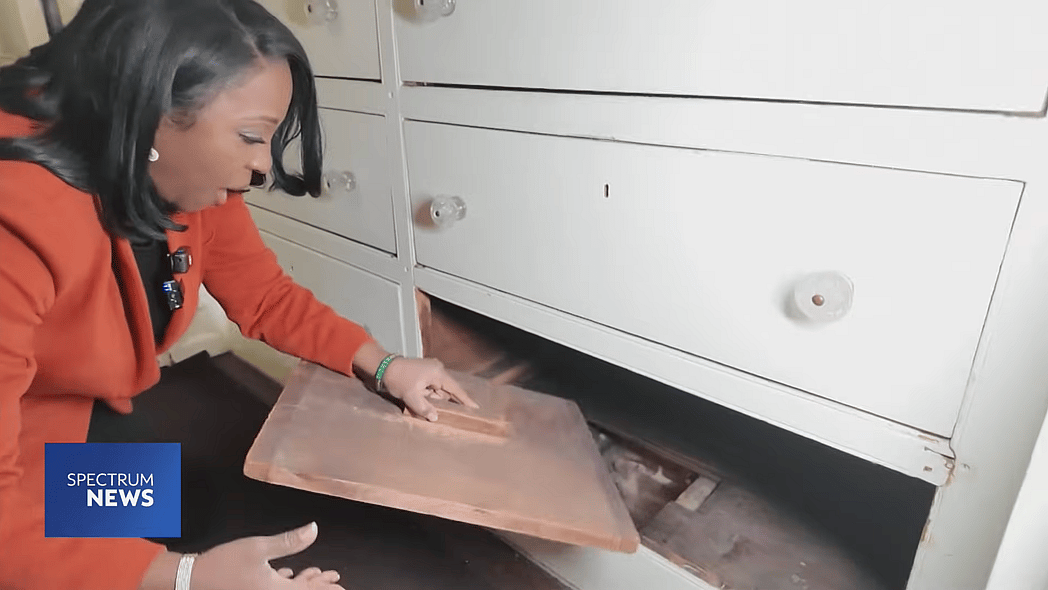
A new piece of Black history was recently discovered in Manhattan, New York. Since 1936, the Merchant’s House Museum has given visitors a glimpse into “old New York.” However, little did they know that the city’s first landmarked building housed a passageway on the Underground Railroad.
“We knew it was here, but didn’t really know what we were looking at,” Camille Czerkowicz, the curator for the Merchant’s House Museum, told Spectrum News’ Cheryl Wills.
“I’ve been practicing historical preservation law for 30 years, and this is a generational find,” Michael Hiller, a preservation attorney and professor at Pratt Institute, added. “ This is the most significant find in historic preservation in my career, and it’s very important that we preserve this.”
For years, historians have recognized the Merchant House to be a “safe house” for enslaved Black people who escaped from the South. But it was not until architects and preservationists explored a concealed compartment behind the home’s built-in drawers that they discovered its powerful history.
“This is very emotional because I’m sitting where desperate, desperate people yearning to be free, once sat with their eyes on freedom,” Wills said during her report. “They went down to a 2×2 space. You could barely stand up in it, and they stayed there, waiting…this was the path to freedom.”
The hidden compartment featured a ladder that led down to the home’s ground floor, but appeared completely invisible in the home’s design; thus, undetectable to slave catchers in the 19th century . Experts suspect that Joseph Brewster, the man who built the home, intentionally made these design choices before selling the building to the Treadwell Family in 1835. While it is unclear whether or not the Treadwells assisted enslaved Black people seeking freedom, the discovery further reveals New York’s part in the abolitionist movement, and as Councilman Harvey Epstein noted, is “a critical piece of the overall struggle for freedom and justice.”
“Being an abolitionist was incredibly rare among white New Yorkers, especially wealthy white New Yorkers,” Patrick Ciccone, an architectural historian, noted.
“Many New Yorkers forget that we were part of the abolitionist movement, but this is physical evidence of what happened in the South [during] the Civil War, and what’s happening today,” Manhattan Councilman Christopher Marte explained.
