
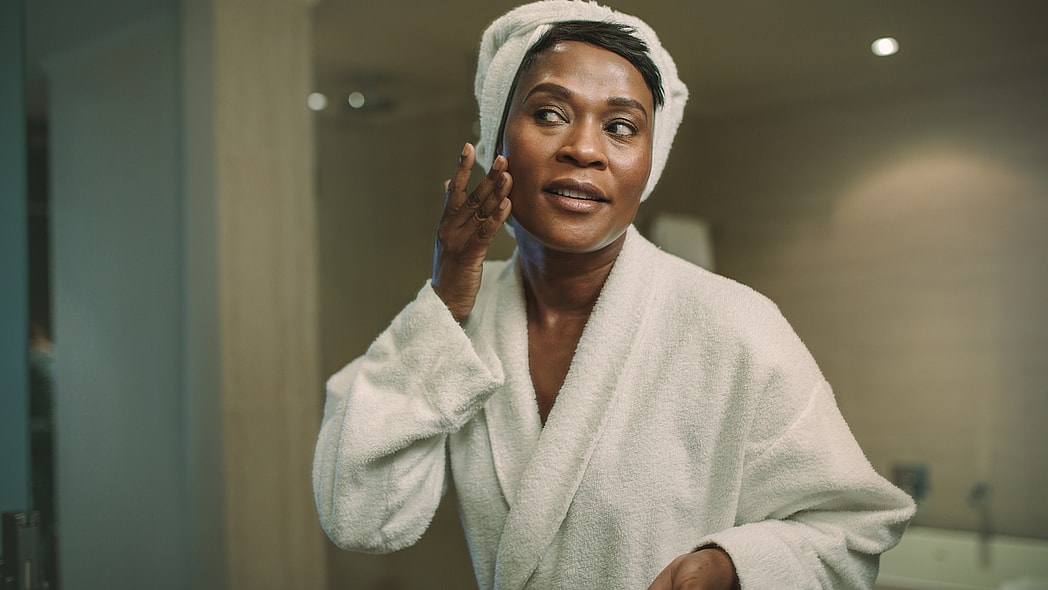
“Black don’t crack” is a saying many of us grew up hearing. And while there’s scientific truth behind it, the phrase has almost made melanin-rich skin feel immune to the realities of aging—and the ways it shows up on our faces.
That is, until that “mirror moment.” The moment subtle shifts become noticeable: a change in texture, a new bump, lingering dark spots, or skin behaving differently than it used to. It’s something we all experience eventually, and it can quickly send you spiraling down a rabbit hole of research, TikTok tutorials, and endless virtual beauty aisles filled with products promising to fix it all.

To silence the noise and hundreds of product recommendations on social media, we sat down with beauty scientist and Olay’s Principal Scientist, Dr. Rolanda Wilkerson, affectionately known as Dr. Ro, to understand exactly what we should be doing to care for our skin, especially in these frigid winter months.
“We might not crack, but our texture will change, and that hyperpigmentation will come, and those are all signs of pre-aging or photo-aging,” Dr. Wilkerson said. “[Melanin-rich Black people] have a very low likelihood of being on the side of having a lot of fine lines and wrinkles. However, there are other things that we need to care about, care for, regarding our skin over time.”
Over time, our skin changes in ways we can’t always see. Dr. Ro explains that in your 20s, the skin begins to lose antioxidants, which serve as its natural internal protection, triggering a “chain reaction” of changes that aren’t always visible to the naked eye.
“There are things that happen at every decade in our skin, the loss of antioxidancy, your barrier begins to weaken, and depending on the ethnicity and the person, there is a reduction or overproduction in the natural oils and sebum,” she explained. “So we must know that the basic moisturizer, once you enter into your 30s, 40s, 50s, is likely not going to be enough s not going to be enough to defend, care, protect, and repair your skin.”
Now, if you look up skincare routines on any social media platform, you’ll be inundated with videos and posts spotlighting 5 to 20-step routines filled with serums, sprays, essences, and creams, which can add up to hundreds of dollars at a time. While there is nothing wrong with having extensive routines, Dr. Wilkerson emphasized that skincare does not necessarily have to be expensive or complicated.
“There are skincare products that can cost three and $500,” she noted. “Do I believe that’s necessary to get benefits like smoothing fine lines, firming your skin, improving your elasticity, hydrating your skin, and sculpting your skin? No, because Olay is actually delivering that with high scientific proof.”
Understanding that Olay skincare may be considered pricey for some consumers, Dr. Wilkerson explained that the brand’s reformulated “Micro-sculpting cream” offers a triple collagen peptide that strengthens skin cell bonds for just $37.
“Cell science shows us that when cell bonds are weakened, the that allows for more visible changes in the skin, oftentimes it happens chronologically with age, but if a person hasn’t been taking care of their skin, and their skin has been exposed to other external factors, for example, prolonged sun damage, or they didn’t wear sunscreens, that pre-aging can happen quicker,” she noted of Olay’s reimagined legacy product.
Now, beyond recommending products like Olay’s micro-sculpting cream or super serum lotions, Dr. Wilkerson stressed the importance of understanding and intentionally caring for your skin early.
“It should be I am caring, not reactively repairing,” she explained, noting simple steps like the importance of simple things like a hydrating moisturizer and SPF in your routine. “We don’t realize how much we expose our skin to without protection, no matter the ethnicity.”
Ultimately, as we continue to navigate a few more weeks of what feels like an arctic winter, Dr. Wilkerson’s key piece of advice is, “moisturize, moisturize.”
“Dryness, trans-epidermal water loss excess on the skin can have some of the same impacts on skin that pre-aging can,” she explained. “So all of those things impact how the skin looks: dullness, it brings out the fine lines. It brings out deep wrinkles over time because the dullness makes them more evident. So moisturizing, moisturizing, moisturizing is so important.”
