
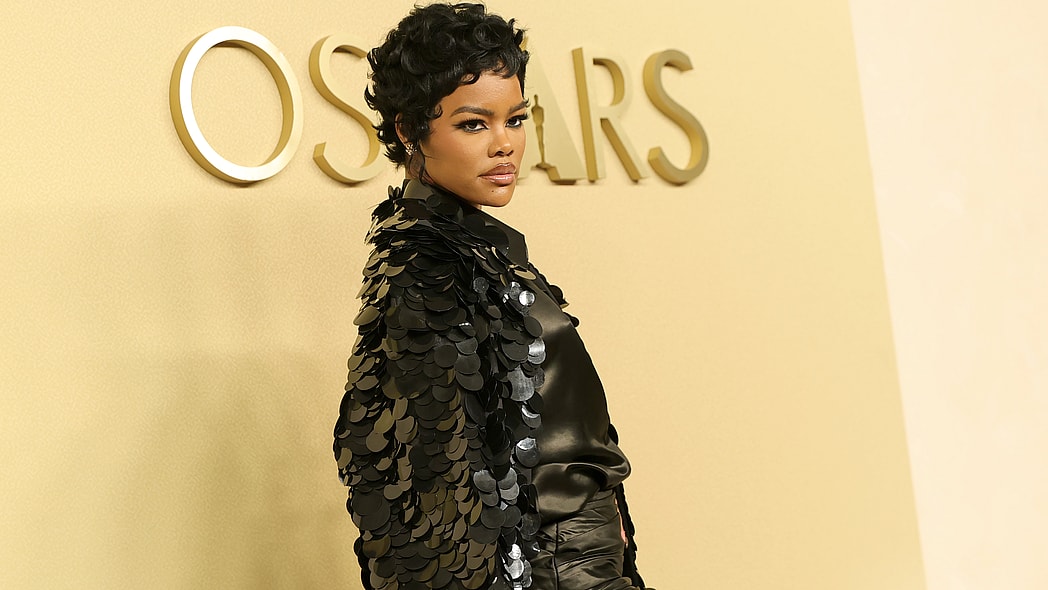
Just as fans celebrate Teyana Taylor’s victorious sprint through award season, racking up a Golden Globe win and Academy Award nomination, some social media users shared mixed feelings about the role Taylor is being recognized for, noting a pattern in the types of roles Black women seem to have to play in order to receive industry recognition.
In “One Battle After Another,” Taylor plays Perfidia Beverly Hills, a complex revolutionary who uses her sexuality and seduction to her advantage. However, in the Perfidia storyline, viewers also witness her being sexualized by two white men, a theme that has sparked discourse on social media. Taylor says she welcomes the discussion around her character in a recent interview with the Los Angeles Times’ “The Envelope” podcast.
“Honestly, I’m not surprised of any of the talking,” she said. “I love conversation, and I like when we can converse. Get it off your chest, tell me how you feel. And I’m open to [receiving] that. So I knew that it would shake the table. I also knew that it needed to be done.”
She continued, “So I’m happy that the controversy around her can create dialogue like this, can create healthy dialogue or even uncomfortable dialogue. As long as it’s dialogue and we’re conversing and we are speaking and people are speaking from their point of views, I can absolutely respect that.”
However, there’s one piece of the conversation that Taylor feels audiences are overlooking in the chatter surrounding her character: postpartum depression.
“Another thing that I feel like the controversy is proof of is how much of a non-factor postpartum depression is. Half of the mistakes we see Perfidia make is her dealing with postpartum depression,” she noted. “Nobody is really taking the time to think about what’s happening in her mind. We can’t control how a person handles postpartum depression. We hear her, through the door, cry, and then we see Bob put his ear to the door — and instead of him walking in, he walked away.”
She added, “Every mother handles postpartum depression differently. But I think that’s what I love about her character, because you get to see a harsh reality that I know is hard to take in[…] Postpartum depression is a big thing for me that I feel like it needs more light. It needs light around it. We need more solutions for it. And like I said, you see this person, this woman in survival mode. You see this woman be ignored. You see this woman be fetishized. And is that not the truth? Is that not what happens, especially in this place of a Black woman feeling the least protected?”
Beyond her character’s promiscuity, Taylor noted how misunderstood her character is.
“This is a woman who has been in survival mode, who has been fetishized, who has been ignored, not seen. We’re seeing this woman deal with that, where in movies we’re used to seeing us women have to be in capes all day and you see this woman rip this cape away and it’s just unapologetically herself — even in her weakness,” she said. “I think her sexuality is her armor. It is also her power […] If you think about her spirit and mentally and emotionally as a woman, it felt good to see a woman actually be selfish and put her[self] first, which we never really get to do.”
Taylor is encouraging the conversations and strong opinions about Perfidia, regardless of whether you loved her character or absolutely hated her.
