
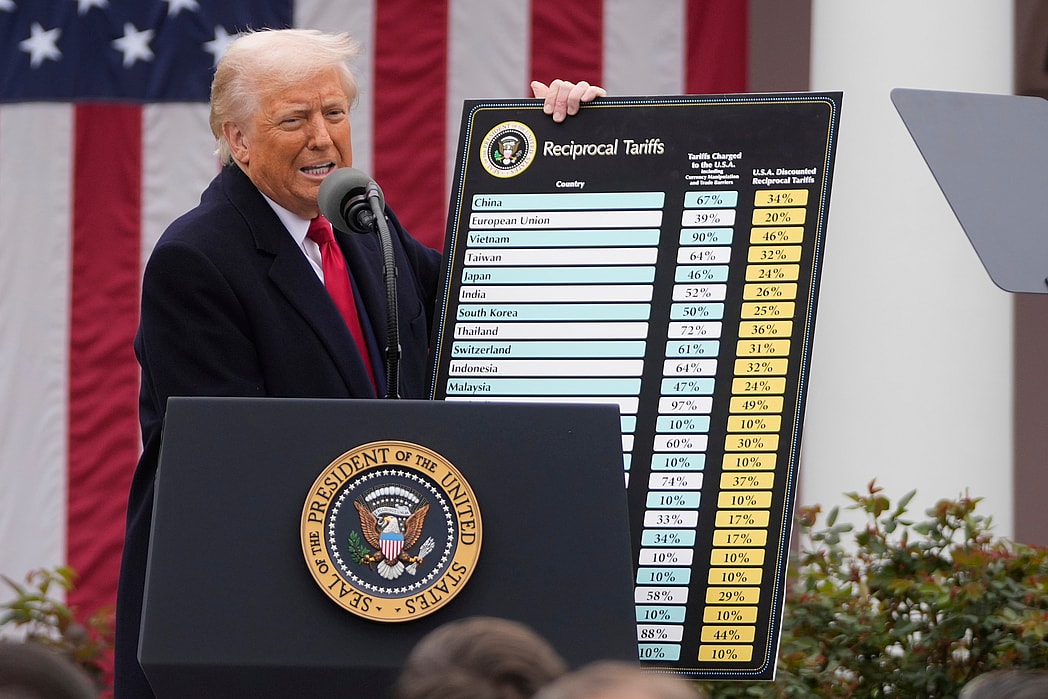
After the U.S. Supreme Court ruled that President Donald Trump‘s reciprocal global tariffs were illegal, the Trump administration must now decide what to do with the more than $175 billion in tariff revenue it has collected.
There are already several ideas floating around, including the Trump administration reportedly strategizing a plan to keep a bulk of the money. Another option is to issue refunds to companies that were forced to pay higher fees due to Trump’s tariffs. Democrats have already demanded that the federal government provide direct rebates of up to $1,700 per American household that have had to pay more for consumer goods due to the tariffs.
Elected officials and advocates tell theGrio they want to ensure that any such refunds make it into the pockets of Black Americans, who have disproportionately been hit economically in Trump’s economy.
“There’s no doubt, when you have a 75% disapproval rating from Black Americans in this country, when we are faced with economic instability. It would be malpractice not to have our communities be rebated or refunded for this escapade that this president went on, whether you’re a producer like our farmers, or you’re a consumer like many of the folks in my constituency and Black constituencies across the nation,” U.S. Rep. Yvette D. Clarke, D-N.Y., chairwoman of the Congressional Black Caucus, told theGrio. “We certainly knew all along that tariffs were a regressive tax on the American people. [Trump] was denying it.”
The CBC leader told theGrio that U.S. Rep. Rosa DeLauro, D-Conn., the ranking Democrat on the U.S. Appropriations Committee, has already drafted legislation that requires a refund to every American who has been impacted, as well as small businesses that have been impacted by imported goods for their businesses.
On the day the Supreme Court blocked Trump’s tariff program under the International Emergency Economic Powers Act (IEEPA), U.S. Reps. Steven Horsford, D-Nev., and Janelle Bynum, D-Ore., introduced the Restoring Economic Lifelines for Independent Enterprises and Family Businesses (RELIEF) Act. The bill would require U.S. Customs and Border Protection to automatically refund tariffs and customs duties collected under IEEPA since Jan. 1, 2025.
“Run us our money, get it back quickly,” Bynum told theGrio.
Though President Trump indicated that paying back companies would be too complicated a task following the SCOTUS ruling, the freshman congresswoman said she spoke with the business community, who explained the process is “very simple.”
“You can go back to the paperwork, and they can reverse the tariffs that small businesses have paid. It’s not an administrative nightmare,” she said.
Even before Trump’s tariffs were deemed illegal, the president promised $2,000 “dividends” for Americans; however, no such payments were ever distributed.
Cliff Albright, co-founder of Black Voters Matter, told theGrio that it is imperative that any refund distributed by the U.S. government be returned to Black consumers who were impacted.
“It’s not just the increased prices that are impacting Black voters and black community members. It’s that you’ve got that taking place at the same time as everything else,” said Albright. He explained, “You’ve got that taking place at the same time that Black unemployment is skyrocketing. We’ve gone from under [former President] Biden, having the lowest unemployment rate ever, to now it is skyrocketing.”
The Black Voters Matter leader warned that the true economic picture for Black Americans is likely much worse than what the data presently shows.
“We don’t know if we’re getting accurate information anymore. The reality is, we’re probably already in a recession as a country,” he cautioned. “If the country isn’t, I can guarantee that the Black community is in recession right now. But it’s hard to know exactly when you can’t trust the information that you’re getting from these government agencies.”
While the jury is still out on what the Trump administration will ultimately do with the billions in tariff revenue, any action taken will likely be litigated. As Trump said during a press conference the day the Supreme Court ruled against his tariffs: “We’ll end up in court for the next five years.”
