
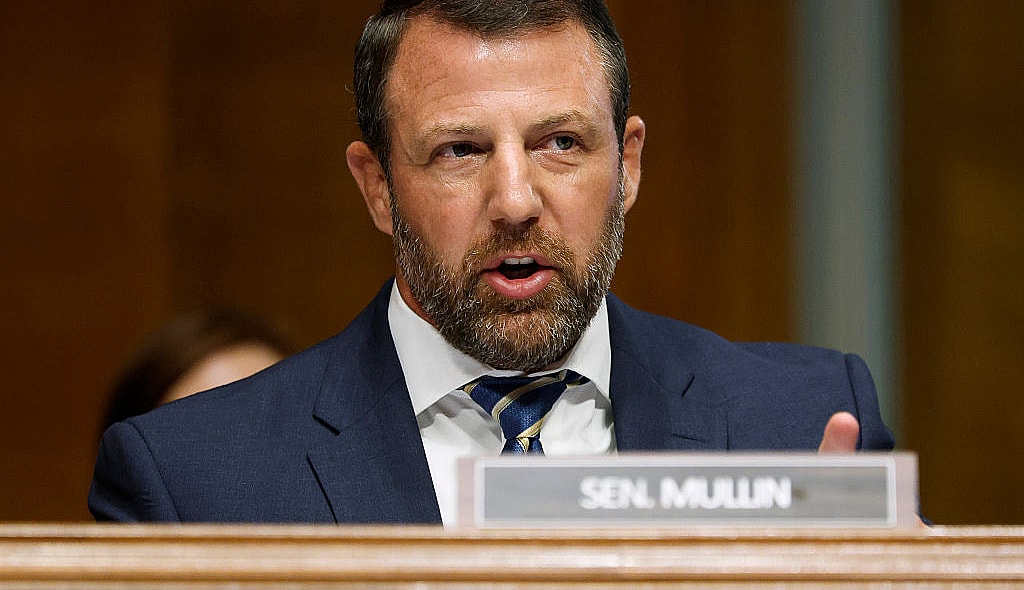
All eyes are on Markwayne Mullin, who President Donald Trump tapped to be the next Secretary of U.S. Department of Homeland Security following the firing of Kristi Noem.
So who exactly is Mullin, and what should Black Americans know about his record?
Mullin is a pro-MAGA U.S. Senator from Oklahoma who has served in the Senate since 2023 and, before that, the U.S. House of Representatives since 2013. The former mixed martial arts cage fighter is Native American and a member of the Cherokee Nation.
The Republican lawmaker has pushed the false conspiracy that the 2020 election was rigged against Trump, despite the outsized role Black voters played in electing President Joe Biden and Vice President Kamala Harris. Mullin refused to vote for the certification of Biden and Harris’s historic win and signed an amicus brief in support of a Texas lawsuit seeking to invalidate the election results in Georgia, Pennsylvania, Wisconsin and Michigan—all states where Black voters made the difference in the election’s outcome.
An analysis by The Brennan Center for Justice found that voters with racial bias attribute voter fraud to predominantly Black cities.
Most recently, Mullin made headlines during Trump’s State of the Union address after he tried to snatch a sign that read “Black People Aren’t Apes” from the hands of Texas Congressman Al Green, who sought to bring attention to President Trump’s racist video post depicting former President Barack Obama and former First Lady Michelle Obama as apes.
Mullin has used his Native ancestry to criticize how slavery and racial segregation are taught to children and to justify the Trump administration’s anti-DEI agenda, which has left thousands of Black Americans out of jobs and funding designed to address historical and racial inequities impacting Black communities.
During a Senate hearing in 2023, Mullin denounced the book “Our Skin: A First Conversation About Race” by authors Jessica Ralli and Megan Madison, because it taught children historical facts about racism in America.
Reading the book aloud, he said, “A long time ago, way before you were born, a group of white people made up an idea called race. They sorted people by skin color and said that white people were better, smarter, prettier, and they deserved more than everybody else.” The senator said he “one thousand percent” disagreed with the book and slammed the reading as an attempt to “socialize our pre-K system” and suggest that “white kids are to blame” for America’s history of racism.
When a witness testifying during the hearing tried to explain that racism was a reality of America’s history, Mullin said, “I don’t want reality.” He quickly followed up that he “misspoke.”
While defending Trump’s cuts to diversity and equity programs, Mullin pointed to his Native American family’s past discrimination and how he didn’t use it as an “excuse” in his life.
“I grew up in Indian Country. I lived on the same place that my family got forced to move to before 1840…I didn’t get handed anything other than an opportunity,” he told a reporter.
When the reporter pointed to decades of redlining that Black Americans experienced, which still impacts their communities today as a result of property values and environmental exposures, Mullin said, “I’m talking about today. I’m talking about what’s happening in my lifetime…I can’t control what happened in the ’60s. I can’t control what even happened in the ’70s. I definitely can’t control what happened in the ’50s and the ’40s, in the ’30s and the ’20s and the 1800s.”
He added, “We came a long ways as a country.”
The Oklahoma senator instead suggested that Black Americans and other marginalized people who are disadvantaged by historical harms are simply unwilling to “keep walking through those doors and being uncomfortable.”
“Are you going to let your past or your circumstances hold you back? You can make the decision yourself. A lot of people, they get stuck in a rut and they don’t want to get out of that rut. That’s your choice, that you choose to stay in that rut,” he argued.
According to a 2023 health study published by the National Library of Medicine, there are modern consequences of historic redlining.
“Emerging evidence shows the health consequences of historical redlining on present-day health indices including increased risk of diabetes, hypertension, and early mortality due to heart disease,” the study reads. “Evidence suggests that historic redlining operates upstream to suppress social advancement by limiting potential to achieve higher income.”
