
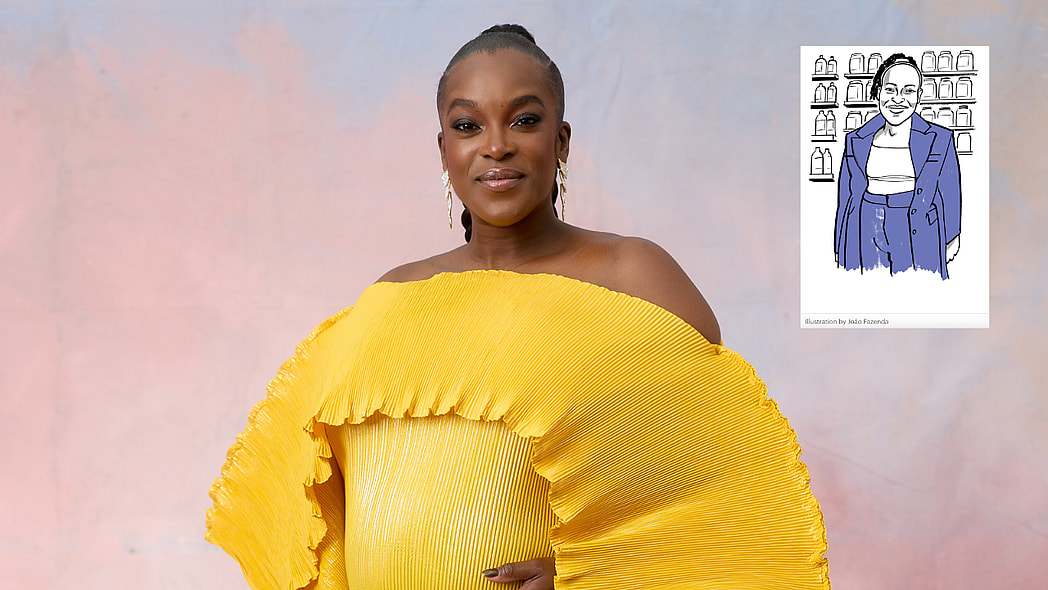
When Wunmi Mosaku appears on screen, audiences tend to notice two things immediately: her talent and her presence. The award-winning actress has spent years building a reputation as a magnetic performer, most recently captivating viewers in Ryan Coogler’s horror film “Sinners.” But this week, Mosaku is at the center of an entirely different conversation; one about how Black women are seen, and who gets to decide what that vision looks like.
View on Threads
On March 5, The New Yorker published an article titled “The Lost Vibes of Wunmi Mosaku” that featured an illustration by João Fazenda of Mosaku that readers pointed out shared little resemblance with the actress. The illustration and The New Yorker’s decision to publish it received very mixed reactions. However, in the wave of reactions, artists across social media began sharing their own illustrations of Mosaku, many capturing her with the elegance and warmth fans say the original image lacked. Now, the collective response felt less like an attack on Fazenda’s talent and more like a broader statement: when it comes to portraying Black women, representation is about more than technical skill. It’s about vision, which is exactly where critics say the problem often lies.
View on Threads
For decades, mainstream media has struggled with how it visually represents Black women. From athletes to actresses, there have been repeated instances in which women at the height of their achievements were paired with images that felt careless, distorted, or simply disconnected from how they actually appear. Even when the written words celebrating them are glowing, the image is often what lingers, and sometimes it undercuts the very praise the story intends.
This wouldn’t be the first time the New Yorker has received backlash for the way its illustrations have portrayed Black people. In 2008, the magazine received backlash for an illustrated cover of Michelle Obama in an afro holding a machine gun, fist bumping a depiction of President Barack Obama in a turban. While the magazine labeled the controversial cover as “satire,” noting that the issue featured an article spotlighting the former President’s rise to politics at the time, Obama’s campaign called it “tasteless and offensive,” per Politico.
Similar debates have surfaced elsewhere in media illustrations. In 2018, Australian cartoonist Mark Knight drew tennis legend Serena Williams as an exaggerated, almost grotesque figure smashing her racket after her loss at the 2018 U.S. Open. The image drew swift condemnation from leaders like the late Rev. Jesse Jackson Sr. and Bernice King, as well as the National Association of Black Journalists, who called it “repugnant on many levels” at the time, per NPR.
Critics noted that the cartoon didn’t just exaggerate Williams’ emotions; it placed her within a long tradition of caricatures that render Black women as physically exaggerated or aggressive. Meanwhile, her opponent, Naomi Osaka, was illustrated as a small, blonde, white-passing figure, further intensifying the racial dynamic at play.
This discourse also extends to photography. Renowned photographer Annie Leibovitz has notoriously received backlash for how unflattering her signature shadowy, desaturated style is for Black women, as seen on the Vogue covers of Simone Biles and Ketanji Brown Jackson. Contrarily, but equally as problematic, photographers have consistently edited Black women’s skin from Lupia Nyong’o to Gabourey Sidibe (Elle magazine, 2010) to appear lighter on covers.
This is a consistent and exhausting pattern because when the people shaping the visual narrative don’t fully see Black women, the result can feel like erasure, even when the intent isn’t malicious.
Writer and actor Leta McCollough Seletzky captured that sentiment on Threads, writing that the Mosaku illustration is “one of the reasons why I’m so cautious about who captures my image and for what purpose.”
“Many lack the capacity to see people like me,” she wrote. “So they cannot be trusted to properly recognize me. Let me be recognized by those who know how to see me.”
Ultimately, the outrage over Mosaku’s illustration isn’t simply about one drawing or one artist. To be seen requires the one behind the lens or the pen to possess not just technical skill but a genuine understanding of and reverence for their subject. Black women have always deserved that. Wunmi Mosaku deserved that.
