
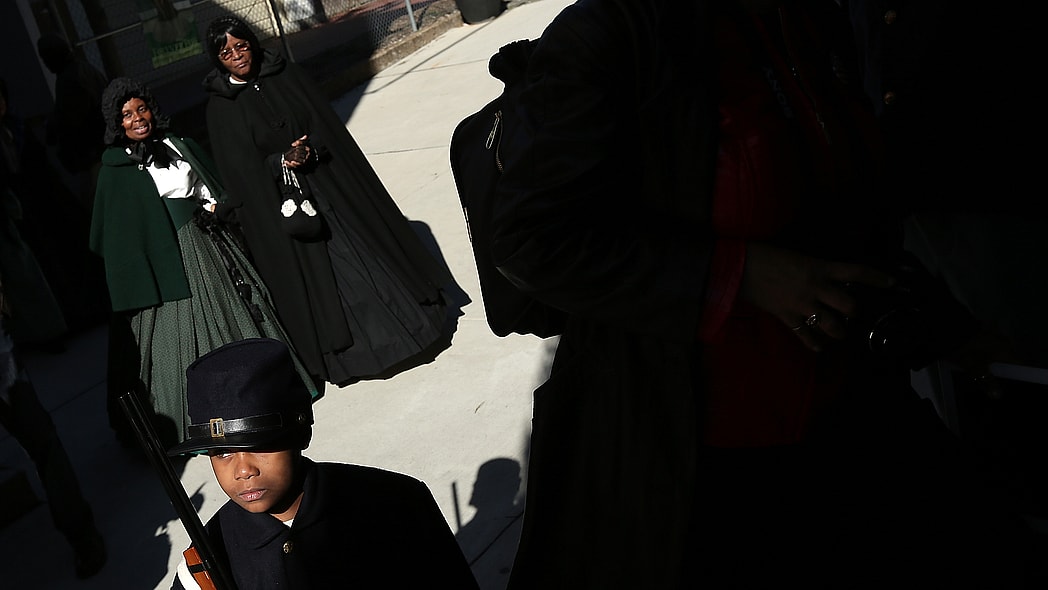
There are many ways to honor our ancestors, and for Marquett Milton, Millicent Sparks, and Darius Wallace, dressing in replicas of 19th-century garments and re-enacting critical moments in history is one of them. Black interpreters, both seasoned and amateur, play a very special role not only in helping communities understand US history but also in showcasing Black people’s consistent presence in these historical events, despite being left out of many history books.
“These are American heroes, this is American history,” Marquett Milton, who works at the African American Civil War Museum in Washington, D.C., told NBC News. “I’m happy that I get to share it.”
“I try to find the humanity in my characters. And finding pieces of myself in them. It’s a very intimate process,” actor and writer Wallace added, reflecting on interpreting figures like Malcolm X, Fredrick Douglass, and Martin Luther King Jr.
While interpreters have graced stages of museums and programs for years, in recent years their roles have become particularly poignant as legislators attempt to erase, cover, and even rewrite history.
“At a time when America is debating the great values of democracy, it could not be a better time to fully understand the importance of the U.S. Colored Troops,” Frank Smith, Jr., founding director of the African American Civil War Memorial Freedom Foundation, explained. “They sought freedom, and in doing so, helped to unite a divided country.”
Through these re-enactments, communities are not rewriting history but instead shifting the spotlight to highlight various elements of these foundational moments. For instance, female interpreters like Sparks and Joyce Bailey can shine a light on the many Black women who played pivotal roles in communities and households but may not have received their due credit due to societal norms at the time.
“Beyond the heroic Black men in the U.S. Colored Troops, heroic Black women were there too,” said Dawn Chitty, the director of education at the Civil War Museum, which launched the Female RE-Enactors of Distinction (FREED), designed to “educate the public and promote the accomplishments of the African American Civil War soldiers and the women who supported their fight for freedom.”
Offering a range of educational programs, like re-enactments and dramatic readings, the volunteer group is fueled by a desire to educate people, especially younger generations.
“I’ve been a re-enactor for at least 20 years. I do it because I feel it’s important, especially for young people, to understand history that rarely has been presented accurately,” Bailey concluded.
