
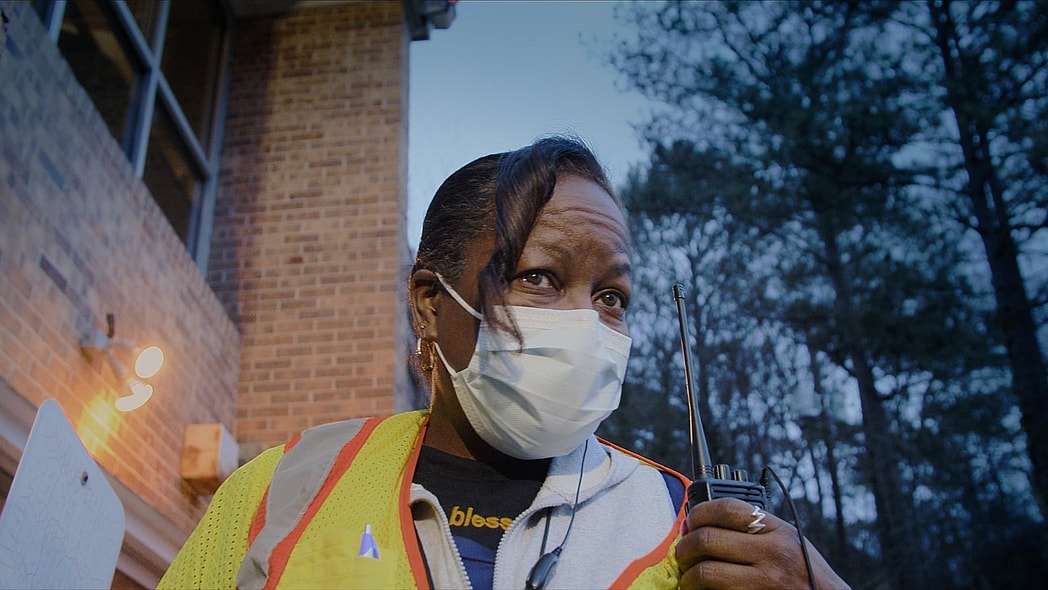
The documentary short “The Devil Is Busy” may not have won its category at the 98th Academy Awards on Sunday, but it had already made history before the stars even hit the red carpet.
When the film, which chronicles a day in the life of an abortion clinic in Atlanta, Georgia, through the lens of its lone Black woman security guard, was nominated for Best Documentary Short, it also marked a milestone for director Geeta Gandbhir, who became the first woman nominated for both Best Documentary Feature (The Perfect Neighbor) and Best Documentary Short in the same year.
“It’s so empowering,” the film’s co-director and co-producer Christalyn Hampton told theGrio during an interview ahead of the Oscars. “When we set out to do this story, I don’t think any of us were thinking about awards. I think we were thinking about telling a story that was important, that was impactful for viewers to see how one decision can have this ripple effect.”
In just 30 minutes, “The Devil Is Busy” takes viewers from the start of the day, with Tracii, the head security guard, opening the facility at the crack of dawn, through the close of business. Viewers watch as she conducts security checks, compassionately checks in with early arrivals in the parking lot, prays over the day, and eventually welcomes other staff members, including additional security personnel.
Nearly every person she encounters, she greets with the same question: “Are you good?”
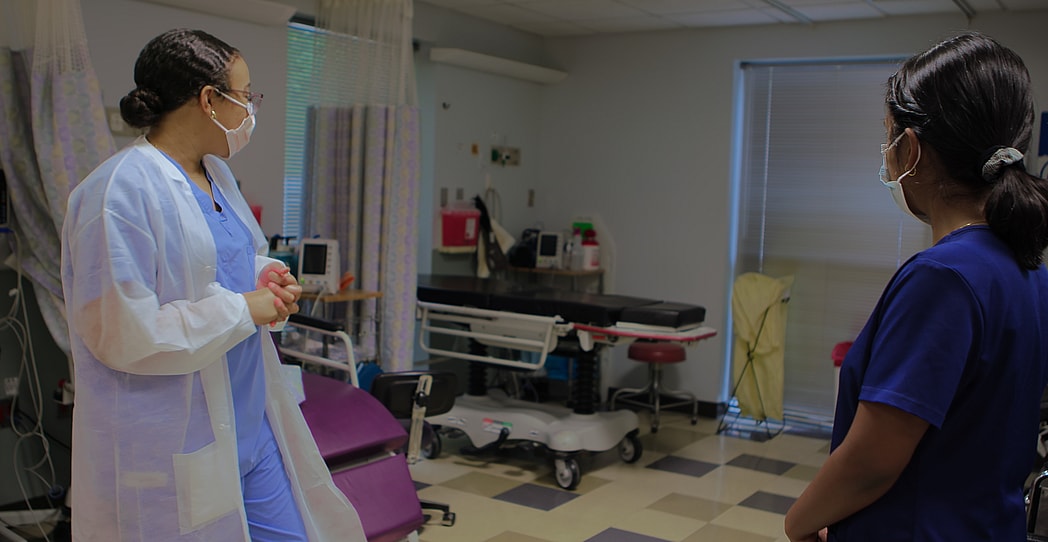
She thinks about patients traveling across state lines who are afraid to even stop for water at a gas station, and she makes sure snacks and drinks are available for them. She does all of this as a fierce, God-fearing woman. It was this intersection of spirituality and her work that especially drew the filmmakers to her story.
“Tracii is a faith-fueled woman,” Hampton noted. “And I respected that so much about her, because you would think she’s working inside an abortion clinic. People feel like you can’t be religious, you can’t be faith-based. And I thought that was just a really interesting, unique take and to sort of tell this story with that lens really, I felt, revealed the humanity behind what these women go through on a day-to-day as clinic providers and staff members.”
The filmmakers also faced the challenge of telling such an intimate and emotionally charged story through a cinéma vérité style, which meant capturing real moments as they unfolded while being mindful of the vulnerability and sensitivity surrounding patients, staff, and the climate around reproductive healthcare.
At one point, as Tracii watches protesters gather outside the clinic, she reflects on the hypocrisy of a man who was once arrested and served time for attempting to burn down a Black church now standing among those protesting the clinic, claiming God forgave him.
“He doesn’t forgive anyone else?” she asks in frustration, shaking her head.
The film’s title comes from a moment when Tracii remarks, “The devil is always busy,” referring to the constant threats facing the clinic and women’s healthcare. Captured shortly after the fall of Roe v. Wade in 2022, the documentary highlights how much more complicated it has become for women in many parts of the country to legally access healthcare, as more than 25 million women have lost abortion rights or face severe restrictions. Staff and physicians recount the agonizing stress of turning patients away who are just beyond legal limits, sometimes by only a matter of days. Many also express disbelief that they are working in a field with fewer protections than existed a generation ago.
“I really hope that women will begin to truly advocate for themselves and their health care,” Hampton said. “Abortion is a form of health care, and people make those decisions for their own bodies and their own rights. And I think reproductive freedom and full autonomy of your body is important.”
She added that she has also seen the film spark conversations among men about bodily autonomy.
“A lot of men are becoming aware of the importance of being able to have control of your body and understanding through this process, you know, and being a witness to it,” she continued. “They realize, ‘okay, women are being weaponized. They are being policed.’ And so I think having that awareness, maybe we have more men vote for women to have reproductive rights as well.”
In the meantime, the film’s final moments leave audiences with a clue about what to do. The story comes full circle when, just as she began her day, Tracii ends it the same way, bowing her head in prayer before heading home. Her quiet ritual becomes a powerful metaphor for the work itself. The routine of showing up day after day to protect women, their health, and their rights, even as the pressures mount.
In many ways, her discipline of faith mirrors what the broader fight for progress has always required: consistency, endurance, and the willingness to keep going even when the outcome feels uncertain. Like her daily prayer, the work continues. Show up. Do the job. Protect each other. And when tomorrow comes, do it all over again.
“The Devil Is Busy” is currently streaming on HBO Max.
