
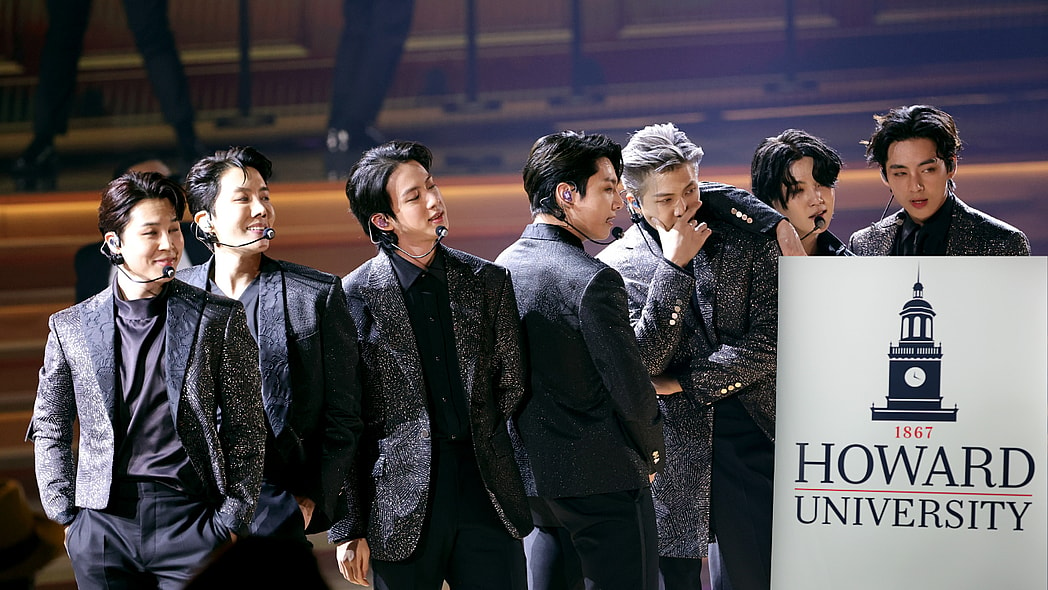
Popular K-Pop band BTS released their comeback album “Arirang” today. However, in the days leading up to it release the Korean boyband sparked discourse on social media when they shared a promo video that was intended to honor the history of seven Korean students who attended Howard University, whitewashing the crowd at the Historically Black college.
At the beginning of the video, the brand shares a disclaimer stating:
“This video was inspired by the story of seven young Koreans as documented in The Washington Post on May 8, 1896 (“Seven Koreans at Howard”) some of whom captured the first known audio recordings of Koreans in Washington, D.C., on July 24 of that same year. As a modern reimagining, this work draws upon the profound cultural significance of these historical records, which preserve the authentic voices of young Korean men and the first-ever recording of ‘Arirang.’ This production may deviate from actual historical events and does not serve as a formal evaluation or interpretation of any historical event or person.”
However, fans quickly noticed that the crowd surrounding the group of Korean singers on the Howard campus was majority white, a small but noticeable detail in a depiction that is supposed to be spotlighting a Historically Black College and University during segregation.
As the group notes in its disclaimer, the video references seven Korean students who enrolled at Howard University with the help of Korean Minister Suh Kwang Bum. At the time, the students were reportedly stranded in Vancouver with little to no funds. In search for help, the group reached out to the Korean Minister in Washington D.C. for assistance. Minister Bum reportedly helped them travel from Vancouver to the nation’s capital.
At the time, Howard University, founded in 1867, was a safe haven for Black Americans seeking education in a segregated society. However, in 1896, the university dedicated to helping formerly enslaved Black people get educated became a sanctuary for other marginalized communities who were often met with unwritten discriminatory rules.
Historian Ray Logan noted, per WETA Boundary Stone: “On April 29, 1896, the Korean Minister personally requested at the meeting of the Executive Committee, that rooms be provided for…Korean young men. The Committee voted to make them available to them, free of charge, in Clark Hall, provided all other expenses were paid. The Korean minister agreed to pay for the furniture which the Treasurer was to purchase. On May 12, 1896, the Committee noted that the rooms had been fitted for the Korean students.”
“D.C.’s Howard University was featured in an animated video by the K-Pop group BTS, which teased its upcoming album. The school’s callback has received mixed reactions on social media.”
Though there are limited reports on how the Korean students acclimated to Howard’s student body at the time, multiple sources noted the group’s amazing singing. Their singing was so captivating that, apparently, one summer, anthropologist Alice C. Fletcher invited several of the students to her home, where they reportedly recorded and produced what are believed to be the first known recordings of Korean voices and music in the United States, including the Korean folklore song “Arirang.”
“Howard University stands as one of the most iconic institutions in the nation’s capital, distinguished globally for its founding mission to bring together people from diverse backgrounds to advance culture, scholarship, and discovery. The University has welcomed students from across the globe who both shape and are shaped by its unique environment—one that champions freedom of thought, discovery, and innovation, while proudly honoring its identity as a leading historically Black university,” Howard University wrote in a statement to WJLA. “This legacy reflects why Howard is known worldwide as “The Mecca.”
This rich history is exactly why the whitewashed crowd in that promo video stings the way it does. However, BTS’s latest incident highlights a broader issue within the K-Pop community. Through the years, there has been a pattern of Korean artists drawing inspiration from elements of Black culture to the point that some fans have categorized it as cultural appropriation.
“I think the discourse reveals what I basically kind of felt with a lot of K-pop,” Devin L, Howard University class of 2017 alum and K-pop fan, told theGrio. “It’s a bit of an arm’s-length appreciation of our culture rather than a full-on embrace. Which considering a lot of the obvious influences, it should be more of the latter.”
