
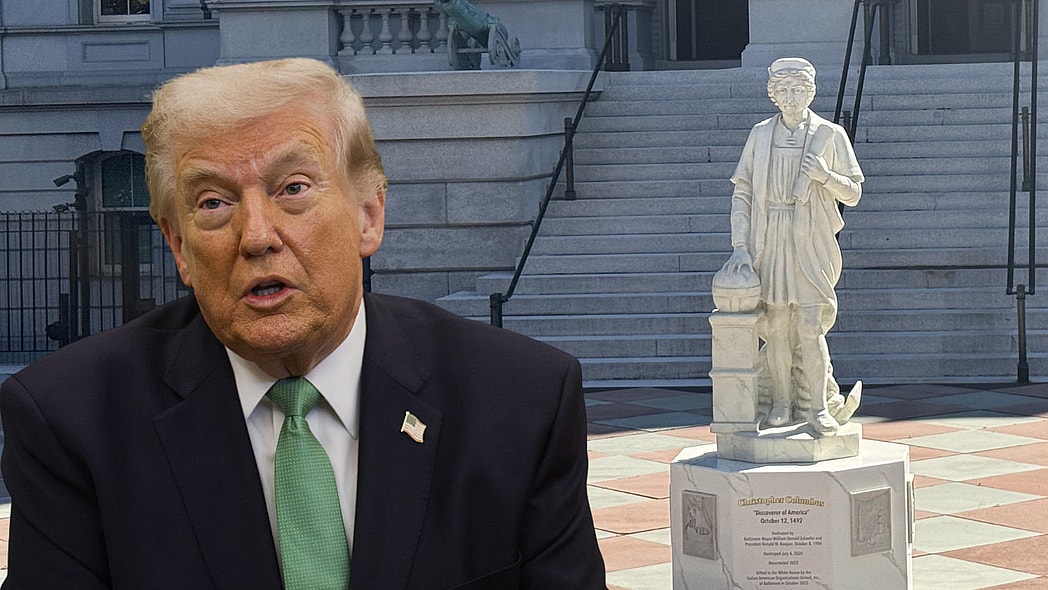
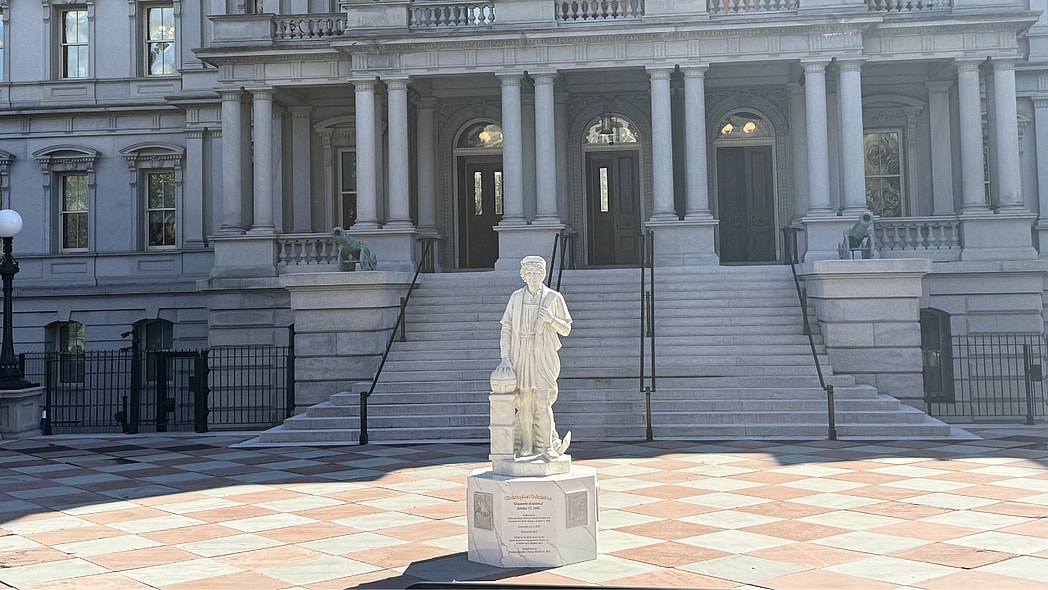
Nearly six years after Black Lives Matter protesters toppled a statue of Christopher Columbus and threw it into Baltimore’s Inner Harbor, President Donald Trump has erected a replica of the controversial Italian explorer on the White House grounds.
The statue was installed on Sunday outside the Eisenhower Executive Office Building, just feet away from the White House.
“In this White House, Christopher Columbus is a hero, and President Trump will ensure he’s honored as such for generations to come,” the White House said in a statement following the statue’s placement.
According to the New York Times, the replica was created by sculptor Tilghman Hemsley and his son, using scans of the salvaged parts of the original retrieved from the harbor after it was destroyed by BLM protesters. The statue has an inscription that reads, “‘Discoverer of America’ October 12, 1492.”
The return of the Columbus statue on White House grounds follows a series of actions the Trump administration has taken to restore white nationalist symbols, including other statues and the renaming of military bases in honor of Confederate generals. Critics of the president have slammed the actions as a “whitewashing” of U.S. history.
“President Trump is trying to glorify people who wanted to preserve chattel slavery and destroy the United States instead of honoring those who fought to make this a better nation. Americans, especially Black and Brown Americans, will never forget the decades of oppression that so many communities endured,” Margaret Huang, president and CEO of the Southern Poverty Law Center, said after President Trump signed an executive order to restore Confederate monuments.
Columbus, who did not set foot on U.S. soil despite historical praise for discovering the Americas, was responsible for the genocide of indigenous people across the Americas during the late 1400s and early 1500s.
Dr. Marcus Board Jr., an associate professor of political science at Howard University, told theGrio of Columbus, “He was not any form of good in the world. He came to conquer and to dominate.”
Board continued, “I hope that we have evolved more as a people to know that that way of being should no longer exist. And when you try and get to the root of white nationalism, I think it’s important to point out that you always end up with someone who was a representative of the lowest form of civilization, of society and of humanity.”
Columbus’s violent history is so controversial and well-documented that a movement to rename Columbus Day as Indigenous Peoples’ Day gained momentum in the U.S. during the 1990s. President Joe Biden issued the nation’s first proclamation honoring Indigenous Peoples’ Day in 2021.
President Trump’s move to honor Columbus is in direct contrast to the cultural shift away from honoring the controversial explorer.
“We tell stories about dead men to make living men feel stronger. Christopher Columbus exists as a story so that men justifying domination can say that they are heroes,” said Dr. Board. “And so when we tell the story of this new statue and the White House where it rests, just remember to talk about how much education, how many cultures, and how many people had to be destroyed in order for their myth to exist, and then get to work.”
Keith Boykin, a political analyst and former Clinton White House aide, said of President Trump’s move, “Unfortunately, Trump’s statue is predictable rage bait. Whenever he’s in trouble, he launches a new culture war battle to distract his base from his failures.”
