
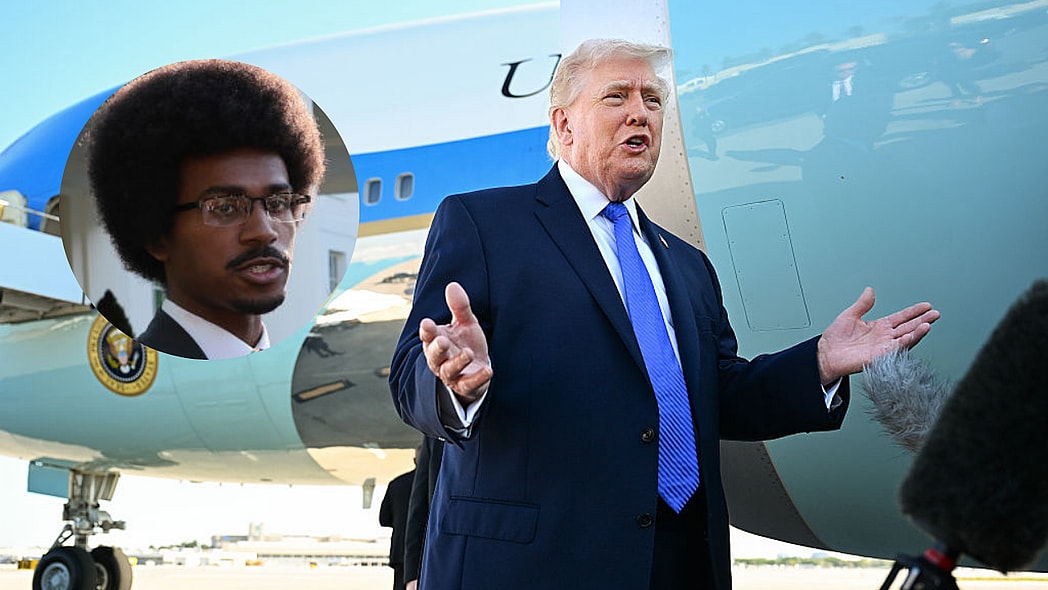
As President Donald Trump visits Memphis on Monday to highlight his administration’s deployment of the National Guard to address public safety in the majority Black city, local leadership says the president and his Memphis Safe Task Force are causing more harm to Black and Brown residents than the stated goal of keeping them safe.
“He isn’t welcome here because he is a racist, xenophobe who has spewed hatred and hurt our communities more than he has helped them,” Tennessee State Rep. Justin J. Pearson told theGrio.
Pointing to Trump’s efforts to deploy the military in other cities like Washington, D.C., Los Angeles and Chicago, Pearson added, “Memphis is being treated as a pawn in his authoritarian playbook and scheme, and we can’t forget the origins of the takeover of our city, which was a part of the takeover with other cities which were being targeted as Democratic-led and or Black-led.”
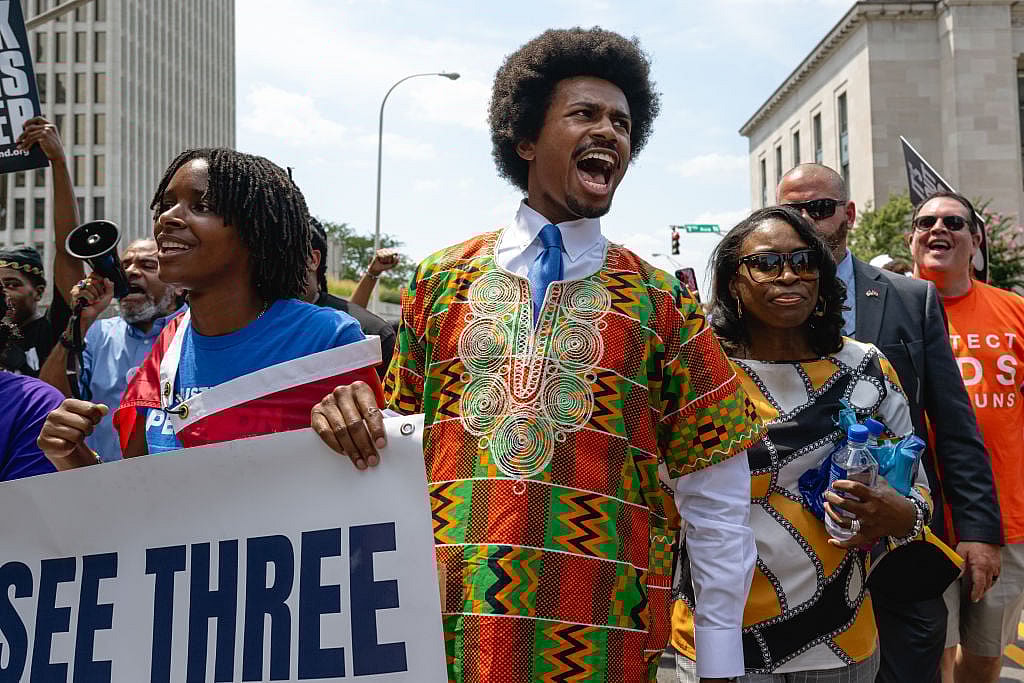
Pearson, who is a candidate for U.S. Congress in Tennessee’s 9th Congressional District, joined hundreds of protesters in Memphis on Monday for a “Dump Trump” rally to oppose Trump’s visit and his six-month-long task force, which has resulted in the racial profiling of Black and Latino residents and the enforcement of the Trump administration’s tough immigration policies.
“Over 300 families have been separated. Hundreds of kids are missing school consistently and continuously out of fear, and our jail system is being overtaxed and overburdened, to the point that I’ve called in help from the Tennessee Department of Corrections to take some of the people who are being incarcerated, mostly for traffic violations and tickets,” Pearson told theGio. “This unsafe Task Force is not helping to reduce the root causes of crime, like that’s what we need resources for, and that’s been the demand since day one. We want poverty eradication, not military occupation.”
The Trump administration has characterized its Memphis operations as a success, citing significant reductions in crime in the city. According to the Council on Criminal Justice, in 2025, homicides in Memphis were down 24%, and robberies were down 30% from 2024 levels.
Kyler Gilkey, a Memphis native and candidate for Tennessee State House District 84, told theGrio that Trump is coming to take credit for the drop in crime, even though crime was already dropping without his federal intervention.
“In reality, when our mayor, Paul Young, took office, in roughly a year, we had already seen crime drop down. I think it was roughly 18 or 20%. And so this administration is going to come in and kind of take credit for the work that was already being done,” he said. “There are so many other ways to do that, except coming in and taking over, which Memphis is the largest minority majority district in the country, so basically saying that these Black people can’t run their own city, so I’m going to come in and do it.”
Gilkey scoffed at the presence of the National Guard in Memphis, pointing to its historical context: “Before October, the National Guard hadn’t been deployed in Memphis since Dr. Martin Luther King was assassinated in 1968, and so seeing that contrast is very striking.” He added, “We know that this administration is just manufactured chaos. They can come in and swoop in and quote, unquote, save the day.”
Memphis leaders say that, rather than deploying hundreds of military troops and federal agents into communities, the Trump administration could simply invest in proven local programs and resources that have proven to drive down crime.
State Rep. Pearson noted the hundreds of millions of dollars that the Trump administration has cut from gun violence prevention and other grants geared toward public safety, noting that federal funds could go toward community housing, access to health care, and education, which would “precipitously drop our crime rate.”
“You can see the immorality of this administration through its budget proposals. And you can also see that the veneer of Black criminality is a part of how they are seeking to abuse and misuse their authority as the federal government over our communities,” said Pearson.
As for racial profiling, Pearson said, despite the city making gains after the 2023 police killing of Tyree Nichols to end pretextual traffic stops, a September 2025 ruling from the U.S. Supreme Court has essentially granted nationwide racial profiling by ICE.
“Pretextual traffic stops disproportionately target Black, African-American, and people of color,” said the congressional candidate. “Stats are showing 94% of the people who are being stopped are Black folks, Latino folks and people of color.”
Gilkey told theGrio that his younger brother was one of the many Black residents stopped by law enforcement.
“He got pulled over, essentially for no reason at all, and there were like five different cars behind him, and you know, for a Black man getting pulled over by the police, that’s already a scary situation,” he shared. “Essentially, it is getting to the point where folks are just being terrorized by the National Guard, all these different folks there.”
While it is unclear how long the Trump administration plans to enforce the high presence of the National Guard and federal agents in Memphis, Rep. Pearson said leaders have to think about “what happens the day they leave.”
He added, “Our communities are left with trauma, with pain, with the repercussions of actions that we did not ask for. They were not invited here, and yet, are forced to deal with the ramifications of their being here.”
