
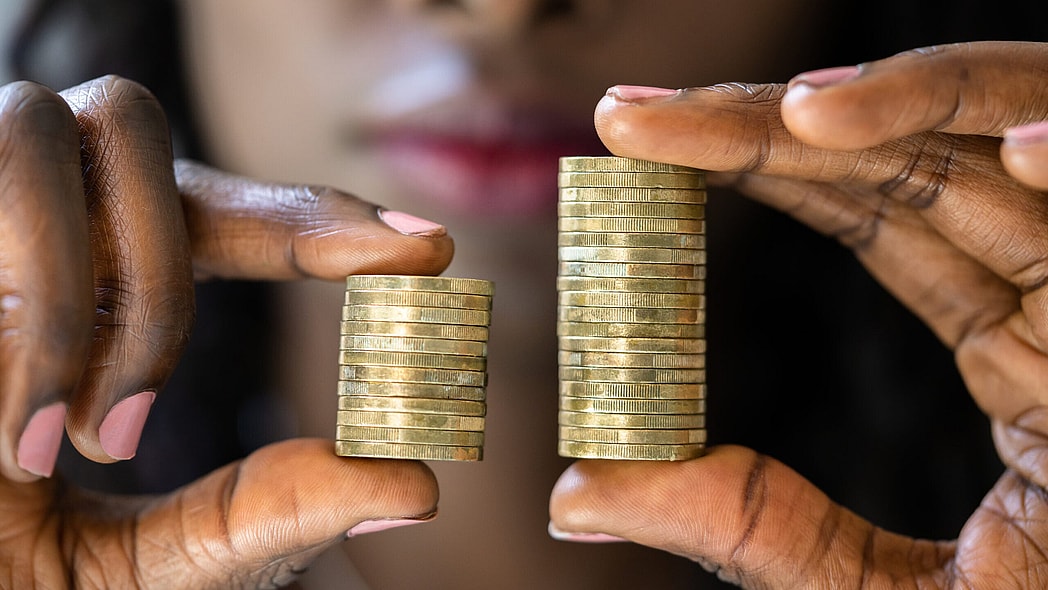
As we commemorate another Equal Pay Day today, amid Women’s History Month, experts and advocates alike are reckoning with the fact that the gender pay gap continues to widen.
In fact, the gender pay gap has widened for the second year in a row. According to the most recent data from the U.S. Census Bureau, women working full-time, year-round earned 81 cents for every dollar men earn, down from 83 cents in the year before and 84 cents in 2022. When you break this down by race, the trend especially spells trouble for Black women.
While white women earn roughly 81 cents to the man’s dollar, Black women are barely earning over 70 cents. According to the Institute for Women’s Policy Research, Black women who worked full-time earned 66.5 cents per dollar that white men earned, and these pay disparities may not close for Black women until 2183 for full-time year-round workers (and 2224 for all workers).
“The trends are very clear: unless there are major policy changes, Black women’s median pay (roughly $48, 984) will not reach the same level as white men’s pay for generations, ” Dr. Jamila K. Taylor, PhD, president and CEO of IWPR, told theGrio over email on Thursday, March 26.
“Lower pay right now does not only impact the current generation of workers,” she continued, “it also reduces Black women’s ability to build up wealth and economic security for future generations of Black women and girls.”
Part of the reason for the gap’s growth is that, according to the U.S. Census Bureau, men’s pay increased over the last two to three years, while women’s pay remained relatively stagnant. Meanwhile, for Black women, in the past decade, the earnings ratio for full-time year-round workers has barely moved beyond two cents, from 63 cents in 2015 to 65 cents in 2025, per dollar earned by white men.
Citing “Across Degrees, Titles, and States, Black Women Earn Just 64 Cents on the Dollar,” Taylor explained that Black women were paid less than White men across all education levels, including in leadership and professional positions. Among full-time year-round workers, she said Black women with bachelor’s degrees earned 62.7 percent of what White men made, while Black women with master’s degrees earned 64.4 percent, and Black women with professional degrees earned 59.0 percent.
The severity of pay disparity also varies depending on the region for Black women. According to the IWPR, Utah, Louisiana, and Washington, D.C. have the worst median annual earnings ratios between Black women and white men working full-time year-round at 50.9 percent, 51.8 percent, and 52.8 percent, respectively. Beyond the pay disparity, Black women also face barriers to advancing in the workplace.
“As a result of being Black and being a woman, we encounter unique compounding inequities of racism and sexism in the labor market. Black women are more likely than men of color, White women, and White men to experience workplace harassment,” Taylor noted.
She added how Black women with majority white coworkers are more likely to be rated as low performers, bill fewer hours, and report more training hours compared to their counterparts, and are often held to higher job performance standards than their coworkers. Stereotypes, like being labeled “angry,” and the continued devaluation of work also don’t help.
“One of the long-term consequences of slavery is the undervaluation of care work—such as working with young children, looking after the sick and the elderly,” Taylor explained. “Health care employs many Black women, but it often pays less than other jobs that require the same education and experience. Even within healthcare jobs, Black women are significantly over-represented in lower-paying jobs.”
When it comes to what ultimately needs to be done to achieve pay equity for Black women in the workforce, the IWPR’s 2025 Black Women’s Equal Pay Day fact sheet outlines that closing the pay gap for Black women requires a holistic approach. One that takes into account both the racism and sexism that Black women face at work. This could look like banning salary history questions, so past pay discrimination doesn’t follow workers from job to job, expanding access to paid leave, and child and elder care.
“These changes don’t just support Black women,” Taylor said. “They strengthen the entire workforce.”
