
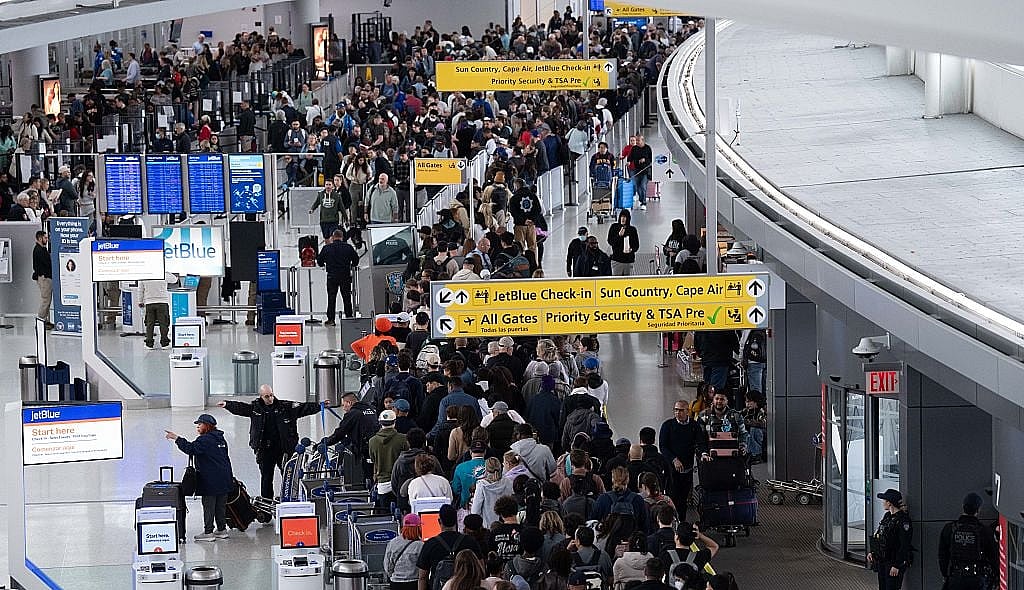
After squirreling away funds after the last partial government shutdown in October, Cherry, a Transportation Security Administration agent based in California, was financially prepared for the partial government shutdown that began in February. It was the emotional toll she didn’t bargain for.
“What really happened was kind of like a big deterioration in my mental health,” said Cherry, who uses that moniker on social media and has asked theGrio to keep her real name private.
“As the shutdown went on longer, it was hard for me to get out of bed to even want to go to work,” she continued, “Because not only were we facing the uncertainty of when we were getting our money, bills were piling up. Morale at work was just low. So you’re dealing with not only you feeling sad, but your co-workers feeling sad. We’re still dealing with a traveling public. They’re not nice, of course. So it’s like justifying going to work while not getting paid, still dealing with people angry about us doing our job.”
The ordeal got so bad for the agent who works at Los Angeles International Airport (LAX) that her psychiatrist ordered her to stay home briefly. Back at work and finally receiving back pay, Cherry, who spoke to theGrio on Wednesday (Apr. 1), warned that TSA remains in a difficult situation.
“I want people to realize that we are still not out of the woods yet,” she expressed. “This back pay situation is very dicey. They’re still debating the legality of if Trump did this right or not. Right now, what we’re being told is that we’re only getting compensation until May. So after May, we could very much be in the same position.”
On Feb. 14, the government entered a partial shutdown primarily due to a legislative deadlock over funding for the Department of Homeland Security (DHS), specifically regarding reforms to U.S. Immigration and Customs Enforcement (ICE). Among the many inconveniences the shutdown has caused, it has affected funding for DHS agencies, and TSA agents went without pay from Friday, Feb. 27, until Tuesday, March 31, when retroactive payments began.
What has become clearer and clearer with each shutdown, particularly this time around, is that they’re not just delaying crucial government functions and paychecks; they are destabilizing a workforce already under much pressure. Since it began, a record number of agents have called out, while nearly 500 quit, causing significant disruptions to travel and leading the government to send ICE (somewhat ironically) in their stead. The optics, considering the workforce is nearly half of color and more than a quarter Black, adds insult to injury.
“That’s another reason why a lot of us think that they don’t really care,” she admitted. “It’s not affecting the group of people that they’re supposed to care about.”
She added, “We all feel extremely dispensable.”
Eight years ago, at the age of 21, Cherry first joined the agency seeking a path towards financial security after growing up experiencing a range of disparities, including homelessness in her teens. She, like many people who work in government, chose the government for its long-standing track record of providing reliable, stable jobs. Government agency jobs have been among the avenues that have helped build the Black middle class. She recalled how people encouraged her during the application process, noting that she would have great pay and good benefits.
“I wanted to just grow up and never really have to struggle again, and this seemed like one of the most secure positions that I could get in without a degree,” Cherry explained.
Now, like many government workers whose careers have been caught in the crossfire of recent shutdowns and layoffs since the Trump Administration took office again in 2025, she’s not so sure.
She said, “We have never faced more insecurity than with this administration. This administration has caused so much turmoil for us, but honestly, it’s caused so much turmoil for everybody.”
While they wait for either the shutdown to finally fully lift or for more clarity on what comes next, she has taken to her social media. A recent TikTok she posted, in which she is simply standing at work in uniform with the text “Oh, okay because we still aren’t getting paid,” as the song “212” by Azealia Banks plays, has racked up over 780,000 views. In another post on the same platform, after an outpouring of inquiries, she clarified that she wasn’t crowdsourcing, as there are thousands of folks in her shoes, but offered her Venmo and Cash App.
Meanwhile, offline, the reality remains much the same. She and many of her remaining colleagues continue to show up and do their jobs to the best of their ability, even as they have to politely smile through travelers who, for the hundredth time, day in and day out, remark how sorry they are.
Speaking directly to the traveling public, Cherry said, “Come to the airport and give the officers a lot of grace [we are] going through very unprecedented times, but we still do want to keep everyone safe.”
