
Though the White House is claiming “victory” after President Donald Trump agreed to a final-hour ceasefire with Iran, it is struggling to explain away Trump’s vow to kill the entire Iranian civilization, which drew chills all around the globe.
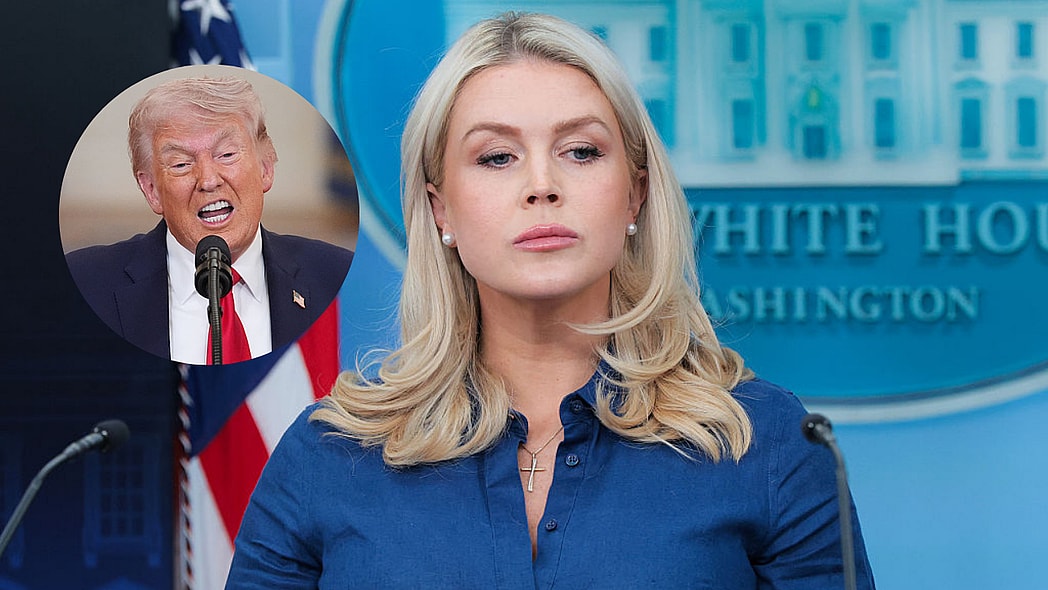
During Wednesday’s White House press briefing, Press Secretary Karoline Leavitt was repeatedly pressed about President Trump’s violent rhetoric and tried to justify his days-long threats to attack innocent civilians, particularly children.
“I understand the questions about the president’s rhetoric, but what the president cares most about is results,” said Leavitt, who described the president’s threat as “tough rhetoric.” She said, ultimately, it, along with his “tough negotiating style” led to real results with the current ceasefire.
When asked what her understanding of the president’s threat against Iranian civilians was, the Trump spokesperson said, “I think it was a very, very strong threat from the president of the United States that led the Iranian regime to cave to their knees and ask for a ceasefire.”
Leavitt affirmed that Trump’s remarks were “not an empty threat by any means,” explaining, “The Pentagon had a target list that they were ready to hit go.”
Despite the White House’s rush to declare victory over the two-week ceasefire, many questions remain as to when the U.S. military will fully retreat from Operation Epic Fury and when the economic ramifications of Trump’s war will come to an end. There are also no guarantees that the war fighting will actually end past the two-week ceasefire or that the ceasefire won’t be violated amid continued strikes between Israel and Lebanon.
Leavitt admitted that “ceasefires are fragile by nature,” telling reporters, “It takes time sometimes for these ceasefires to be fully effectuated.”
What’s more, a major part of the deal between the United States, Israel and Iran–the opening up of the Strait of Hormuz–may have already collapsed. According to multiple reports, Iran claims that the waterway passage for oil and gas shipments is closed again, despite the White House’s claim that it had been reopened as a result of the ceasefire deal. The blockade of the Strait of Hormuz, which was the cause of Trump’s vow to target Iran’s entire civilization, has resulted in gas and oil prices skyrocketing in recent weeks.
Critics of Trump’s handling of the military operation in Iran say regardless of the ceasefire, which is welcomed, the president has lost all credibility after threatening to commit what amounts to war crimes.
“President Trump has gone from threatening civilizational annihilation in the morning to announcing a very tenuous ceasefire in the evening. There are many questions to answer, including how sustainable it can be,” said the National Iranian American Council (NIAC). “Everything can get far worse if this opportunity for peace lapses. Trump will have to do some serious work to make this ceasefire work.”
“Donald Trump brought us to the precipice of global disaster by choosing war over diplomacy,” said U.S. Senator Raphael Warnock. “We lost American lives. We killed innocent civilians, including over a hundred precious little girls, with our bombs. We undermined America’s standing in the world. We spent billions of taxpayer dollars.”
Leavitt insisted on Wednesday that President Trump “absolutely has the moral high ground over the Iranian terrorist regime,” and suggested that questioning otherwise is “frankly insulting.”
When a reporter shared an anecdotal story about a friend in Iran telling her “goodbye” in anticipation of the president’s threat to kill the entire Iranian civilization, the Trump spokesperson claimed that the administration’s goal is to ensure that Iran is ultimately becomes a “country of peace” and “prosperity.”
“We’re moving into this next round of negotiations to hopefully come to an agreement with this new regime that will create long-term stability in the Middle East,” she said.
Iranians and advocates say President Trump is far from a peacemaker, but rather a symbol of a decades-long history of America being a bully on the world stage.
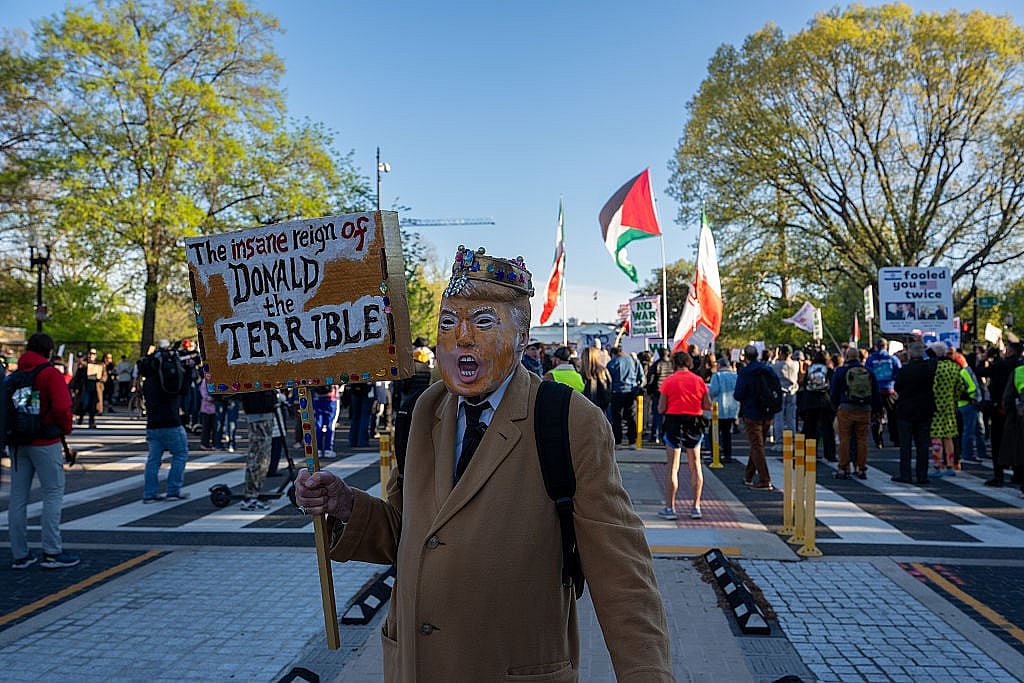
“Trump only unmasks what has always been the case,” said Zaid Khatib, a member of the Palestinian Youth Movement, at a Tuesday rally, where hundreds gathered to protest Trump’s war in Iran. Khatib said the temporary ceasefire was a “sign of U.S. imperialist failure” and the “failure to break the spirit of the Iranian people.” He added, “Let Iran be the graveyard of Trump’s ambitions.”
He continued, “The U.S. has been at war with Iran for over four decades. It’s been at war with the Palestinian people for over seven decades. It’s been at war with Venezuela, with Cuba, with every country, every group of people that stands up against U.S. imperialism.”
The advocate said the issue of the Middle East is beyond Trump, adding, “It does not matter if it’s a Republican or Democrat in office.”
