
Editor’s note: The following article is an op-ed, and the views expressed are the author’s own. Read more opinions on theGrio.
Despite the popularity of the natural hair movement and films like “Hair Power: Me and My Afro,” “Nappily Ever After,” and “Good Hair,” which appear to boast about the beauty of embracing natural hair, every so often Black social media timelines are ignited with discourse about the same curly, kinky, coily hair they claim to embrace.
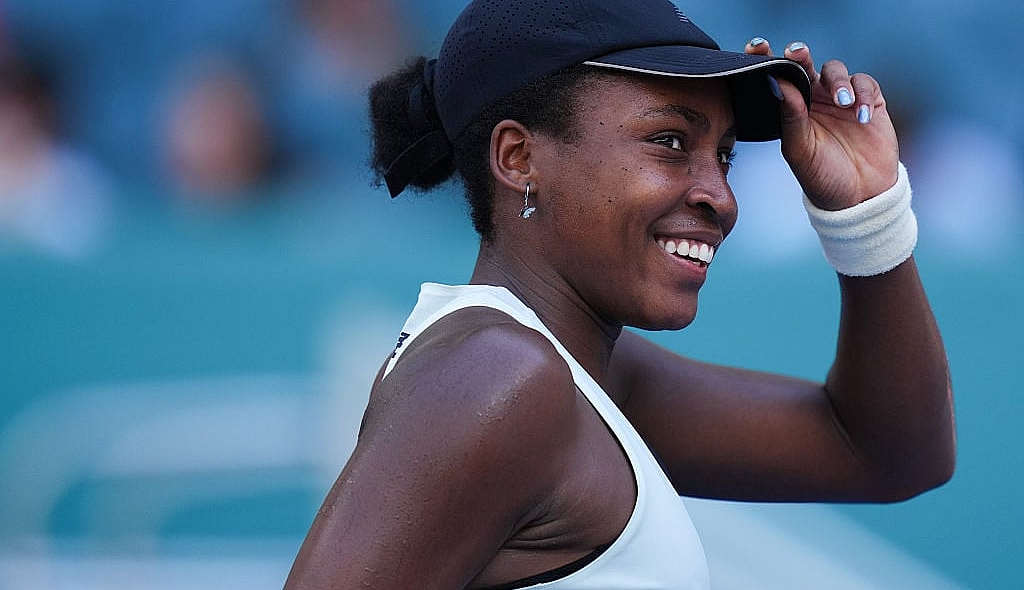
Most recently, Coco Gauff became the victim of this discourse when she released photos from a new campaign she shot with a luxury fashion brand. While promoting the capaciousness of Miu Miu’s “Vivant” bag, the brand captured Gauff in her natural element on the tennis court, sporting her coils in a bun.
But while the brand’s focus may have been the bag, or even the styling, social media’s attention landed on Gauff’s hair.
In the photos, the tennis champion appears to have brushed her hair back into a neat bun. However, unlike the conventional slick-back bun image that comes up when you look up “bun hairstyles on Black women” on Google, Pinterest, or any digital platform, Gauff opted out of the copious amounts of gel and tension often required to tame her coils into a bun that meets societal standards. As a result, the tennis star became the target of social media “jokes” about her appearance.
Now, unless you’re someone who has lived with kinky, coily hair, which can sometimes have a mind of its own, you wouldn’t understand how tedious and often damaging it is to get the “super slick” look we often see when Black women rock buns, a reality Gauff highlighted in a recent TikTok video discussing the recent discourse.
“So I logged out of TikTok and Twitter for a month to come back on Twitter and see thousands of people talking about the way that I look and not in a positive way,” she began before giving some context to how the shoot came to be. “The concept was everyday, like using the bag every day, so I did my everyday hair and makeup. I personally don’t like to slick back my hair super sleek because it does damage my hair. I do play tennis, so most of the times when I’m wearing a bun, I choose to allow my hair to be and present in its 4C self because I do have 4C hair and I don’t want it to be super slick back because it’s just not good for my hair. And so that’s how I do my hair.”
@cocogauff ❤️
♬ original sound – Coco Gauff
“I’m not gonna apologize for the way that my hair looked because there are other girls who have the exact same hair as me, and I just wanted them to feel represented; your hair is literally fine the way it is. My hair was good enough for a high-fashion brand like Miu Miu to promote one of its newest launches. So if my hair 4C is good enough for that, then yours is good enough to do whatever you need to do,” she added.
The fact that Gauff felt compelled to offer that context speaks to a larger, more exhausting pattern: the persistent policing of Black women’s hair across spaces. For years, the acceptability of natural hair in professional settings has been debated, prompting legislation like the CROWN Act to address discrimination based on texture and style. And while institutions have made incremental progress, cultural attitudes haven’t always kept up. And oftentimes the disconnect shows up closer to home.
And while, yes, the advice to mute the noise and block out negativity is valid, the repetition of these conversations is, frankly, exhausting, especially for Black women navigating a world where it often feels like nothing is ever quite enough. On one hand, we’re told to embrace our coils, our kinks, our fullness. To reject Eurocentric standards. To show up as we are. But the moment that “as we are” doesn’t align with a curated, socially accepted version of “natural,” the praise turns into policing.
The reality is that social media loves to attack and psychoanalyze why Black women do anything. However, when it comes to hair, those critics feel particularly personal because ultimately, we cannot control the way our hair grows out of our scalp. One thing we can do, though, is choose how we want to show up in the world. Hair has always been more than just hair; it’s autonomy and a form of expression. On any given day, that expression might look like an afro, braids, locs, twists, or even a bun that doesn’t try to shrink itself into submission. Other days, it might look like silk presses, wigs, or lace fronts, and at the end of the day, none of these choices is more valid than the others.
“I made this video to just say to all the young Black girls out there who have kinky hair like me, do what you want to do with your hair. If you want to straighten your hair permanently, straighten your hair; if you want to perm your hair, perm your hair. If you want to work your hair out, work your hair into an afro. If you want to wear braids, wear braids. If you want to wear cornrows, wear cornrows. If you want to slick back your hair to the gods, slick it back. If you don’t and you just want to put it in a bun, put it in the bun,” Gauff stressed. “Do what you want to do, ’cause at the end of the day, people who hate on your appearance and hate on the way that you look have something deeply insecure about themselves.”
At this point, the cycle is predictable. The commentary comes, the critiques follow, and Black women are left to carry on regardless. And while it would be nice for natural hair to exist without unsolicited opinions, backhanded compliments, or unwarranted critique, the repetitive nature of this discourse makes one thing clear: for Black women, confidence isn’t optional—it’s necessary. And it’s the thing that allows us to move through the noise, reject the projections, and show up as ourselves anyway—every single time.
