
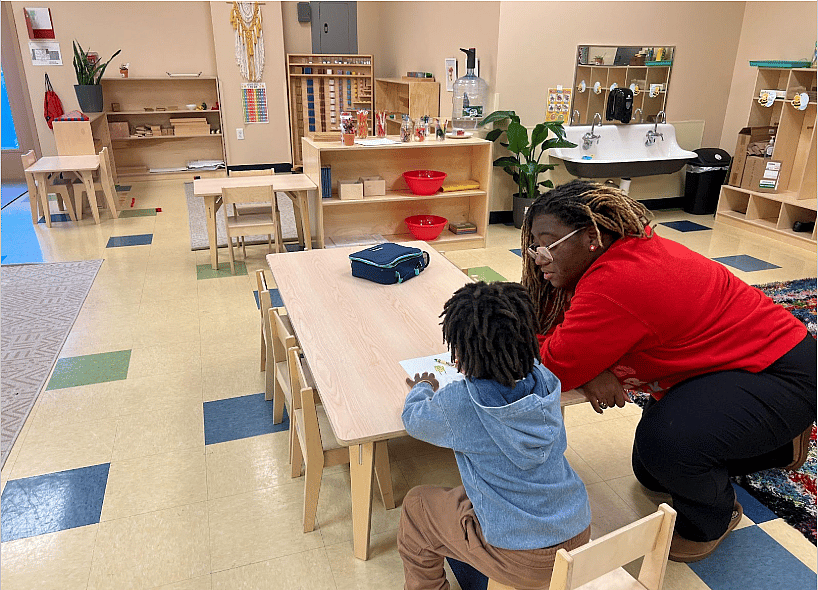
The afternoon sun peeked through the windows of the front entrance of the Honeypot Montessori school on Halsey Street in downtown Newark. It was just after 3:30 p.m., and three of the 10 enrolled kids were still waiting to be picked up.
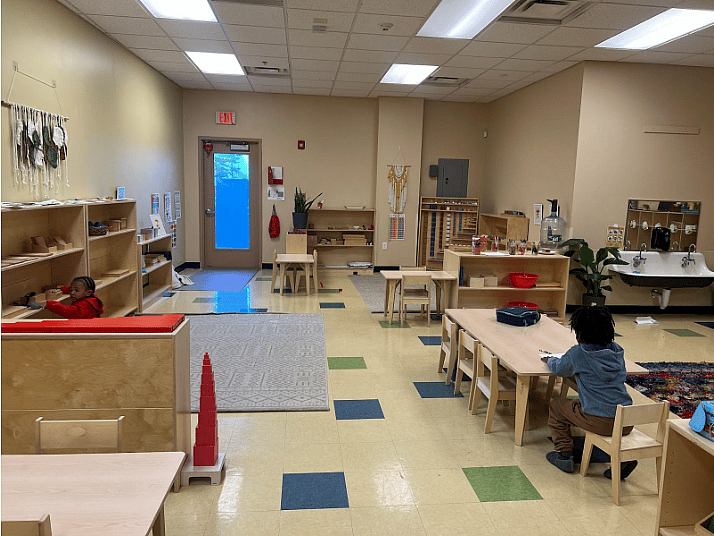
Toddlers were busy playing as the day wound down. One stacked wooden blocks on the carpet – another sat at the table, drawing, while another little girl opened up her markers to begin her masterpiece on a blank sheet of white paper. Soft music filled the air.
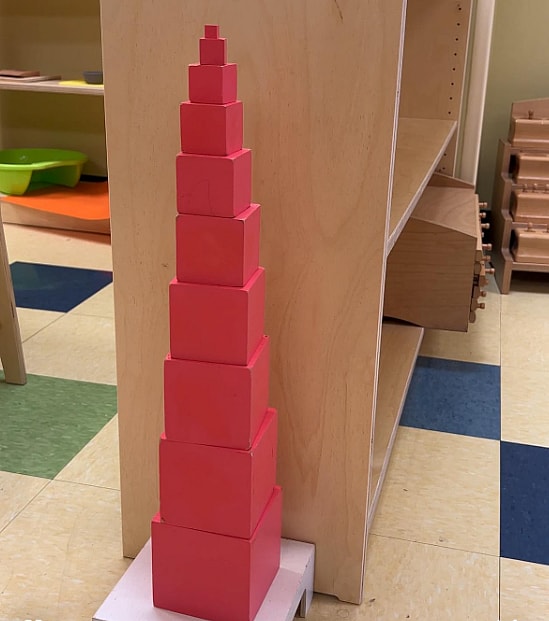
In one corner, on a shelf, were small terracotta pots of dirt with wooden popsicle sticks sticking out. These were the students’ plant projects. Another corner housed their math supplies opposite colorful drawers full of ‘sight words.’ Against one of the bookshelves stood the symbolic representation of an authentic Montessori education – the pink tower.
The Journey of Opening a Montessori School in an Urban City
More than 10 years ago, Dr. Deja Jones began a job combining her love of working with young people and teaching journalistic storytelling techniques. Jones pivoted into education after her experience working in an alternative school setting in Newark. “…around 2014, the literacy rate [of the school] started to decline. Rutgers University reached out to see if we would be interested in piloting a program where we [would] combine journalistic styles of writing with English literature to see if it would kind of boost interest and make learning fun for students while also helping with the literacy rates.”
Her first year of teaching was eye-opening. “My first year as a teacher was not what I expected. I came in, and reality smacked me in the face, fast and hard. I just realized how much policing goes on in schools. There’s a lack of autonomy for teachers in school. Teachers can’t bring their full selves into the classrooms because you have to follow so many different protocols,” Jones said.
As we sat in the small kindergarten-sized chairs in the empty, nature-focused classroom, Jones revealed that she approached teaching as a problem-solver, aiming to figure out how to improve the experience. “I think over the years of being a traditional school teacher, whether in public schools or charter schools, I’ve just always walked into a space, just kind of like, what can I do to make this better? How can this be better?”
Her experience working at a charter school exposed a harsh culture of feedback that impacted her confidence as a teacher. “I’ve always tried to do things differently in my classes. The last school I worked at was a charter school, and I just remember having my teacher’s license, having my master’s in education and credentials to be a teacher,” Jones said. “I just remember my time at the charter school feeling so incompetent and feeling like I was a terrible teacher because of that culture of feedback. The nitpicking of the joy and creativity out of you.” Jones said that harsh culture also transferred onto the kids, who were often unfairly scrutinized. “But I also saw that that’s something that the school did to children, too. We drilled the kids into compliance, where we take the joy and the fun out of learning.”
“One of my former colleagues at the charter school said I never followed the school’s disciplinary policy. She said maybe I should consider Montessori,” said Jones.

Officially Opening Honeypot Montessori in Newark
The Honeypot Montessori school is two and a half years old, with its current location having opened in September of 2025. Jones launched her Montessori concept as a pod in East Orange, N.J., right after the pandemic.
“We started our real estate search in 2021 in Newark. We were looking everywhere in Newark, old churches, community centers – we were even thinking about doing a house model. We were looking at storefronts, but everything we found required so much work. Either the churches were severely old and they were having a lot of environmental issues. And the community centers had really big [restrictions]. They would say we could use their community room, but at the end of the day, I need you to pack it all up and move your stuff into storage because we have other things going on here. That wasn’t feasible… we didn’t want to go forward with agreements like that.”
Eventually, Jones landed an event space in East Orange, where the owner gave her a deal. They allowed her and her business partner to operate their school Monday through Friday, requiring them to pack up their things on Friday night, and to unpack Monday mornings before school started.
“For them they saw it as a steady stream of revenue,” said Jones. “If we were to pay rent to operate Monday through Friday then they’d get their other revenue from the weekend events. It worked out but it was straining because we had to shut down every Friday to put our things into storage and then set up either every Sunday night or Monday morning before the kids came. We did that for two years.”
Despite the difficulties in securing a solid location, Jones was determined to make the Honeypot Montessori a permanent reality. “We took two years off after operating out of an event space. Me and my [business] partner parted ways… I knew that Honeypot was a dream I’d had since leaving the charter schools in Newark. I just knew that something had to be different for our kids, and I found that in Montessori for myself as an educator.”
Jones soon connected with local real estate agent, Melvin Sykes. The pair scoured Newark’s five wards in search of the perfect location. After looking at old banks and storefronts, they came across a childcare center that was going out of business on Halsey Street in downtown Newark.
“He brought me in here while [the childcare center] was still in operation and everything was set up as if they were operating. I came in, and I looked at it and was like, ‘Wow, this place doesn’t require any work.’ It was already licensed, and everything was set up.”
Why Newark
Montessori schools are traditionally viewed as an educational option for more affluent, suburban populations. It is rare to find one in an urban community, since socioeconomic status plays a huge part in affordability. Montessori schools are privately run, so tuition payments are the responsibility of the parents. For parents in Newark, Honeypot offers multiple options to accommodate the working-class population. Honeypot aspires to be an affordable option for parents. They accept Programs for Parents, follow the 333 equity model, and offer a sliding-scale payment option.
“We are a private school, so we are tuition-based, but we follow a 333 equity model. We reserve a third of our seats for low-income families, and they pay reduced tuition. We reserve one-third of our seats for middle-income families, and they follow a moderate scale. And we reserve a final third of our seats for the high-income families who pay the full tuition,” Jones explained.
In a study presented by the National Library of Medicine’s National Center for Biotechnology Information, students attending Montessori schools performed 25% higher academically. The study states, “On academic outcomes, Montessori students performed about 1/4 of a standard deviation better than students in traditional education.”
Parent Laverne Rivera credits her daughter’s improved speech to Honeypot. “Honeypot has reached every level of expectations that I have regarding education when it comes to my daughter,” Rivera said. “My daughter not only expresses herself but also speaks clearly and annunciates her words.”
Jones explained that eliminating the rigid structure presented by traditional learning environments was ideal for Honeypot, “I find that when you take away all of those different structures and systems, kids thrive because they feel like they’re in a place that values them as people. I like the slow burn of Montessori because it gives kids time to develop naturally with their natural rhythms.”
Jones continued, “I felt like we needed something like this because you know, typically in our communities we dehumanize children and we kind of treat them like robots that just need to comply and do what we instruct them to do. We don’t let them have a voice.”
