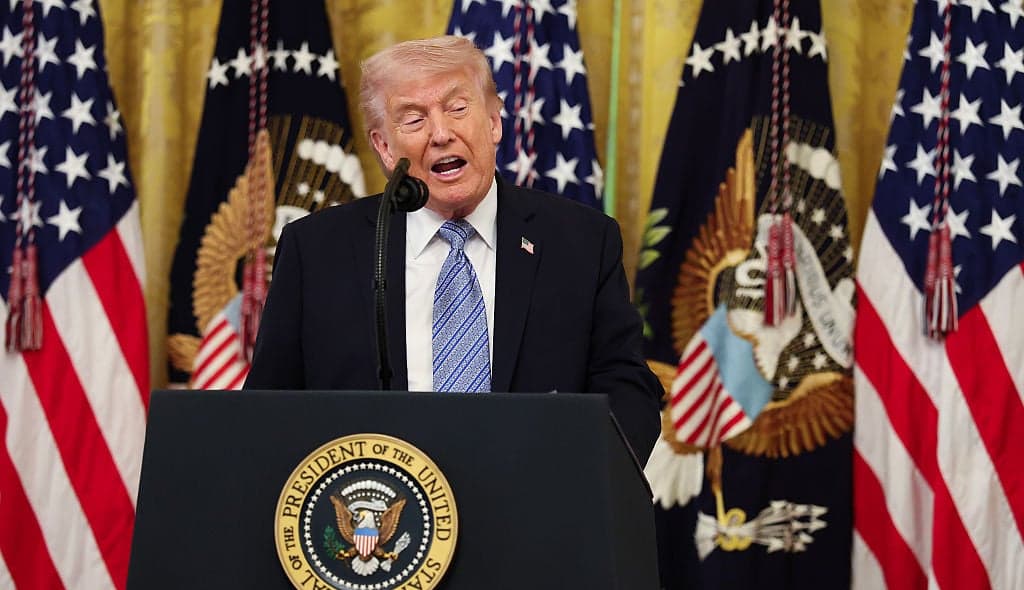
President Donald Trump gathered small business owners at the White House on Monday to kick off Small Business Week and tout what he said were his administration’s actions to bolster success for industries. But many of the actions highlighted by the president have had direct negative outcomes for Black businesses and households since he returned to office last year.
Trump celebrated the relatively low unemployment rate, which in January reached its lowest level since 1969. Standing at a podium inside the East Room, the president said, “More Americans are working today than at any time in the history of our country.”
A more accurate picture of the U.S. economy is complex nationally, and even more bleak for Black Americans. It is true that unemployment remains low at 4.3% and more people are working in America than ever before (because of population growth and not an increased employment rate), but the jobless rate does not account for the current affordability crisis in which even employed Americans, most especially Black Americans, are struggling to afford life necessities like health care and housing. And while the unemployment rate may be at a decades-long low, the Black unemployment rate is 7.1%, which is higher than it was during the global coronavirus pandemic at the end of 2021.
Trump bragged about his administration’s historic cuts to the federal government workforce, which, ironically, is a key driver for Black unemployment, given many of the jobs scrapped were held by Black workers related to diversity, equity, and inclusion or roles perceived as such. For decades, the federal government served as a major vehicle that expanded the Black middle class.
“We terminated a lot of federal jobs that are unnecessary, and they don’t like me for doing it,” Trump said at the Small Business Week event. “But a year later, they like me because they end up having a much better job.”
Despite Trump’s claims, reports reveal many federal workers laid off or pressured to accept buyouts by the administration struggle to find comparable work or any work at all.

As for Black businesses, while the president and Small Business Administrator Kelly Loeffler claimed the administration had issued record lending for small businesses, it has likely excluded Black-owned operators, whose businesses saw federal lending nearly double to record highs under the Biden-Harris administration. In line with its anti-DEI mandates, the Trump administration instead terminated programs, including contracting and federal grants, intended to diversify the Small Business Administration’s reach and services for Black-owned businesses.
Trump also signed an executive order to eliminate the Minority Business Development Agency (MBDA), which was established to close racial gaps in access to capital for businesses owned by Black and other disadvantaged operators.
“Measuring the full economic impact from these executive orders is difficult because the Trump administration did not just cut specific programs but rather shifted the entire regulatory structure that helped Black businesses compete,” says a report by the Joint Center for Political and Economic Studies.
Black businesses, which struggle to access capital and are often sole proprietors, have also taken a hit over the past year due to President Trump’s global tariffs on imported goods. According to the Joint Center, “The direct and indirect effect of these policy actions have been demonstrably harmful on Black business owners and a drag on Black entrepreneurship in 2025.”
While businesses saw relief in sight after the United States Supreme Court ruled Trump’s tariffs unconstitutional, he has already moved to enact new tariffs against importers under a different law used last year. This means that the high costs of doing business for Black owners will likely persist.
Trump also promoted $18 trillion investments in the U.S. from AI companies. Though that number is based on company pledges and cannot be verified, there remain concerns that the rapid growth of AI without regulatory measures will result in harm not just job displacement for Black workers but also environmental risks for Black communities.
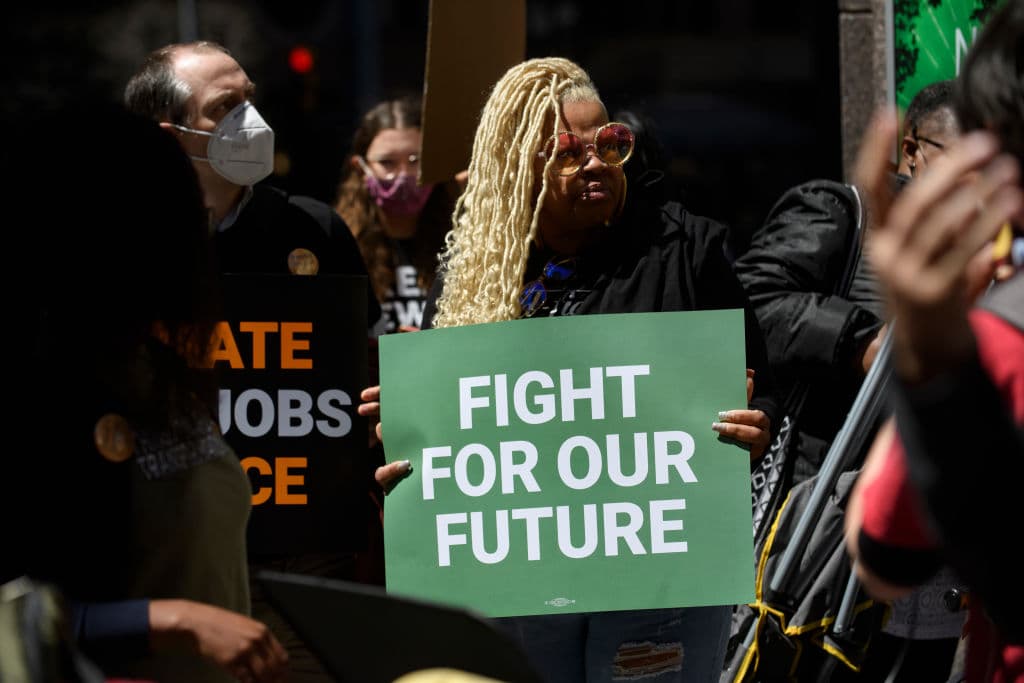
According to Forbes, “Data shows that Black people are overrepresented in the jobs most vulnerable to displacement by AI and automation, such as healthcare support, retail and administrative work.” The outlet cites National Science Foundation estimates of over 45 million U.S. jobs impacted by AI in three years, with “significant exposure in fields where Black workers are concentrated.”
Trump boasted, “We have [AI] plants being built all over the country.” However, tech companies are building data centers in mostly majority-Black and poor communities. This has become a major environmental justice touchpoint in cities like Memphis, Tenn., Southaven, Miss., and South Carolina’s Low Country.
TheGrio previously reported that the rise of unregulated data centers — paired with Trump’s environmental rollbacks and rising energy costs — has become the new frontier in the fight to protect Black communities from negative health and economic outcomes.
As for the state of American small businesses, including Black-owned businesses, economic challenges also remain as the U.S. continues to engage in war with Iran. Despite efforts to wrap up the military conflict, the war has extended for more than 60 days, resulting in the rise of oil, gas, and other goods that are shipped through the Strait of Hormuz, where U.S. and Iranian navy ships have engaged in an arms battle.
Trump said the costly military conflict has been “worth it” in order to deter nuclear proliferation by the Iranians, whom he called “lunatics” who want to “wipe out countries with the push of a button.”
“So I had to do it,” said the president.
