
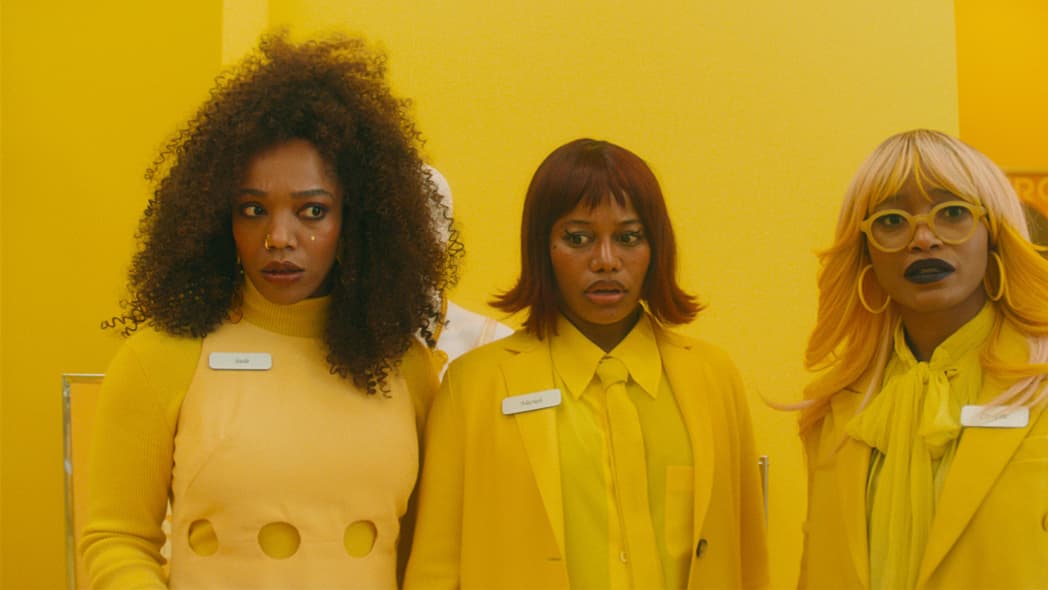
In “I Love Boosters,” survival—by-hook-or-crook—is in style.
The upcoming film from writer-director Boots Riley, arriving in theaters Friday, May 22, may have been conceived years ago, but it couldn’t feel more relevant, especially for Black women.
“It seems like it’s prescient, and it is, but it’s just because we always have the same system,” Boots told theGrio of the film’s urgency.
“Like a lot of my stuff, I’ve been talking about the same for a long time, and it is happening right now,” he continued. “But it’s just that, unfortunately, my work hasn’t been made irrelevant. And that’s the hope eventually.”
Starring Keke Palmer, Naomi Ackie, Taylour Paige, Poppy Liu, Eiza González, LaKeith Stanfield, and Demi Moore, “I Love Boosters” follows a chaotic but chic girl gang, dubbed the Velvet Gang, boosting luxury fashion in a world drenched in designer excess, vibrant, surreal absurdity, and desperation disguised as high glamour. As groceries, rent, gas, and everyday survival continue moving further out of reach for many Americans, particularly Black women facing layoffs and shrinking workplace opportunities at disproportionate rates, Riley transforms those anxieties into a campy, wild Black feminist fashion fantasia about survival and community.
Recalling a recent investigative report into an uptick in petty crime coverage in local media that may have been influenced by law enforcement, Boots said, “Even before all of that, these groups of women were being villainized. This group in society, boosters, were being villainized. And in actuality, you know, they are the line between Black folks and other communities of color who inspire fashion but can’t afford it, and so, they serve a purpose.”
Rather than framing its version of these women as cautionary tales or irredeemable criminals, “I Love Boosters” lets them be loud, messy, glamorous, reckless, hilarious, and deeply ambitious all at once. Palmer’s Corvette moves through the film’s surreal world with a genuine love of fashion, a relatable amount of anxiety, fast-talking charisma, and a determination that makes even the movie’s most chaotic moments feel seductive. Meanwhile, Ackie, Paige, Liu, and González build a girl gang dynamic that feels equal parts sisterhood and survival network, dressed in monochromatic neon hues like yellow, chartreuse, and aquamarine, and sporting what feels like an endless rotation of wigs.
“We’ve come out of an era where it was like, quite a big ‘girl boss’ energy, where it’s like, ‘I want it all. I wanna have it all, soft life.’ And those things are really valid. But anything that doesn’t include what community means and what it means for your wider circles, I think, is kind of, well, fruitless in the end,” Ackie told theGrio. “Ambition is amazing, but if you’re the only person on the mountaintop, it’s pretty lonely. I think the message of the film is about banding together and having those dreams, but thinking about how those dreams can service a wider community.”
Paige added that it’s about asking, “Who do you want to go with? When all is said and done who do you get to share it all with?”
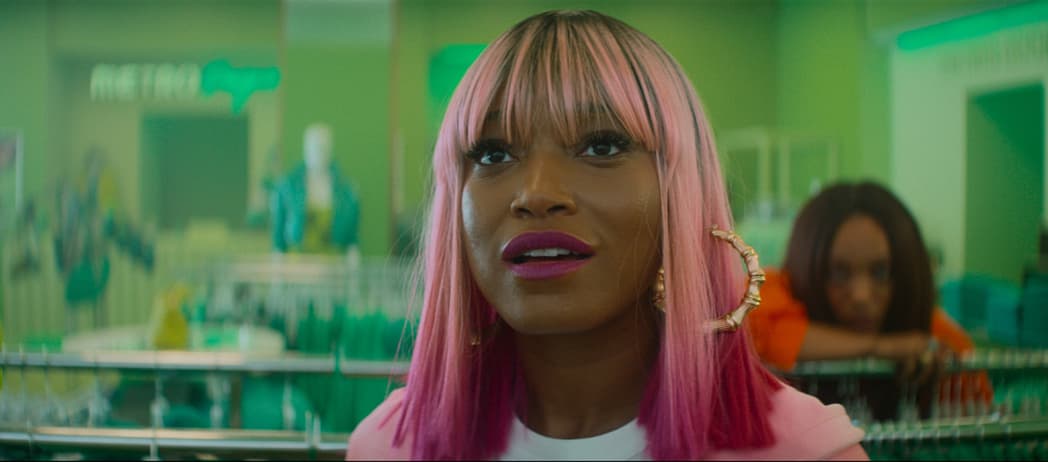
Throughout the film, luxury fashion operates as fantasy, armor, aspiration, and escape all at once. One moment feels like a glossy editorial spread, only for the next to spiral into something grotesque, absurd, or emotionally raw.
“I think a lot of their actual objectives and conflicts in their life are actually really real-world problems,” Liu explained. “Boots creates such an amazing heightened reality, surrealist world. But each of the girls in this film, what they’re dealing with is impossible rent, labor rights, and the ability to make ends meet.”
Piggybacking off that, González added, “It becomes a more relatable story in every sense.”
“You forget about the surrealism of it all, because you’re so connected with the root sensation of each of these women,” she said.
Like many of the worlds Riley creates, “I Love Boosters” eventually reveals something stranger lurking beneath all the fashion-maximalist surface. Stanfield’s mysterious character, Corvette’s love interest, introduces a darker, more unsettling energy into the story, one that pushes the film beyond fashion satire and into something more symbolic about greed, overconsumption, extraction, and survival itself.
“I thought that he stood for a symbol of connection between two people, once one becomes only fixated with what they need more so than what the other needs. And there’s an imbalance that happens there, and you can actually end up hurting people,” Stanfield explained.
As the film spirals toward its climax, the Velvet Gang ultimately finds itself swept into something much larger than boosting luxury fashion. Armed with a reality-altering teleporter device, the crew aids a global worker strike against exploitative fast-fashion mogul Christie Smith (Moore), turning the film into a frenetic, pro-labor takedown of the systems fueling overconsumption and worker exploitation in the first place.
And while Corvette spends much of the film insisting she wants “everything,” Riley ultimately reframes that desire into something more collective. In “I Love Boosters,” having the clothes, the style, the ambition, and the fantasy of a better life doesn’t have to come at the expense of other people. In the end, the film’s message is surprisingly hopeful: nobody is getting through these times alone.
