
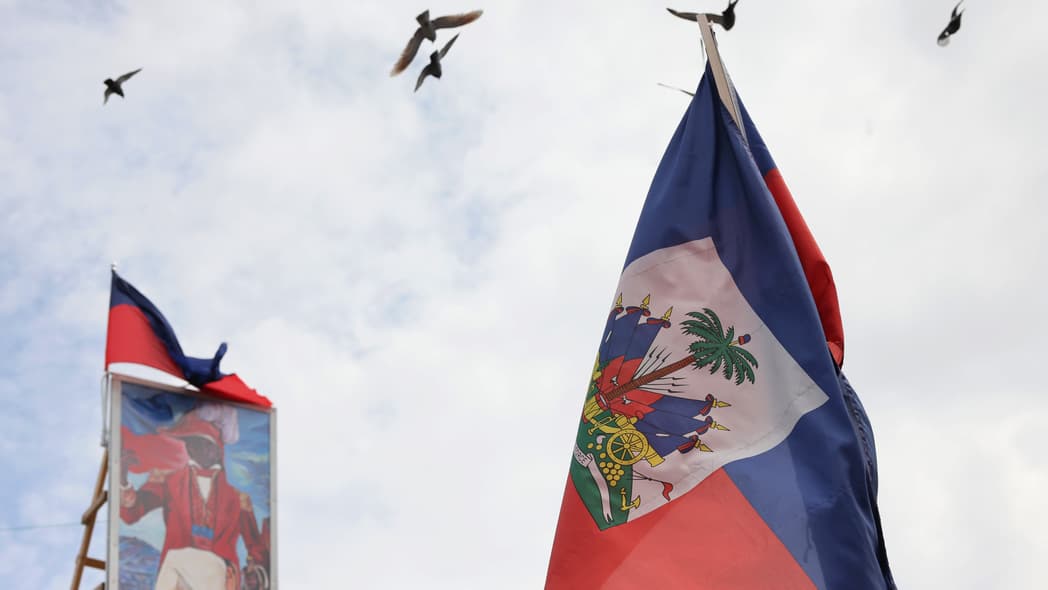
Every year on May 18th, and the days leading up to it, Haitian communities across the country host a variety of celebrations in honor of Haitian Flag Day. From parades to parties to concerts, the jubilees mark the day Jean-Jacques Dessalines ripped the white from the French flag, creating the first iteration of what would become the national flag of the first free Black republic.
If you live in a city with a large Haitian population, like Boston, Brooklyn, or Miami, this season can look like a surge of parties, with red and blue flags waving in the air as the beats and drums of Konpa, Raboday, and Rara reverberate through the streets. But for Haitians, this season represents so much more. In a world where headlines about Haiti often spotlight the country’s struggles, these celebrations feel like moments to showcase the beauty of Haitian culture. That’s not to dismiss the socio-political action needed to support the island, but just as every iteration of the Haitian flag represents the resilience and resistance that led to Haiti’s freedom, joy, too, is a form of resistance.
It’s a sentiment activist and author Monique Clesca knows well. “It’s not called Haitian Heritage Month for nothing, it is not really about, ‘oh, let me make a scarf, or a jacket with the flag.’ No, it is what happened,” Clesca told theGrio. “What did we fight for? What was it about? It really was about the fact that we are humans, and we demand that our human rights are respected. And I think that is the message that really has to be carried through now.”
For Clesca, that meant showcasing the joys of Haiti in her book “Silence and Resistance: Memoir of a Girlhood in Haiti.”
“I thought it was extremely important to show the Haiti that I knew, the Haiti that still exists, but that we don’t talk about, because we’re always talking about there is a kind of narrative that [Haiti’s not good],” she explained. “I really wanted people to feel, to smell, you know, and to hear what I heard, and what I smelled, and what I saw when I was growing up, and to show that Haiti, you know, the physical beauty of the land and the physical beauty of the people needed to carry that, because there was, there is so much pride. I love being Haitian, and I wanted to transmit that, and I wanted to transmit the root of that love.”
Through the years, Haiti has seen multiple iterations of its national flag. From blue and red to red and black, each iteration of the flag carried a very specific meaning. It all began on May 18, 1803, at the Congress of Arcahaie, when Dessalines took a French tricolor and ripped out the white center, a direct rejection of colonial rule, and handed the remaining blue and red bands to his goddaughter, Catherine Flon, to sew together.
Blue represented Haiti’s African residents while red represented those of mixed European and African descent, two communities united in the fight for freedom. After Dessalines declared himself Emperor in 1804, he adopted a new flag featuring two vertical bands: black for Death and red for Freedom. When he was assassinated in 1806, his successor, Alexandre Pétion, brought back blue and red, this time in horizontal bands, and added the coat of arms and the motto “L’Union fait la Force” (Unity Makes Strength).
The blue-red flag flew for years, until 1811, when General Henri Christophe declared himself as king. The self-proclaimed monarch changed the flag’s color back to red and black, featuring a shield with a phoenix under gold five-pointed stars, all on a blue background; the shield bears a crown and the Latin inscription ‘Ex Cineribus Nascitur’ (From the ashes we will arise).
Although the country did have a few other iterations between 1822 and 1849, the flag that flew during the Duvalier era was particularly prominent. In 1957, François “Papa Doc” Duvalier came to power, marking the beginning of what many remember as a particularly violent time in Haiti. In 1964, Duvalier, who had named himself president for life, restored the flag to black and red, a nod to what he called a “black revolution.”
It was not until after his son, Jean-Claude “Baby Doc” Duvalier, was forced to flee the country in 1986 that the current blue-and-red flag was reestablished. Today’s flag features the same blue and red horizontal bands, with a white center panel bearing the coat of arms, a palm tree topped by the Liberty Cap, flanked by cannons and rifles, all set against the nation’s enduring motto, “L’Union fait la force.” Every stitch, every color shift, every redesign is a reflection of Haitian history, the many elements that make up who Haitians are, and the many struggles the nation has endured to obtain and maintain its freedom.
“I think the biggest misconception is that Haiti is poor, and I think Haiti is one of the richest countries,” Clesca shared. “Haiti, in terms of its geography, is an absolutely mesmerizing country, and then the dancing, the songs, the theater of everyday, the humor that we have, despite sometimes economic problems, but you find the humor that people have. Haitians are winning prizes for their books, for their music, for their plays, you know, because we have that inside of us, so to me, that is the biggest misconception. People say it’s poor, no, economically I say that our leaders have impoverished us, but Haitians, with the geography that we have, with the history that we have, with the storytelling skills that we have, I believe we are culturally and geographically one of the richest countries and people in the world.”
So today, when you see Haitians proudly waving their flag, understand that behind every post and every celebratory cheer is something that can’t be reduced to a party or a parade. It is the memory of Catherine Flon’s hands sewing blue and red together in an act of defiance. It is the weight of ancestors who fought, bled, and won freedom that the world tried to take back. It is the grandmother who carried the island with her when she came to America with nothing but hope, the first-generation kid who learned what it meant to be Haitian not in a classroom but in the smell of diri ak djon djon and the sound of Konpa filling a living room on a Saturday afternoon.
It is a complicated pride that holds grief and glory in the same hand. A love for an island that has been misrepresented, underestimated, and exploited, yet continues to produce people of breathtaking beauty, brilliance, and resilience. And beneath all the celebration, an unwavering, unspoken prayer: that one day, the Haiti the world sees in the headlines will finally match the Haiti that Haitians have always known.
