
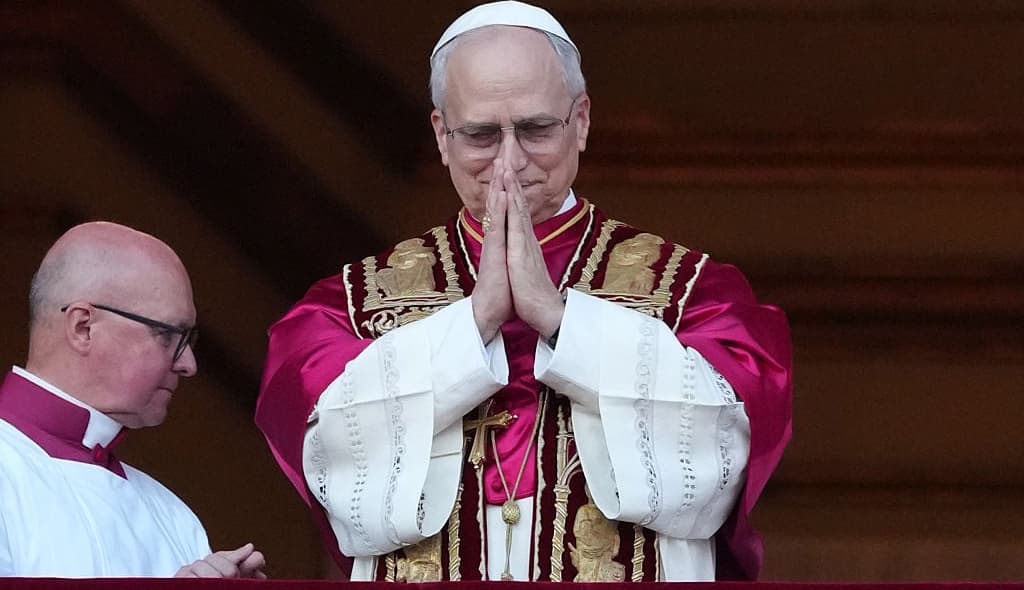
Pope Leo XIV is making history with an apology that goes further than past papal statements on slavery.
The pope apologized Monday for the Vatican’s role in legitimizing slavery and for the Catholic Church’s failure to condemn it for centuries. Leo called that record a “wound in Christian memory,” ABC News reported.
The apology appeared in Leo’s first encyclical, “Magnifica Humanitas,” or “Magnificent Humanity,” a broader document focused on protecting human dignity in an era increasingly shaped by artificial intelligence. But inside that warning about modern exploitation, Leo confronted one of the Catholic Church’s most painful historical chapters: the way past popes helped give European rulers religious authority to subjugate and enslave people described at the time as “infidels.”
“It is impossible not to feel deep sorrow when contemplating the immense suffering and humiliation endured by so many in stark contrast to their immeasurable dignity as persons infinitely loved by the Lord,” Leo wrote. “For this, in the name of the Church, I sincerely ask for pardon.”
The statement is historic because past popes have apologized for Christians’ involvement in the trans-Atlantic slave trade. But according to the Associated Press, no pope had publicly acknowledged and apologized for the role past popes themselves played in giving European sovereigns explicit authority to enslave non-Christians.
That distinction matters. This is not only about individual Christians participating in slavery. Leo’s apology addresses the Holy See, the central governing authority of the Catholic Church, and how its institutional power helped give religious cover to slavery during the colonial era.
ABC News reported that 15th-century papal directives authorized Portuguese sovereigns to conquer parts of Africa and the Americas and enslave non-Christians. In 1452, Pope Nicholas V issued “Dum Diversas,” a papal bull that gave Portugal’s king and his successors the right to “invade, conquer, fight and subjugate” certain non-Christian peoples and take their possessions. The directive also allowed them “to reduce their persons to perpetual slavery.”
Another papal bull, “Romanus Pontifex,” followed in 1455. Together, the two documents helped form the basis of the Doctrine of Discovery, the legal and religious theory used to justify European colonial land seizure in Africa and the Americas.
The Vatican formally repudiated the Doctrine of Discovery in 2023. However, ABC News noted that the Vatican has never formally rescinded, abrogated or rejected the papal bulls themselves.
In his encyclical, Leo acknowledged that the Apostolic See of Rome had intervened “to regulate and legitimize forms of subjugation” and, in some cases, the enslavement of “infidels.”
He also said the Church’s condemnation came far too late.
“It took eighteen centuries for its full incompatibility with slavery to be explicitly recognized,” Leo wrote.
Leo, the first U.S.-born pope, also has a personal connection to this history. According to genealogical research published by Henry Louis Gates Jr., AP reported that Leo’s family tree includes both enslaved people and slaveholders.
The pope connected the Church’s past failures to modern forms of exploitation, including human trafficking, forced labor and labor connected to the rare minerals needed for AI chips. He warned that if the Church does not condemn today’s forms of exploitation clearly, it may again have to ask for pardon in the future.
For many Black Catholics and descendants of enslaved Africans, the apology may land as both historic and unfinished. The words matter. But so does what comes next, especially when the Vatican has acknowledged the harm while still not formally revoking the papal documents that helped justify it.
