
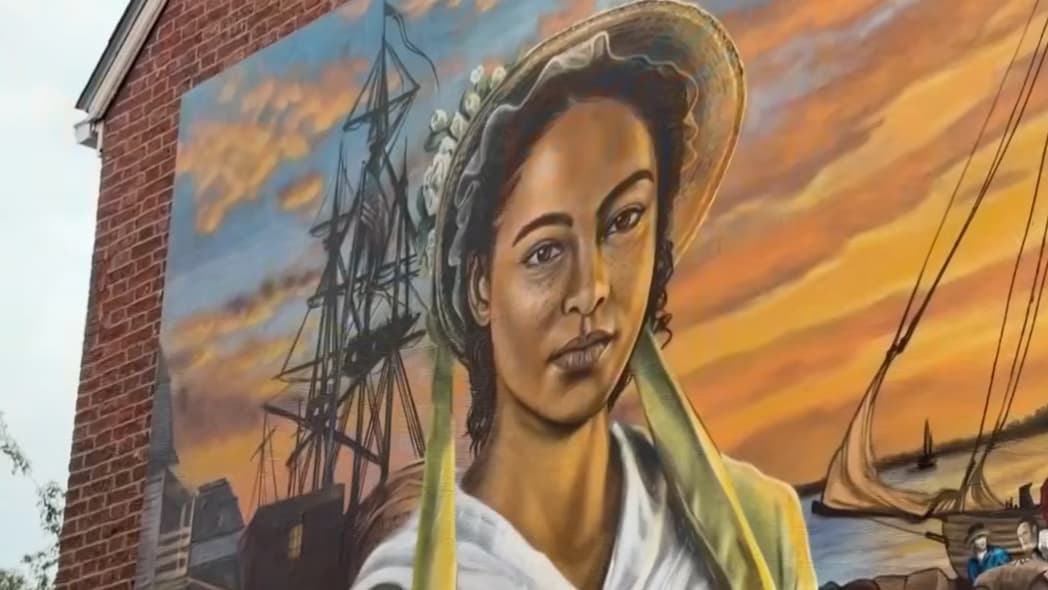
230 years ago, in 1796, Ona Judge Staines, a young woman enslaved by President George Washington and his wife, Martha, escaped the presidential household in Philadelphia and fled to Portsmouth, New Hampshire. Yet despite risking everything, including the wrath of the most powerful man in America for freedom, it was as if she slipped away and then slipped into obscurity. That is, until now.
On Saturday, May 23, to commemorate the 230-year anniversary of her daring escape, the Black Heritage Trail of New Hampshire unveiled a mural of Staines on the wall of its headquarters.
The mural, created by artist Manuel Ramirez as part of a larger local “History Through Art” initiative, depicts the historical figure as much of history remembers her: a lighter-skinned, freckled-faced, multiracial Black woman in a green dress with a white apron and straw hat trimmed with green ribbon, standing at the port with the life she fled lingering in the background.
“At a time when stories of struggle and freedom are being erased, New Hampshire is choosing something different: to make the quest for freedom visible, permanent, and undeniable,” the organization said in a release.
The mural unveiling comes as the Trump administration has made aggressive attempts to strip discussions of slavery, race, and systemic oppression from federal sites and institutions, including exhibits connected to Staines at Philadelphia’s President’s House site. More than 230 years after escaping George Washington, the enslaved woman who defied the most powerful man in America is again challenging the country’s sanitized version of itself, forcing her story — and the contradictions at the center of the nation’s founding — back into public view at a moment when many fear this history is actively being erased.
Born around 1773 to an enslaved woman named Betty and a white indentured servant hired by Washington, Staines grew up at Mount Vernon before eventually becoming a personal attendant to Martha. By the standards of the Washington household, she occupied a privileged position inside the home, something that reportedly made the family all the more stunned when she escaped at just 22 years old while the presidential family lived in Philadelphia. History claims that, after arriving in Philly and making connections among the colored populations and Quaker movements, she slipped out one evening while they were having dinner.
According to historians, Washington became incensed after her escape and made repeated efforts throughout his life to retrieve her. Staines, however, refused to return. She eventually settled in Portsmouth, where she married a free Black sailor named John Staines, raised a family, and later gave interviews to abolitionist newspapers recounting her escape and explaining why she chose freedom over the supposed comfort of the Washington household.
An interviewer who happened to speak with her before her death in 1848 recorded: “When asked if she is not sorry she left Washington, as she has labored so much harder since, than before, her reply is, ‘No, I am free, and have, I trust been made a child of God by the means.’” You can learn more about her story and Washington’s pursuit of her in the book “Never Caught” by Erica Armstrong Dunbar.
Her legacy continues to resonate because Staines’ life directly conflicts with the carefully polished narratives often attached to Washington’s legacy. (Bad news about those so-called wooden teeth!) Even in her own time, she fought to have her version of events recorded publicly. Now, more than two centuries later, the continued effort to preserve and elevate her story runs parallel to that same struggle. Honoring Staines this way during a time such as this quite literally challenges the way America attempts to remember itself. She was real, while the idea that George Washington didn’t own slaves is not. Her story and the story of the millions of others who were enslaved and who built this country are real.
That effort to immortalize her recently intensified in Philadelphia as well, where May 21 was officially declared Ona Judge Day. On Thursday, advocates and elected officials gathered at the President’s House historic site for a rally after exhibits about Staines and other enslaved people connected to the site became targets of the Trump administration’s larger effort to remove historical material from federal properties deemed “disparaging” to Americans.
Participants, per AP News, chanted, “Tell the truth! Restore our history!”
One of the restored panels features Staines, while a series of bronze footprints embedded in the sidewalk symbolize her escape to freedom.
Dawn Chavous, a volunteer for the Avenging the Ancestors Coalition, told AP News, “You can’t love America without knowing the good, the bad, and the ugly.”
