
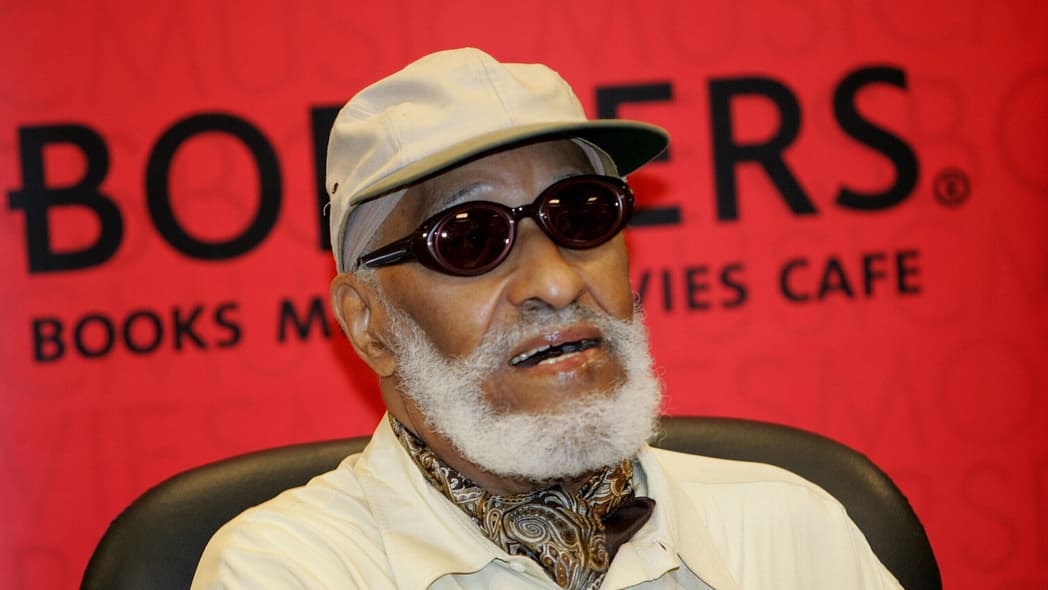
Sonny Rollins, the tenor saxophonist widely considered America’s greatest living jazz musician and the last of the bebop era’s true giants, has died. He was 95.
His publicist, Terri Hinte, confirmed that Rollins died Monday at his home in Woodstock, New York. No specific cause of death was given, though Rollins had been largely housebound for the past two years due to various physical problems, including pulmonary fibrosis. As theGrio previously reported, the jazz world has been losing its foundational voices, including Roberta Flack, who died in February 2025 at 88, and several other pillars of Black music, including Roy Ayers and Sly Stone, also departed in 2025. People, citing the Associated Press, reported that Sonny Rollins dying leaves jazz without one of its most singular and restless voices.
Born September 7, 1930, in New York City, Rollins grew up in Harlem’s Sugar Hill district, where jazz legends were neighbors. He was drawn early to the bebop experimentation developing around him and by his late teens had already been invited to play with Thelonious Monk. He went on to record with Miles Davis, Charlie Parker, Bud Powell, Clifford Brown and Max Roach before breaking through as a leader in 1956 with “Saxophone Colossus,” the album that gave him his lasting nickname. That same year, he and John Coltrane recorded “Tenor Madness,” a side-by-side showdown that became one of the most celebrated recordings in jazz history.
His compositions, including “St. Thomas,” “Oleo,” “Doxy” and “Airegin,” became jazz standards played the world over. In 1958, he recorded “Freedom Suite,” a 19-minute suite explicitly dedicated to the Black American experience, with liner notes that read: “America is deeply rooted in Negro culture: its colloquialisms, its humor, its music.”
When Rollins felt he had reached his creative ceiling in the late 1950s, he took a self-imposed sabbatical from recording and performing. He spent it practicing on the Williamsburg Bridge in New York, the open air giving him the space his apartment walls couldn’t. When he came back, the music was different. He never stopped searching. He maintained a rigorous practice regimen and continued to tour into his 80s. His last concert was in 2012. He stopped playing altogether in 2014, when pulmonary fibrosis made it impossible.
Rock fans encountered his sound when the Rolling Stones included his wistful saxophone on “Waiting on a Friend” from their 1981 album “Tattoo You.” Four days after the September 11 attacks, Rollins, who had been evacuated from his apartment blocks from Ground Zero, performed a concert in Boston at his wife and manager Lucille’s urging. She died in 2004.
The news that Sonny Rollins dies at 95 marks the end of a living connection to bebop’s founding generation. He is survived by his nephew, Clifton Anderson, and nieces Vallyn Anderson and Gabrielle DeGroat. He received the Kennedy Center Honor, the National Medal of Arts, the NEA Jazz Master designation, and multiple Grammy Awards.
