
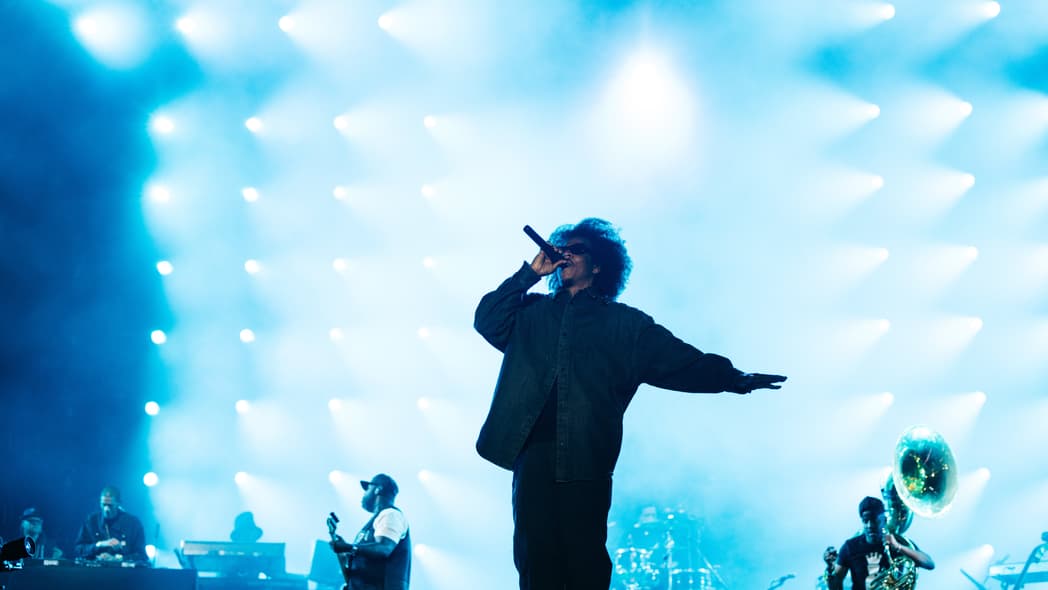
Before Jay-Z uttered a single lyric at the 2026 Roots Picnic, he’d already said everything.
On Saturday, May 30, Hov took the stage at Philadelphia’s Belmont Plateau for his first solo performance since 2019. Dressed in all black, signature shades in place, he walked out to a roaring crowd, and while the surprise freestyle and special guests delivered, it was his hair that stopped people mid-scroll. The freeform locs he’d been growing since around the release of “4:44” in 2017, which had quietly become as iconic as his catalog, were gone. In their place: a full, free afro.
So as social media users reacted to the 56-year-old’s bars, many also couldn’t stop talking about his hair. Over the years, Jay-Z’s hair has been a topic of conversation, particularly as he grew it from a low Caesar cut to a low fro to freeform locs. As it took on various shapes and styles, Jay-Z’s hair became a quiet part of his artistry. As he recalled his daughter, Blue Ivy Carter, saying: “‘No, Dad, you can’t cut your hair. It’s part of who you are.’”
From the low cut to the various fros to the locs, Jay-Z’s natural hair journey has illuminated something the mainstream rarely holds space for: the full, expansive range of Black men’s hair. In a culture that still tries to sort Black hairstyles into columns labeled professional or unprofessional, acceptable or threatening, Black men are often expected to pick a lane and stay in it. Hov never did. Instead, the “Dead Presidents” rapper has proved that the strands that loc, twist, braid, shrink to half their actual length when dry, and expand to something enormous when wet are also the same strands that, given time and intentionality, can transition from one identity entirely to another. Because ultimately, Black hair has and will never be one thing. Sometimes it reflects a continuous conversation between a person and their hair, one that changes as they change.
Jay-Z’s afro, full and present above a man who has been making music for over thirty years, is also a meditation on time. Just as it took time for his locs to form—and then reportedly took four days and four bottles of Cécred’s detangling spray for his loc technician, Marie Munoz of @houstonlocs, to comb out the locs he took years forming—there is something about a man in his mid-fifties stepping into an afro that feels like a form of reclamation. Like a return to something before the industry, before the mythology, before the empire.
The afro has always had that quality; it strips away the performed and returns the wearer to something essential. It was Marcus Garvey who famously encouraged Black communities to “‘remove the kinks from their mind, not their hair,” and in the 1960s and 1970s, afros both large and small became staples in Black culture, becoming both a political and fashion statement among Black Americans. So while some people may try to rebrand Black hairstyles with ridiculous terms like “cloud bob,” or “boxer braids,” Black communities understand the powerful stories that transcend aesthetics when it comes to Black hair.
So for anyone who has ever sat in a kitchen while somebody worked a comb through their hair, or watched a loc slowly form, or meticulously tied on a durag to protect their waves, or worn a pick in their back pocket as a quiet act of pride, these chapters of Jay-Z letting his hair show up on its terms read like something deeply, beautifully, and unapologetically Black.
