
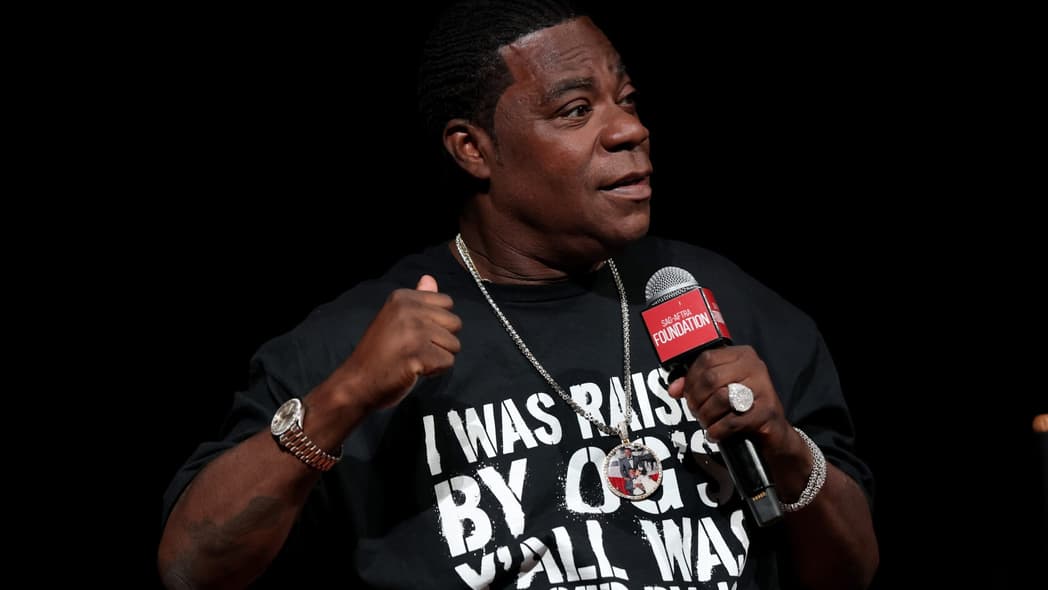
As the school year winds down across the country, Tracy Morgan has ignited a debate among teachers.
During a recent sitdown with “Saturday Night Live” star Marcello Hernández for Variety magazine, the 57-year-old comedian admitted he doesn’t like teachers. The topic arose when Hernández explained that he now appreciates getting paid for mischief, after spending much of his school years being labeled mischievous.
“No, they didn’t understand you,” Morgan said. “You had a sense of humor, and they couldn’t control that. God gave that to you.”
When Hernández said, “And now look, I’m getting paid for mischief,” Morgan was quick to add, “And they still making minimum wage. You know how much them teachers are probably making right now?”
As Hernández chimed in with “not enough,” Morgan declared, “I can’t stand teachers; you know why? Because they have a ceiling, they have a limit. That’s all they ever gonna be, man. I teach my kids sky’s the limit.”
Since clips of the conversation began circulating on social media, many educators and advocates have weighed in as backlash around Morgan’s comments continues to grow. While some have expressed offense and disappointment over what they view as a sweeping generalization about teachers, others say they hear something deeper beneath his words.
“I heard a lot of trauma in Marcello Hernandez & Tracy Morgan’s depiction of teachers. It’s heart breaking and reminds me that I didn’t have the average Black kid’s education,” a user under the handle @jamrenaissance wrote on Threads.
Another user, @marynetra, added, “[I’m] surprised at the teachers not understanding which teachers Tracy Morgan was talking about. They be smart as hell, (and) know their stuff but [have] an extremely limited pedagogy tool box. They couldn’t reach the class clown or emo artist in the back or roll their eyes at the drama queen… they make childrens learning experience real difficult trying to get them to learn the only way they know how to teach.”
The conversation has also tapped into a much larger reality about the complicated relationship Black children have historically had with the American education system. Black students have navigated an education system shaped by segregation, unequal resources, and racial disparities for generations. While Brown v. Board of Education formally ended school segregation in 1954, according to educators and advocates, it pushed a lot of Black educators out of the system. Researchers continue to examine issues ranging from racial bias in school discipline and discriminatory hair and dress codes to disparities in funding, culturally limited curricula, and the very real school-to-prison pipeline.
“I don’t agree with Tracy Morgan. Teachers are very important and are undervalued,” one user, @real_dl2.0, began in a post on Threads. “We do need to keep it real though, the school-to-prison pipeline doesn’t happen without contribution by teachers. For those lucky enough to have good teachers kudos to them. Bad teachers make or break how a student feels about education. The regressive public school funding doesn’t help at all.”
Another user, @janelle_ntim, said teachers were some of her first bullies.
“Growing up some of my worst bullies were my teachers. It wasn’t one teacher, it was multiple. I remember in 7th grade we were reading ‘The Watsons Go to Birmingham.’ Mrs. Humble told me I was wrong in front of the class about the older brother Byron relaxing his hair or otherwise called getting a perm. I used the word perm which she only attributed to getting a perm as a white person. I was right. The thirteen-year-old Byron secretly gets a chemical process B.K.A. a ‘conk’ to straighten his hair,” she wrote.
The debate extends beyond race as well. Children with learning disabilities, mental health challenges, physical conditions, and undiagnosed neurodivergence often experience school differently than their peers. Many adults now look back on childhood experiences where teachers labeled them disruptive, inattentive, lazy, or difficult before anyone recognized ADHD or another condition. Those experiences can leave lasting impressions long after students leave the classroom.
Several commenters shared stories about feeling misunderstood, mislabeled, or isolated during their school years. For some, Morgan’s comments landed less as a criticism of teachers and more as an acknowledgment of how difficult it can be to grow up as the child who does not fit neatly into traditional classroom expectations. Many entertainers have shared similar stories throughout their careers, describing how adults often viewed the traits that later fueled their success as problems to be corrected.
Or, as one user on Threads, @troubleoh7, put it, “Some people succeed because of education – Some succeed despite their education. Tracy Morgan didn’t graduate high school. Not because he’s not capable. His teachers weren’t qualified to nurture his unique abilities. His teachers probably put him down and made him feel less-than.”
At the same time, teachers are not a monolith. While Morgan’s comments have prompted important conversations about the ways traditional schooling does not always support every student equally, many still argue that those discussions should not come at the expense of broadly condemning an entire profession. Teachers continue to navigate overcrowded classrooms, limited resources, political scrutiny, and stagnant pay while serving students with increasingly diverse needs. Many advocates also point to the number of Black educators who have left or been pushed out of the profession despite the impact they can have on Black students.
“These teachers are barely making it, especially support staff paraprofessionals like myself. We do ALL the things and more,” one user, @queenshermear shared. “They call us the backbone to the classroom yet just as disrespected and overlooked. We struggle especially when we’re off payroll like now during the summer. We hustle, grind and still show up for other people’s kids when they don’t show up themselves. Sorry, Mr. Tracy Morgan someone hurt your feelings, or you felt misunderstood. We get it. I understand too well.”
