
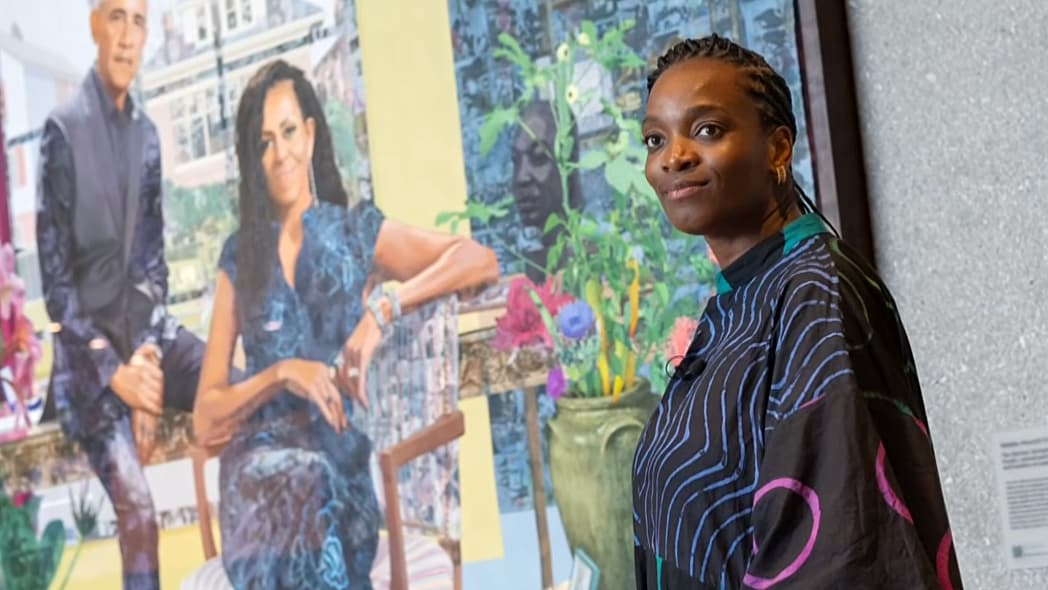
Barack and Michelle Obama just added another milestone to their shared legacy, and this time it’s hanging on the wall.
During a special ceremony on Sunday, June 14, at the Barack Obama Presidential Center in Chicago, ahead of its grand opening on Friday, Juneteenth, the former first couple unveiled their first official portrait together, a sweeping mixed-media work by acclaimed Nigerian-born artist Njideka Akunyili Crosby.
“You know how long I’ve been wanting this woman to do something with and for me?!” Michelle gushed as she remarked how beautiful she found it in clips from the event.
Njideka Akunyili Crosby replied, “It was an honor.”
The work, which will be on view in the museum’s lobby, depicts the couple in an office setting, overlooking a sweeping window filled with greenery and the outline of a home. True to Akunyili Crosby’s richly layered style, the portrait is jam-packed with intimate references to the Obamas’ life together, blending the personal with the historic. A bookshelf lined with family photos, keepsakes, books, and the couple’s four Grammy Awards sits alongside nods to Michelle’s childhood home on Chicago’s South Side, Stevie Wonder’s “Talking Book” album, and the Martin Luther King Jr. bust that stood in the Oval Office during the Obama administration. The artist also incorporated several of the charms gifted to Barack Obama by constituents over the years, many of which he carried with him throughout his presidency.
To prepare for the commission, she said she immersed herself in the Obamas’ story, reading books, listening to interviews, and studying their public lives to capture their essence through her signature blend of paint, charcoal, textiles, photographs, magazine clippings, and more.
“I wanted to make decisions that tapped into those memories, so when you saw this, it felt familiar,” she explained.
Barack teased that his only real question was “How come you didn’t dye my hair?”
Few other contemporary artists are as well-positioned to tell a story about identity, memory, and belonging as Akunyili Crosby. The Nigerian-born, Los Angeles-based artist has built an international reputation through richly layered works that explore migration, family, and the complexities of Black life across continents. Her paintings have appeared in museums and galleries around the world, while public installations of her work can be found from San Francisco to Philadelphia.
Her selection to create the Obama Presidential Center’s first official portrait feels all the more fitting for an artist whose work has long examined the ways personal histories become part of a larger cultural legacy. As the portrait continues to draw renewed attention to her work, here’s what to know about the acclaimed artist behind it.
Who is Njideka Akunyili Crosby?
Akunyili Crosby was born in Enugu, Nigeria, in 1983 and spent her early years between Enugu and Lagos before moving to the United States at age 16. Her mother taught pharmacology at the University of Nigeria, while her father worked at the University of Nigeria Teaching Hospital.
After arriving in the U.S., she attended the Community College of Philadelphia before earning a bachelor’s degree in biology and art from Swarthmore College. She later completed a post-baccalaureate certificate at the Pennsylvania Academy of the Fine Arts and earned an MFA from Yale University in 2011.
In the years since, she has become one of the most celebrated artists of her generation. In 2017, she received a MacArthur Fellowship, often referred to as the “genius grant,” and has earned recognition from institutions around the world. She now lives in Los Angeles with her husband, fellow artist Justin Crosby, and their two children.
How did she develop her signature style?
Over the years, Akunyili Crosby has developed a visual language that blends painting, drawing, photography, and image transfers into richly layered figurative works. Drawing from both Western art traditions and Nigerian pop culture, her paintings often reflect the experience of living between worlds.
The foundation for that approach, she told the Brooklyn Rail, emerged after she returned to Nigeria in 2004. The country she encountered felt transformed from the one she had left as a teenager. Nollywood was booming, Nigerian music was expanding its global reach, and a new generation of creatives was reshaping the country’s cultural landscape.
Inspired by what she was witnessing, she began collecting photographs, magazines, advertisements, and personal snapshots that would eventually become the image archive she still draws from today. Through acetone transfers, she embeds those images directly into her paintings, creating works that layer personal memory with cultural and historical references.
What themes define her work?
Akunyili Crosby’s work is perhaps best known for elevating the beauty and complexity of everyday Black life. Many of her paintings depict familiar scenes such as couples sharing a conversation, family gatherings, friends relaxing at home, or individuals sitting quietly in reflection. But beneath those seemingly ordinary moments are layers of imagery drawn from Nigerian politics, popular culture, fashion, advertising, and personal archives.
Her domestic interiors become spaces where migration, identity, memory, and cultural inheritance collide. By weaving together photographs, transferred images, patterned textiles, and painted figures, she creates visual records of what it means to navigate multiple cultures at once.
The result is work that celebrates Black life while exploring how personal histories are shaped by larger political and cultural forces.
What are her views on depicting Black life and identity?
Throughout her career, Akunyili Crosby has spoken about the importance of telling stories from an African perspective. Her work is informed by the belief that people should have the opportunity to represent themselves rather than be defined by outside narratives. Instead of focusing on spectacle or stereotypes, she centers the intimacy, elegance, and complexity of everyday life. Through portraits, domestic scenes and layered cultural references, her paintings offer a vision of Black life that feels deeply personal while speaking to broader conversations about identity, belonging and diaspora.
Why was she chosen to paint the Obamas’ portrait?
In many ways, Akunyili Crosby’s work aligns naturally with the story the Obamas have spent decades telling about themselves and the country. Her paintings frequently explore questions of identity, heritage, family, and community while examining how personal experiences become part of a larger historical narrative. Those same themes have defined much of Barack and Michelle Obama’s public legacy.
Rather than creating a traditional presidential portrait, Akunyili Crosby approached the commission as an opportunity to tell a broader story within a story. Through layered imagery and symbolism, the work situates the former first couple within the family, memories, and experiences that shaped them. It also cements how complementary they are as a pair.
The result is a portrait that honors not only who the Obamas are, but also the legacy they have built together—gray hairs and all!
