
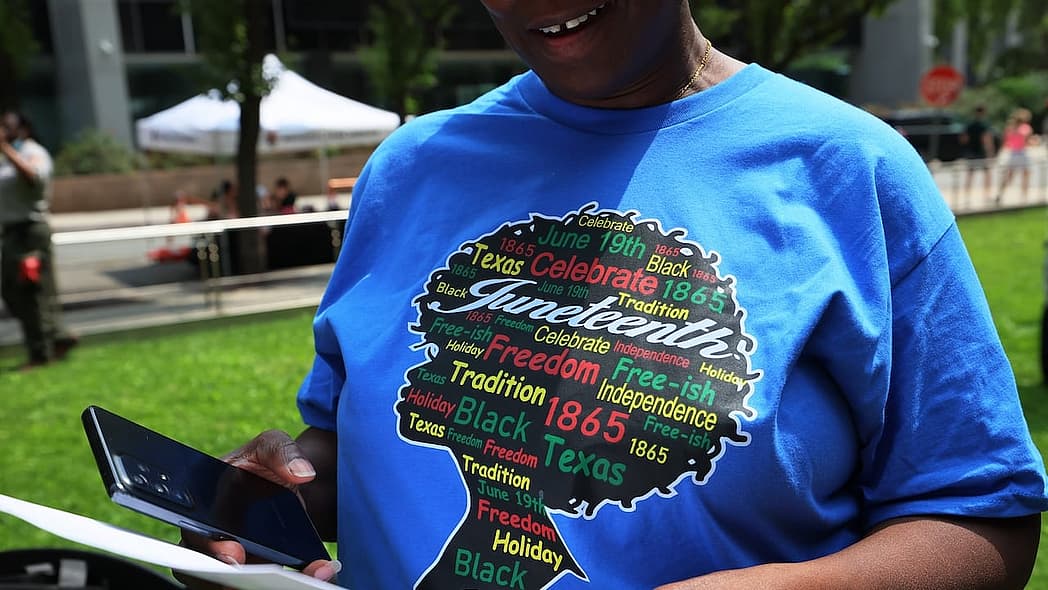
Juneteenth is a celebration of Black freedom, of formerly enslaved Black Texans learning of their freedom two years after the Emancipation Proclamation. Since 2021, it has been a federal holiday, a day in some ways that has taken on similar spirits as Labor Day or Martin Luther King Day, a day off, rather than a full day of community and remembrance.
A large generation of Texans have passed down the origins of the day, from Union officer Gordon Granger telling formerly enslaved people in Galveston, Tex., of General Order No. 3, the proclamation that reinforced the end of slavery. They understand the history of pageants and cookouts, of pilgrimages to Galveston to mark the occasion and more.
How do Black Texans feel about Juneteenth as a federal holiday? It’s complicated.
On one hand, the day has become rooted in Texas traditions of parades and park gatherings, commemorative speeches and treks to Galveston. On the other hand, some feel it has become too commercialized, with the focus and identity of Black Texans, those who benefited the most from Juneteenth, pushed to the background.
Online bickering about what colors represent Juneteenth, how to celebrate properly, who can celebrate, and more has shifted the discourse not to the holiday itself, but to the “perfect” way to honor its history. The Juneteenth flag, red, white and blue, was established in 1997, 132 years after the first Juneteenth. The man who established it, activist Ben Haith, purposely crafted it to mirror the stars and stripes of the United States flag not long after learning about the holiday himself.
“For so long, our ancestors weren’t considered citizens of this country,” Haith, a Boston native, told Capital B News. “But realistically, and technically, they were citizens. They just were deprived of being recognized as citizens. So I thought it was important that the colors portray red, white, and blue, which we see in the American flag.”
The flag also pays homage to Texas and the “Lone Star State” and represents the freedmen and women who set forth on their own after hearing Granger’s declaration.
Even with the establishment of a flag, the holiday has long been represented by the colors red, black, and green, the tri-colors of Pan Africanism, and occasionally gold as a primary accent. Texans, at least those who’ve long celebrated the day, especially those who’ve understood it was recognized as a state holiday first in 1980, have long argued that it doesn’t matter what colors are represented every June 19, as long as the message of what the day means is front and center.
“I do believe that the celebration becoming a national holiday and being seen as a day off by people who don’t understand the history has watered down what we know the holiday is and what it means,” Kendra Greene, an educator and community activist from Port Arthur, Texas, told theGrio. “That means people making merch and events are costing something.”
She continued, “A lot of people don’t even understand the thing they’re selling. A lot of the information being shared and celebrations being held … being hosted by people who don’t understand the root of the holiday is where we’ve shifted away from what Juneteenth is.”
Before it became a national holiday, commemorating Juneteenth statewide in Texas had to go through a very different legislative process than the one in 2021. Al Edwards, a Texas state representative, authored the bill that eventually became Texas state law in 1980. He and Dallas native Opal Lee campaigned tirelessly for the holiday, with Lee in recent years going on multi-mile walks to raise awareness of the day and for it to one day become federally mandated. Edwards passed away in 2020, one year before the holiday became a federal one.
While events will take place across the country, with various flyers promoting parties and cookouts, Texans have urged others to do one thing: recognize the holiday’s origins in Texas, even as it has spread nationwide.
“Some of the larger celebrations of Juneteenth across the country have been in places like California and Washington State,” Greene said. “Most of that is due to The Great Migration from people leaving Louisiana and Texas and heading elsewhere, but keep the tradition of Juneteenth with them.”
As more people come to learn the origins and truths behind Juneteenth, Black Texans will routinely urge them to spread the word, even as cities in different states are removing it from their holiday calendars.
For the day is far deeper than a day off and is a day not to be trivialized.
