
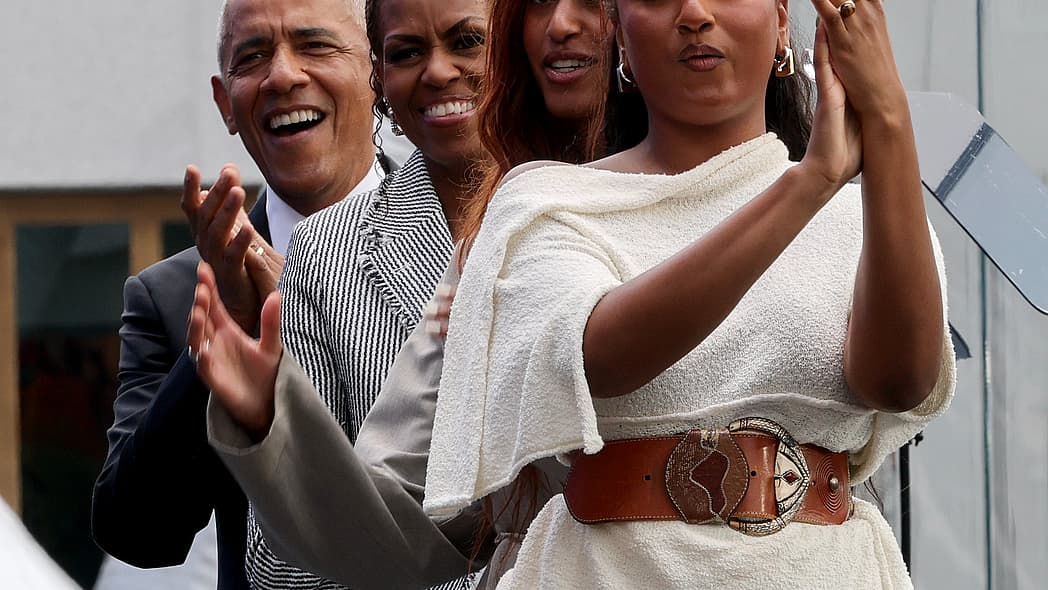
In 2009, two little Black girls walked into the White House at 7 and 10 years old and, without asking, became the most-watched children in the world. Since then, Sasha and Malia Obama have been adopted as Black America’s unofficial nieces, representing possibility, pride, and the particular joy of seeing a loving Black family occupy the most powerful home in the country, while simultaneously carrying the silent weight placed on their little shoulders by virtue of who their father was. That love came with attention and pressure, gaining them a permanent place in the global spotlight almost overnight.
However, while Michelle Obama faced a notorious level of scrutiny for everything from her hair to her sartorial choices, the Obama girls, who grew from kids to teens in the White House, were generally shielded from the public’s critical eye. Michelle and Barack Obama made a deliberate, concerted effort to protect their daughters’ childhoods from the machinery of public life. The former First Lady has spoken about the “long, sometimes messy conversations” she and the President had with staff and the Secret Service to keep the girls’ lives as intact and normal as possible.
“It was really just trying to keep them focused on their lives,” Michelle said on the Baby, This is Keke Palmer podcast. “They only traveled with us on their breaks — so summers, and spring break when they weren’t at camp — so the goal was to make their lives as normal as possible.”
That meant sleepovers. Parties. School commitments that couldn’t be skipped, even when something exciting was happening at the White House. It meant giving the girls space to grow into themselves on their own schedule. When they did appear publicly, the world got something rarer than it perhaps realized: a front-row view of the beautiful, sometimes awkward process of two young Black girls just becoming. From Choker necklaces and Converse to colored hair and aesthetics that drifted from boho chic to soft grunge on any given day, without explanation or apology.
For many Black girls, that kind of freedom isn’t a given. Respectability politics is the unspoken tax Black girls are charged from an early age just to exist in public spaces: dress accordingly, speak properly, don’t give anyone a reason to question you or your people. Most Black girls are taught, explicitly or not, that their choices are never entirely their own; that how they show up reflects their family, their community, their race. That they must always “come correct.” But Sasha and Malia, who arguably had more eyes on them than any Black girls in American history, somehow managed to opt out of that performance through the years.
Even when conservative political staffer Elizabeth Lauten broke the unspoken rule against publicly criticizing the children of a sitting President, the Obama administration gave a measured response expressing their shock and accepting her apology without the girls having to defend themselves or anything. Instead, they just moved on, a grace that their mother was intentional about instilling in them.
“They had to learn how to balance the unwanted attention, but do it politely,” Michelle previously said, speaking of her two daughters on the Moments That Make Us podcast. “To build their own lives in the spotlight and not be eaten up by it.
“I never felt my job was to create mini-mes, or create people who were going to live out some brokenness in me, or fill some hole, or to be my friend. So I felt my job was raising people, and when you’re raising people, rather than babies, you make different decisions. I had to raise them to be stand-up young people on their own, especially as the daughters of a former president,” she added. “That was the intentionality of it, and it had to do a lot with who they were, but I think no matter who we were, that’d have been my approach because I do think that the sooner young people learn to own their lives, the better off they’re able to manage what’s to come.”
And they have owned their lives quietly, on their own terms. Malia has stepped into the film industry professionally under just her first name, intentionally leaving her father’s surname behind. Beyond her USC graduation, Sasha has kept her life largely out of public view. In the era of oversharing, parasocial relationships, and the very particular entitlement some corners of the internet feel toward public figures’ private lives, that restraint reads almost as radical as anything else.
View on Threads
So when viewers across the country watched Sasha and Malia celebrate the opening of their father’s presidential center in Chicago, standing confidently side by side, boho braids and distinct personal styles intact, the collective pride made sense. It wasn’t just about who their father is. It was about who they are. Two women who grew up under an extraordinary microscope and emerged, somehow, as fully themselves.
Sasha and Malia never set out to be symbols. They were just two girls whose parents fought hard to let them stay exactly that: girls. But in doing so, quietly and without fanfare, they modeled something Black girls are rarely given permission to see: that your life can belong to you. That you don’t have to perform your worthiness, earn your privacy, or justify your choices for an audience that was never really rooting for you anyway.
