
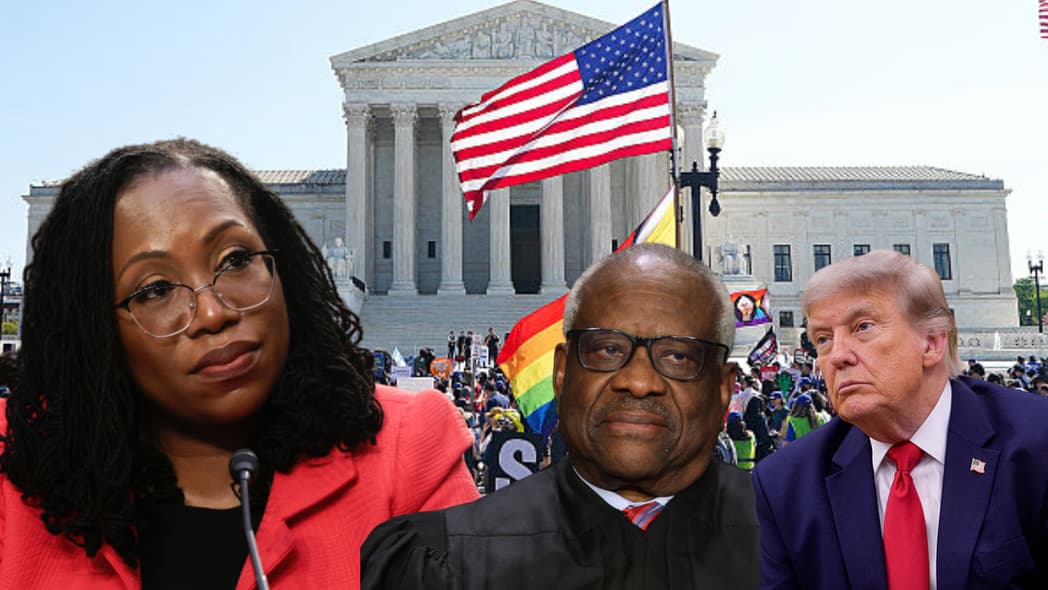
The U.S. Supreme Court ruled against President Trump’s executive order seeking to end birthright citizenship for the children of non-citizens, upholding a post-Civil War constitutional amendment that has existed since 1868.
While Trump has defended his executive order by repeatedly stating that it was meant for the “babies of slaves,” the majority opinion ruled that “Citizenship, then and now, was the right to have rights—to freely participate in our political community” and that “The Framers of the Fourteenth Amendment extended that promise to ‘every free-born person in this land.'”
Most interestingly, Justice Ketanji Brown Jackson, in her concurring opinion in Trump v. Barbara, scolds the Trump administration’s legal argument — which is backed by Justice Clarence Thomas in his dissenting opinion — that the birthright citizenship clause under the 14th Amendment was only intended for the children of former enslaved Black Americans, who had fought in the bloody Civil War that ultimately led to their freedom from U.S. chattel slavery.
“Despite his longstanding endorsement of a ‘colorblind’ Constitution, Justice Thomas now surprisingly suggests that the Citizenship Clause was a race-conscious remedial measure, relating only to ‘freed slaves such as Dred Scott,’ and those who shared with them certain characteristics,” wrote Jackson, the first Black woman to serve on the U.S. Supreme Court.
She continued, “It is for this reason, he says, that ‘children who were born in the United States but [to parents] not domiciled here’ are not entitled to claim birthright citizenship. But that narrow vision of the Fourteenth Amendment bears little relationship to the history of its ratification. Even worse, Justice Thomas’s telling elides the entire point of the Second Founding: The Reconstruction Amendments were an anticaste, antisubordination reset for the Nation, not a mere spot treatment for the dark stain of slavery.”
Jackson goes on to provide a detailed account of the history of the Civil Rights Act of 1866 and the 14th Amendment, both of which redefined citizenship during the Reconstruction Era, as well as subsequent Court rulings that extended citizenship rights to all those born in the U.S., including children of foreigners. Justice Jackson explains the intention of Congress, anchored by the advocacy of Black Americans of the time, such as abolitionist Frederick Douglass, was to establish under law the right to citizenship for all born on U.S. soil — not just former enslaved Black people and their descendants.
“Black people who were generally not permitted at the polls or in the halls of power mobilized nevertheless to advance the universalist vision of belonging and citizenship that eventually won the day,” Jackson writes.
Justice Jackson points out that even after the Civil War and subsequent victories in gaining citizenship, Black Americans faced discrimination, much like immigrants of today — including efforts for them to self-deport to Liberia, the first independent Black republic in Africa.
Despite this unique discrimination, Jackson notes, “Freed Blacks did not advocate for a unique set of rules that catered only to their situation. Nor did they seek to advance their own position relative to, or at the expense and exclusion of, other marginalized groups…The firmest foundation for freedom would require an anticaste reset—’both for his sake and for ours’—and would benefit all.”
It was because of the advocacy of Black Americans and elected officials who supported their enfranchisement through legislation, not in spite of, that other ethnic or marginalized groups, like the Chinese, too, benefited from the protections of birthright citizenship.
“When ratified, the Citizenship Clause thus vindicated the universalist vision of the delegates at the Colored Conventions and their allies in Congress,” the Harvard Law-educated justice writes. “Instead, the Amendment recognized their rightful claim to birthright citizenship simply and solely by virtue of their having been born on American soil.”
Undergirded by this historical context, Justice Jackson says that the Trump administration and Justice Thomas were “wrong” to argue that the 14th Amendment had been misused or “repurposed” for immigrants.
“By ignoring that our Constitution stands firmly against caste and subjugation—on all axes and in all manners—they deny the clear, universalist vision shared and proclaimed by the Fourteenth Amendment’s Framers: to ‘rebuild a shattered empire . . . to plant deep and solid the cornerstone of eternal justice, and to erect thereon a superstructure of perfect equality of every human being before the law,'” writes Jackson.
The justice says the “universalist” intention of the 14th Amendment, and subsequently the birthright citizenship clause, should “forever be the death knell” to the kind of contrary claims made by the Trump administration and Thomas that seek to “make bloodline the marker of birthright.”
“The America that was reborn from the rubble of the Civil War simply does not countenance that inequitable result,” says Jackson, who added, “Thankfully, a majority of the Court remembered this today, and has dutifully preserved the most basic animating principle of our Nation’s founding—that all human beings are created equal—once more.”
