
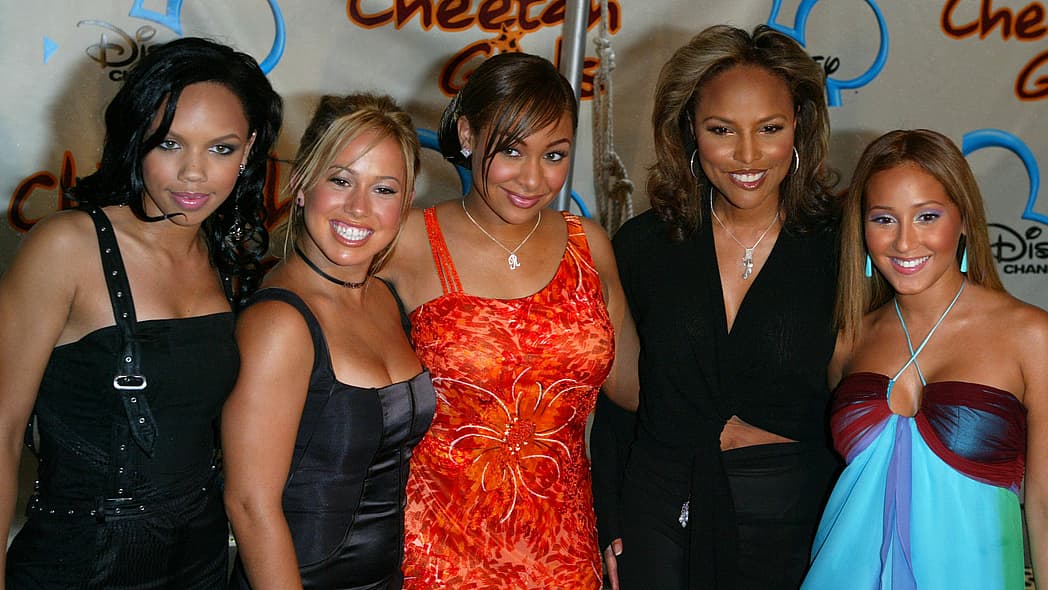
In 1999, Deborah Gregory debuted her young adult series “Cheetah Girls,” following five teenage girls from diverse backgrounds in New York City as they chase their music dreams while navigating high school drama. In 2003, Disney premiered the first movie adaptation of Gregory’s series starring Raven Symoné as Galleria, Adrienne Bailon-Houghton as Chanel, Sabrina Bryan as Dorinda, Kiely Williams as Aqua, Lynn Whitfield as Galleria’s mother, and more.
Fast forward over 20 years, and Disney has announced plans to revive the hit series with “The Cheetah Girls: Next Gen,” reuniting members of the original cast, reprising their roles while introducing Leah Sava Jeffries as Galleria’s daughter Faith, Carmen Sanchez as Chanel’s sister Dior, Kaileen Chang as Ruby, Sophie Lennon as Brooklyn, and Kamogelo Ramashala as Kendi.
News of the reboot has sparked a wave of reactions online. While many fans are excited to see a new generation carry the torch, plenty of longtime fans, the same kids and tweens who grew up on the books and the original film, have zeroed in on one glaring difference between then and now: diversity.
View on Threads
View on Threads
Whether you first met the Cheetah Girls through the pages of a library book or on your television screen, the series was a breath of fresh air for young Black girls coming of age at a time when it was rare to see characters who looked like them centered in books, let alone in a primetime movie. Gregory has said that many details from the books mirrored her own life, Dorinda’s upbringing in foster care, and Galleria’s Black and Italian heritage, pulled straight from Gregory’s own experience growing up in New York.
“I created this whole universe based on my concept of modern-day life being parallel to the real jungle (lions, and tigers, and bears, oh, my!). Naturally, that means they had to represent more than just a singing group. These girls had to have a set of ethics for surviving in the jiggy jungle. They had to be crew. More than anything, I knew they had to be from different backgrounds—just like real girls,” the author explained.
“This is what was the impetus for me, was the fact that they said there were not enough books with urban characters, actually the word they used is Black characters, African-American,” Gregory told NPR in 2007. “I went to the bookstore, and I looked, and I was shocked. The books were boring, and there weren’t enough books with, you know, different characters. It was all pretty white. And I thought, hmm, this is not right. You know, technically, I am biracial. You know, I’m half black and half white. So what it is for me is such an explosion of multiculturalism because that is what fascinates me.”
That authenticity is exactly what made the series resonate the way it did. The diversity, the sisterhood, the culture are stitched into every layer of the storytelling. Gregory has said the idea for the books first took shape after she interviewed Destiny’s Child at Houston’s Galleria mall for Essence, a moment that planted the seed for what would become the Cheetah Girls universe. Five years later, Whitney Houston and producer Debra Martin Chase, the first Black woman to secure a major studio production deal, joined forces to bring the story to the screen, cementing it in both Disney history and the childhoods of Black girls everywhere.
The Cheetah Girls gave little Black girls space to dream before they even understood how often the world would try to stop them from doing exactly that. From the storylines to the outfits to the music to everything that happened behind the scenes, the Cheetah Girls hold a sacred place in Black girlhood. The songs and choreography have stood the test of time, and much like riding a bike, you never forget the words to “Cinderella” or “Strut.” And while the conversation around “Cheetah Girls: Next Gen” has become tangled up with the recent conversations about diversity, equity, and inclusion, there’s still something exciting about watching a new generation get the chance to experience Cheetah Girls magic for themselves.
