
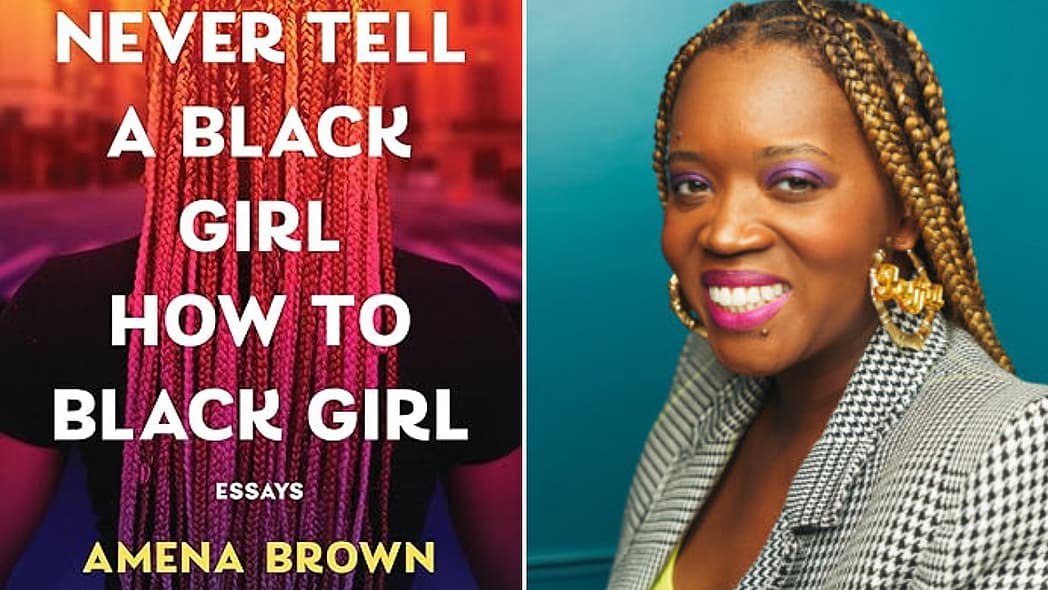
There’s a moment in every Black woman’s life when she realizes “Black girl” isn’t just something you are. It’s something you do. It’s the hip you cock without thinking, the eye-roll you trade with a stranger who somehow already gets it, the Saturday morning hair-pressing ritual, all the little rules nobody wrote down, but every Black girl knew.
Author, poet, and self-described “comedic storyteller” Amena Brown has spent a career putting language to that feeling, and her new book of essays, “Never Tell a Black Girl How to Black Girl,” feels like a joyful, loving culmination of that work.
“Black Girl is a noun and a verb,” Brown writes in the book’s introduction. “I am a Black girl and I Black Girl.” And once you hear it that way, you can’t unhear it.
Brown grew up in a world of what she calls “siloed definitions” of Black girlhood, invisible rulebooks about what was and wasn’t an acceptable way to move through the world as a Black girl. She loved the Red Hot Chili Peppers and Nirvana as a kid, and back then, that wasn’t exactly a sanctioned way to Black girl. And now, as a woman, she’s using her platform to rebel against that very idea. Regardless of whether a Black girl likes to crochet or skateboard, she’s Black girling. Because, as Brown puts it, there is a whole galaxy of ways to Black Girl and every single one of them counts.
Brown began exploring these galaxies for this collection of essays in 2024, four years after the idea for the book first came to mind. Throughout the six-year process from ideation to publication, Brown pushed herself to celebrate and enjoy the internal joys of being a Black girl during seasons in which the world was actively trying to strip us of our joy.
“I will say, writing a book of comedic essays while the world is figuratively and literally burning was a really wild experience, and there were several times in the writing that I questioned myself,” Brown told theGrio. “Is this important enough? Isn’t it impactful enough for all the things that Black women are experiencing and going through right now? Am I playing around by writing this book about me swinging my cornrows as a little girl, or about my friends at Spelman trying to get me to wear my hair natural, and me being like, I would never do that.”
Just as those doubts crept into her mind, Brown would also remember that though joy can sometimes feel like a luxury, it is not a distraction, but rather a tool for survival that has carried generations of Black women through the toughest times personally and societally.
“We need our joy. Our joy is a part of how we make it. Our joy is a part of how we survive.” she shared, recalling her grandmother finding joy watching “Young and the Restless,” and her own younger self finding it in front of “106 & Park,” trying to learn music video choreography off the screen. “That’s a part of how we survived this.”
Even when she doubted an essay about, in her words, titties, while headlines reported on the mass loss of Black women’s jobs, it was other Black women who talked her off the ledge, reminding her that we need to laugh. We need spaces that remind us of how beautiful and absurd our stories can be all at once.
While reflecting on her own funny moments, Brown uniquely captures the innate Black girl code that exists among all Black women, without fully giving away its secrets.
“I think there’s a lot of profound layers to the ways that we communicate,” she said, “and one of my favorite things about being a Black woman is the code with which we communicate, that there are things we say, and there are some of those things we say that we only understand. And I love that for us.”
It’s a code that crosses generations, geography, even language. In our conversation, Brown described meeting Black women from other countries, who speak a completely different language and still somehow instantly connecting with them because of how they Black girl.
Every Black girl inherits and learns the language somewhere. For Brown, her lessons came from her mother, her grandmother, the women preaching from the pulpit of her Pentecostal church growing up, and later, the wide, unruly, glorious range of Black girlhood she encountered at Spelman College.
“Spelman was probably the largest influence I had of a variety of how Black girls Black girl,” Brown admits. “It was amazing to get to experience that. Any of us as Black women that have the opportunity to be in an all-Black school, you sort of get to experience that, because now you’re not the only one. You’re not the first.”
And even if you’ve never attended an HBCU, Brown extends that gift through this book. As I flipped through the pages of the book, I felt the weight of expectations and the need to perform to fit into a singular, sanitized version of Black womanhood lift off my shoulders as I giggled through relatable stories, “Real Housewife” references, and life lessons that always hit home, no matter how many times you’ve heard them.
“I hope generally when a reader gets to the end of this book that they feel this sense of like warm joy, like the kind of feeling you feel after you leave a friend that refreshes you,” the author shared, likening the feeling to sunshine.“For my Black women readers, I hope that their cheeks hurt a little bit from smiling. I hope that Black women see their stories mirrored in this book, and even where our generations may be different, or even where our upbringings may be different, that it says to Black women: ‘Your story is important. The ways you Black girl are permitted, allowed and that you should do whatever that is. That no one gets to decide how we Black girl but us.”
Brown described it to theGrio using an expansive metaphor: if Blackness is a country, then within it there are regions, dialects, entire cultures shaped by geography, upbringing, faith, and generation. And yet, somehow, there’s a thread that runs beneath all of it.
