
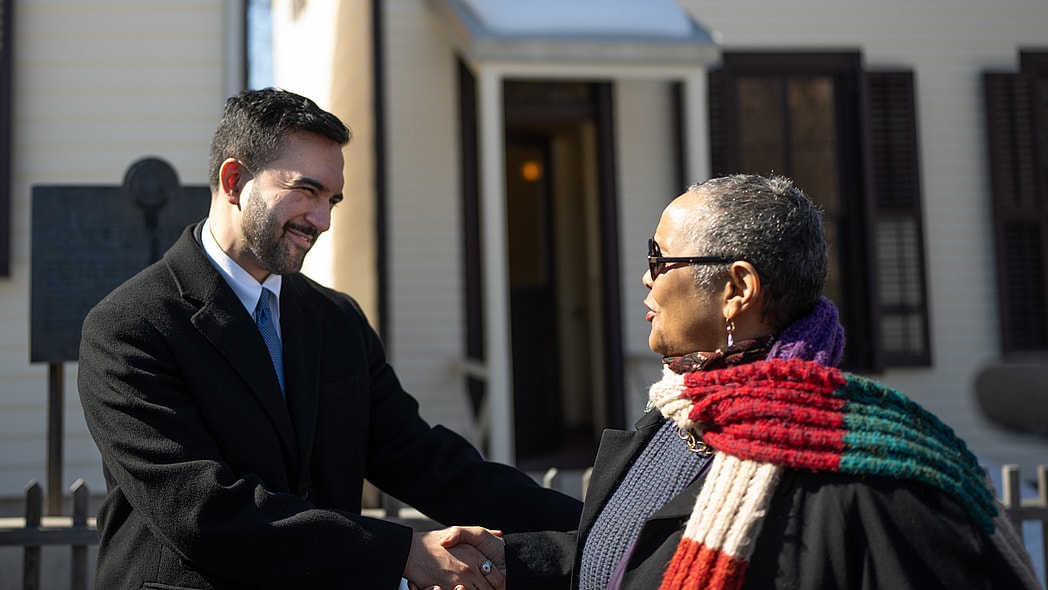
Before there was a “Black Wall Street,” there was Brooklyn, New York’s Weeksville. The original for us, by us, Weeksville was a community that was built by free Black people, for free Black people, defying every odd the 19th century had to offer. And New York City Mayor Zohran Kwame Mamdani is helping make sure that legacy is preserved and highlighted in the tapestry of NYC.
Today, theGrio exclusively debuts “A Dignified Life: The Story of Weeksville,” a new short film detailing the restoration and history of the Hunterfly Road Houses at the Weeksville Heritage Center in Brooklyn by Mayor Mamdani’s office.
“Weeksville reminds us that Black New Yorkers built this city — not just its neighborhoods, but its spirit. This piece honors the generations who fought to preserve that history,” Mamdani told theGrio. “And it challenges us to do our part today: to build a future where the people who made this city what it is can afford to call it home.”
Founded in 1838, a full 11 years after the abolition of slavery in New York State, Weeksville is a blueprint of Black self-determination. Free Black men and women purchased land, sold it to one another, and built an entire community from the ground up, complete with churches, schools, its own newspaper, and even its own baseball team. At its height in the 1850s, Weeksville had grown to more than 500 residents, becoming both a beacon of Black possibility and a sanctuary from the very real dangers of the era.
“The Fugitive Slave Act is put into place in 1850,” President and CEO of the Weeksville Heritage Center Dr. Raymond Codrington explained. “It allowed private citizens to become deputized to round up people that had escaped slavery and return them. So, it wasn’t uncommon for people to be abducted and returned to either a place they knew or a place they didn’t know. That’s a terrifying reality for many Black people that are living at the time, so where do they come? Where is their sanctuary? It was Weeksville.”
The community also served as a safe haven during the 1863 Draft Riots in Manhattan, when racist violence sent Black New Yorkers desperately searching for safety.
The new documentary brings that history to vivid life through archival footage, photographs, and interviews with historians and site stewards, including Tour Coordinator Regina Robbins, Collections Assistant Amanda Henderson, and curator-in-residence Sharifa Rhodes-Pitts. Beyond the history that lives within the houses, the Weeksville Center’s Hunterfly Road Houses are particularly special as they are the only African American historic site in the Northeast still located on its original land.
“What exists in our historic places — but especially in places where Black life has thrived and persisted — are traits of lives lived and time passed,” Rhodes-Pitts says in the film. “When we visit those houses, the feeling I always get is that it’s a place we can touch that reminds us to be as ambitious as the people who had the vision to build them to begin with.”
The restoration, funded by the NYC Mayor’s Office, the Brooklyn Borough President, and the New York City Council, included work on the houses’ façades, siding, windows, doors, and front-entry porches. Practical but crucial upgrades were also made, including a climate-controlled storage room for historical preservation, new plumbing, upgraded fire alarms with smoke and carbon monoxide detectors, exterior lighting, and a new CCTV system.
Today, the Weeksville Heritage Center carries forth the community-driven legacy of the historic neighborhood, hosting everything from yoga classes, workshops, and film screenings to arts programming and intergenerational events.
“In a time when many marginalized communities move through their daily lives with uncertainty, when some fear detention, targeting, or separation from their families, Weeksville stands as a reminder that sanctuary is part of our history. It is also part of our responsibility,” Dr. Raymond Codrington concluded.
And as Mayor Mamdani shares in the film, “may the memory of Weeksville light our way” forward.
