
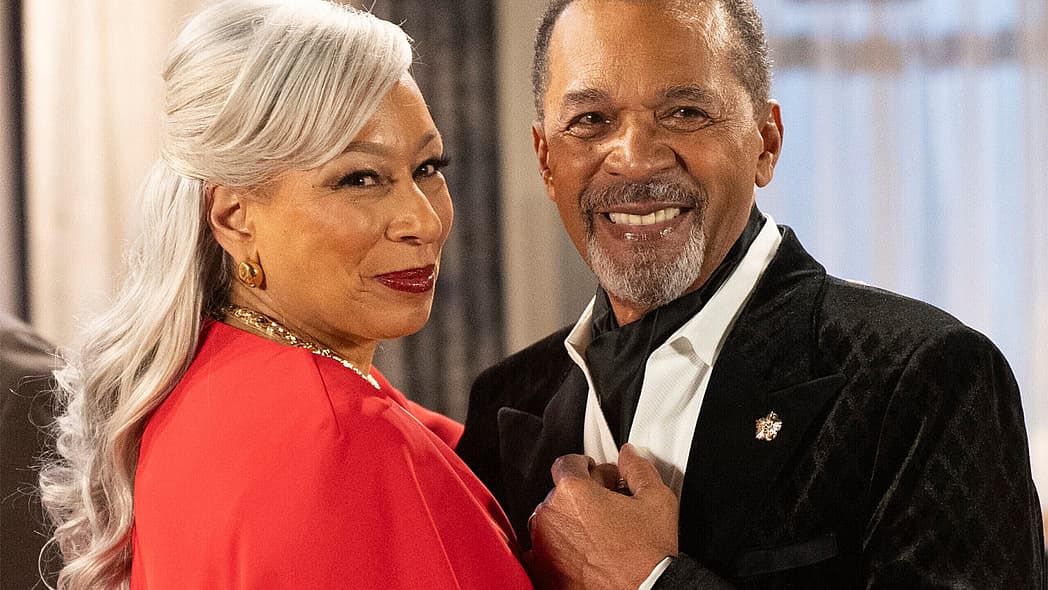
When CBS’ soap opera “Beyond the Gates” premiered in February, soap opera fans and veterans alike hailed it as a win for Black history and culture.
On Monday, the first soap to feature a majority Black cast was renewed for a second season. Its creation was both a savvy business move and an acknowledgment of Black viewers’ passion for the genre as broadcast ratings have declined.
George Cheeks, the CBS chief, told Vulture last year the show was born out of crunching numbers: “One of the things that the data made very clear is that daytime soap operas over index with Black women.”
“I think there’s kind of a renewed appreciation for the audiences that do still engage in broadcast programing, and a recognition that one of those audiences are Black women, and this was a way to serve that audience,” says Elana Levine, a University of Wisconsin-Milwaukee professor and author of “Her Stories: Daytime Soap Opera and US Television History.”
The Drucilla effect
Victoria Rowell’s “Young and the Restless” character, Drucilla Barber Winters, was introduced in 1990 as “an illiterate thief,” she says. Rowell worked with co-creator and then-head writer, William J. Bell to give the character dimension.
Drucilla became a ballet dancer, like Rowell herself, a storyline that showed “it is possible to be in a lower socioeconomic environment and be aspirational.”
She still receives letters from fans who cite Drucilla as inspiration.
The feeling, Rowell explains is, “Oh my God, I can be a ballet dancer through Drucilla, a pull-up-by-the-bootstraps kind of chick that’s rough around the edges and that can learn how to read and write, perhaps, and meet a Neil Winters and get married and improve her life.”
Rowell says she always understood her role as “so much bigger” than an acting job. She recalls meeting with the then-editor of Soap Opera Digest to advocate for a cover featuring the Black cast members — and it ended up happening.
Rowell’s tenure with the show, though, has been up and down. She has only glowing things to say about Bell, who died in 2005. But she sued CBS and producers in 2015 after she says she pushed for the casting of more Black actors and wasn’t hired back on the soap as a result. They later settled. After “Beyond the Gates” was announced, Rowell says she received a letter from CBS acknowledging her place in the show’s DNA.
“I have been contacted with great respect from the powers that be at CBS, thanking me for all of my hard work, recognizing the work that I have done that has influenced this moment and I appreciate that,” she said.
She was “astounded” to be asked to audition for the matriarch role of Anita Dupree, but says she didn’t hear back after submitting her tape. The role went to Tamara Tunie, whom Rowell describes as “a brilliant actress.”
CBS did not respond to a request for comment.
More soap veterans weigh in
Darnell Williams was cast as teen Jesse Hubbard on ABC’s “All My Children” in 1981 to capitalize on younger fans who fell in love with Luke and Laura on “General Hospital.” His fan base exploded after Debbi Morgan was cast as Angie Baxter. Jesse and Angie are regarded as daytime’s first Black supercouple.
“Before that, we didn’t see Black love, and what message does that send? It said that it did not exist because it was not reflected,” said Sherri Williams, an assistant professor at American University who studies Black representation in media.
Darnell Williams says he was surprised by the audience reaction.
“I think about the first time we realized the impact we’d had on the audience, we had gone to a movie in Times Square one night, and after the movie, the lights had come back up and we heard this rumbling. We were looking around and all of a sudden we heard our names being chanted,” Williams said.
When he thinks about “Beyond the Gates,” Williams says he’s hopeful about the job opportunities the show can provide.
For years, Veronica Redd played Mamie Johnson — Drucilla’s aunt — on “The Young and the Restless.” When she tuned into the premiere of “Beyond the Gates,” what she saw got her attention, but what she heard blew her away.
“I was not prepared,” laughs Redd. It begins with a women driving a Mercedes-Benz through the gates of an exclusive country club. The Emotions’ “Best of My Love” is playing — something that told Redd the production value was top notch.
Daytime isn’t usually Redd’s favorite genre even though she acknowledges “it’s paid the bills for many decades.” “Beyond the Gates,” though, has earned a spot in Redd’s TV time.
“They got me hooked,” she says.
Enlightenment through entertainment
If “Beyond the Gates” can open the doors to new conversation, that’s a good thing, says Kimberly McGhee, a Tennessee viewer.
McGhee appreciates how one of the main characters is a psychiatrist. Mental health can be viewed as taboo within the Black community and McGhee believes incorporating it into storylines could help beat the stigma.
The soap also addresses Black history: Clifton Davis plays the Dupree family patriarch, a civil rights activist whose advocacy efforts are often mentioned. Bringing in the civil rights generation is “pretty significant,” said Sherri Williams, but “not surprising” given the NAACP’s producing credit.
“The NAACP is a group that has been fighting for civil rights and for Black liberation for more than a century, and it’s also an organization that has been advocating for authentic images of Black people in television and film,” she explained.
Some have critiqued how the main cast primarily includes light-skinned Black actors, though.
“Now, of the people who auditioned, if they went with the best option, the best talent, totally understand that,” said Atlanta viewer Simone Umba. “But we can still have those talks in regards to colorism because that’s a recurring thing.”
“Black families have to have relatives of all shades, but we don’t see that in this nuclear family. This feels like a missed opportunity to truly be historic and represent Black people across the spectrum,” said Williams.
A diverse audience
“Beyond the Gates” may have been created with a Black audience in mind, but a diverse one is tuning in.
Charlene Polite Corley, Nielsen’s vice president of diverse insights and partnerships, says 52% of the total audience is Black.
“It’s bringing folks along for this really unique story being told in a lot of ways for the first time. And so, yes, the Black audience is leading here, but there’s a whole lot of other kinds of folks who are tuning in, too,” she said.
A varied audience is “good for everyone,” says Elle Murasaki, a Black viewer from New Jersey who hosts weekly live chats on Instagram to discuss the show.
“There is this misconception that being for the culture is exclusive. That it’s Black-only and that we don’t want to include any other demographic into it,” she said. “While there is a majority Black cast telling this story, I think everybody can identify.”
Kerry Bulls, a white fan from Baltimore, also does not miss an episode.
“If you like a good storyline and if you like the genre of a soap opera and something that’s soapy and glitzy, then 100%, this is something that you should watch,” she said. “It doesn’t matter what color you are.”
