
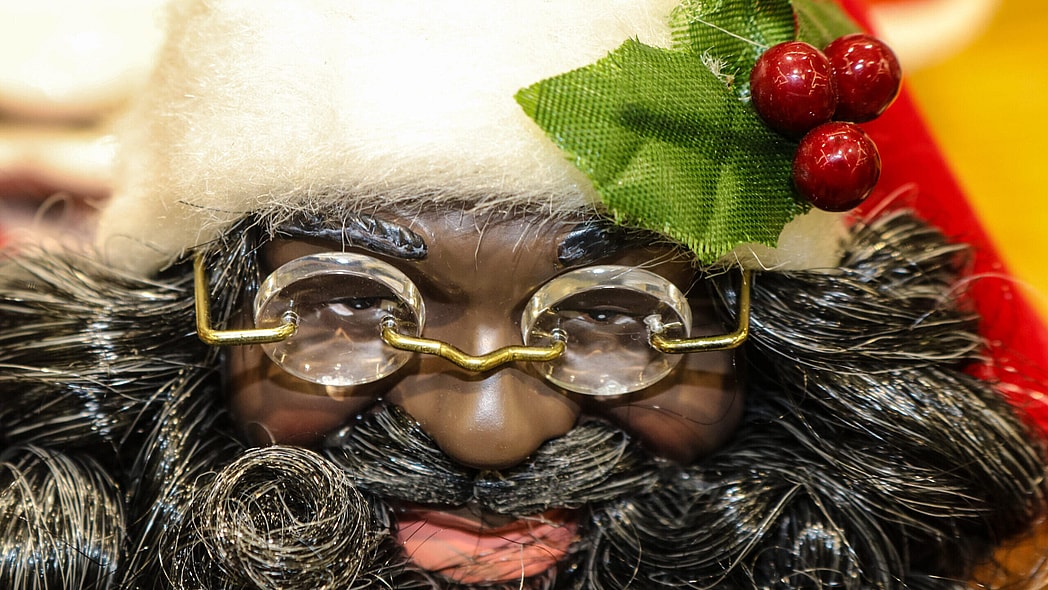
A woman who lost her home in Altadena during the devastating wildfires that tore through vast swaths of Los Angeles County last winter is reflecting on losing one thing in particular: her Black Santa collection.
In an emotional essay for the Los Angeles Times in collaboration with Zócalo Public Square, Katrina Freeny, a retired Social Security Administration claims representative, shares how she and her family, including her husband and daughter, are attempting to rebuild both memories and meaning after the fires destroyed everything they owned—including a collection of more than 80 Black Santas.
Altadena, long considered a historically Black, middle-class enclave and one of the few places where Black families could own homes in the region for generations, was among the communities hardest hit by the fires. Nearly a year later, recovery remains uneven, and for many families, the holidays look nothing like they once did—shaped not only by displacement and loss, but by wider strains including a federal government shutdown, mass layoffs, and growing economic uncertainty. For those who lost their homes, even the small comforts of tradition—ornaments, heirloom Christmas angels, favorite tree toppers—are gone.
“The loss hit me all over again this holiday season, when my daughter and I would usually be taking these heirlooms out of storage to decorate the tree and our home,” Freeny wrote. “I find myself asking a question that has no easy answer: How do you rebuild something that was filled with irreplaceable love?”
Freeny explained that she began collecting Black Santas in the 1970s, long before they were widely available in stores. Her collection expanded to include over 85 individual Black Santa figurines, varying in size and style, as well as over 80 different Black Santa ornaments. Many were handmade by loved ones who have since passed, created during a time when Black representation in holiday imagery was rare, contested, or seen as a novelty. While Black Santas have become more common in recent decades—embraced by many Black households as affirmations of joy and belonging—they still carry deep generational significance for families who once had to seek them out or make them by hand.
Like clockwork, Freeny said she and her daughter would take the Santas out of storage each November, leaving them on display well into the New Year. Tragically, they were still up on January 7, when the fire claimed their home.
“My heart is heavy this Christmas,” she wrote. “I’m grateful my family is alive. I think about how, if we had gone to sleep that January night in our home, we might not be. Still, I am mourning all that burned in the flames, and I’m struggling with how to move forward, when so many traditions I’d held close feel lost or distant.”
Since sharing her story, Freeny has begun receiving Black Santas from friends, family, and even strangers. While she’s touched by the outpouring of support, starting over hasn’t been easy—especially knowing that many of the originals, including her very first Santa, can never be replaced.
“Having to start my collection all over again is heartbreaking,” she said. “But I hope in time they might become something new: new memories, new joy and new moments I can hold on to.”
