
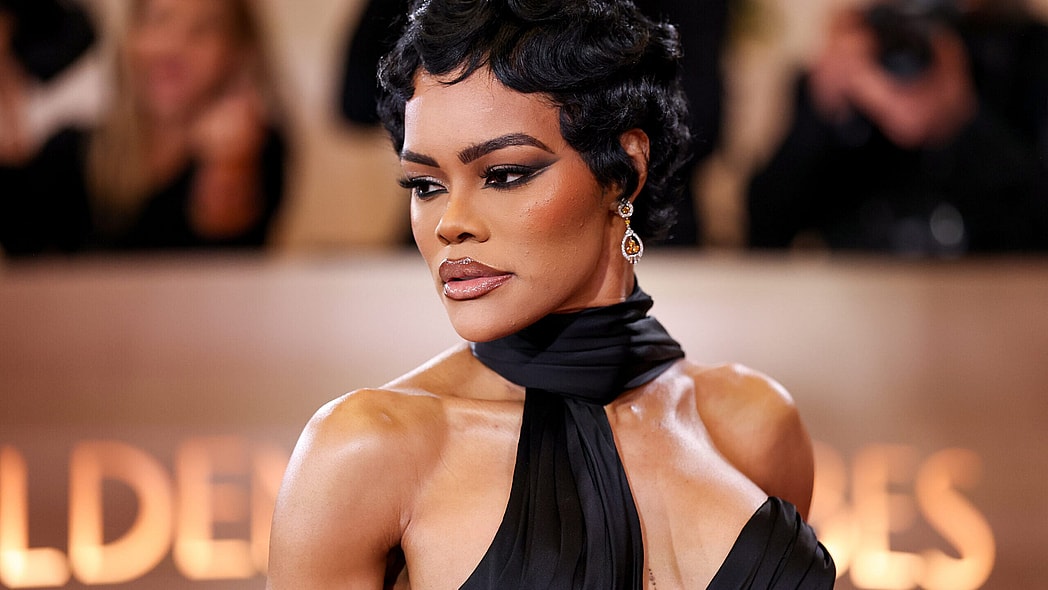
Teyana Taylor, who just won her first Golden Globe for her portrayal of Perfidia Beverly Hills in “One Battle After Another,” says she doesn’t fully understand the scrutiny surrounding her character.
The 35-year-old actress opened up about the role, and the backlash it has sparked for what some viewers have called an oversexualized, fetishized depiction of a Black woman, in a new profile with Vanity Fair.
“Are we watching the same film?” she asked of the Paul Thomas Anderson movie, which also stars Leonardo DiCaprio and Chase Infinity. The film follows a former revolutionary forced back into a world of political violence and retaliation when the forces he once fought against resurface, threatening both him and his daughter.
To the “All’s Fair” star, Perfidia—who serves as a leader of a far-left revolutionary group—is a misunderstood “badass,” a complicated figure shaped by an all-too-relatable reality. But to large swaths of Black women online, the character has become polarizing and deemed a hypersexualized embodiment of fetishized misogynoir. Perfidia, who wields her sexuality in relationships with multiple white men, has been criticized as a character built through a lens that reduces Black womanhood to a “horny” erotic spectacle.
“I think with Perfidia, you see the results of people overlooking postpartum depression,” she explained. “You see how that makes her react. And you see this woman that still wants to shoot guns and still wants to be a revolutionary—and she wants all of the things.”
She added, “I think we don’t enjoy seeing the harsh reality, but this is what’s happening.”
Ultimately, the “A Thousand And One” star believes Perfidia is using her sexuality strategically, rather than being exploited by it. For instance, according to her, the character Steven Lockjaw (Sean Penn) falls into Perfidia’s ploy, finding himself “submissive” to her control.
Or as the actress who plays her put it: “Perfidia kind of dived into the, ‘Oh, you think I’m hot? All right, bet. Cool—if I get to still do what I’m doing, all I gotta do is show you a little titty or something.’”
Even if audiences don’t agree with every choice Perfidia makes, Taylor said she finds it difficult to judge the character.
“It will never be a moment of judgment, because a lot of her mistakes have come from her being in survival mode—dealing with postpartum depression and the title of being a strong woman—a strong Black woman,” she noted, adding in reference to herself, “We don’t get the same amount of compassion as everybody else. We don’t get the same amount of grace as everybody else. Everybody just assumes we’re okay.”
Taylor’s comments haven’t differed from what she has voiced throughout the film’s promotional run. In November, she also pushed back against criticism in an interview with The Hollywood Reporter.
“Is that not what Black women go through?” she said. “We are fetishized, especially by creepy mother—.”
She added, “We are, unfortunately, the least protected people,” and noted that portraying “what Black women go through” is “a hard reality to accept.”
“And this movie should spark debate,” she added. “I always knew it would—because sometimes you just got to shake the table.”
