
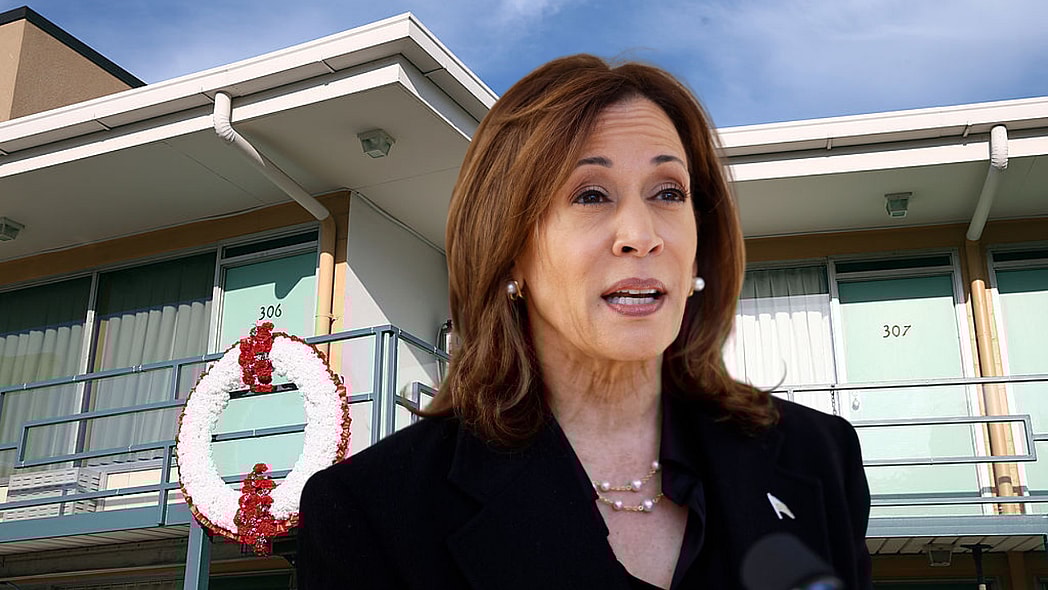
Kamala Harris on Thursday paid a visit to the historic Lorraine Motel in Memphis, where Dr. Martin Luther King Jr. was assassinated in 1968. The former Vice President, who also toured the National Civil Rights Museum in the Tennessee city, was in town for a stop on her “107 Days” book tour.
On what ironically happened to be Dr. King’s birthday, Harris took some time to visit the exact location where MLK was fatally shot by James Earl Ray nearly six decades ago. A photograph of the moment captured by The Commercial Appeal shows the 2024 Democratic presidential nominee having a moment of solitude as she surveyed the area and touched the railing of the storied balcony, where King was shot in the neck just outside of his motel room. On that day in history, April 4, 1968, King was in Memphis organizing protests during the ongoing sanitation strike.
A source close to Harris told theGrio that it was the former Vice President’s first visit to the MLK assassination site at the Lorraine Motel, which was designated a historical site in 1982 and eventually became part of the National Civil Rights Museum complex. The Harris source said the potential 2028 presidential candidate toured the museum for 45 minutes.
The private tour was led by Russ Wigginton, the museum’s president, and Ryan Jones, the director of history, interpretation, and curatorial services. Harris viewed exhibitions spanning five centuries of Black history, from resistance during slavery and the Civil War and Reconstruction, to the rise of Jim Crow, and the pivotal Civil Rights era that led to breakthrough change for Black Americans, including the passage of the Civil Rights Act of 1964 and Voting Rights Act of 1965, and their political power.
MVP @KamalaHarris visited the National Civil Rights Museum at the Lorraine Motel in Memphis, TN earlier today.
— best of kamala harris (@archivekamala) January 16, 2026
📸: Chris Day pic.twitter.com/M4bOUt2Obh
A Harris source shared that, during the tour, Harris asked Jones what he thought Dr. King’s message would be today.
Acknowledging the significance of visiting the museum on MLK’s birthday, now a federal holiday observed on every third Monday of January, Harris told museum staffers, “It is by maybe divine plan, but certainly by coincidence, that we happen to be in Memphis on today.”
“But the work you all are doing here is so critically important in a moment where people need to see light in the midst of darkness, when people need to remember our history,” she told the museum workers. Harris continued, “To challenge us about what we’re supposed to do, at the moment in time in which we exist, facing obstacles and challenges, but also filled with hope and optimism and fight. Yes, it’s so important that people have a place to come, so that while we remember history and while we carry it in our hearts, we can also feel it and see it and experience it in a way that rejuvenates us.”
Hinting but not naming President Donald Trump’s efforts to sanitize and undermine Black history, the historic first Black and female vice president said the role of museums like the National Civil Rights Museum is critical. “Especially at this moment in time, where we need to remind people of our true history in a way that gives us a collective sense of pride and who we are as Americans,” said Harris.
