
There’s a powerful story emerging from Chicago that feels both intensely local and nationally relevant.
In the Austin neighborhood on the West Side of Chicago, a Black woman-owned grocery store is reshaping what access and ownership can look like in communities that have historically been overlooked.
The store is called Forty Acres Fresh Market. Yes, the name is intentional.
“Forty acres and a mule” was the post–Civil War promise made to formerly enslaved Black Americans. Land. Economic footing. A real chance at generational wealth. That promise was never fulfilled.
So owner Liz Abunaw decided to respond to that history with her own vision: a grocery store.
“What would it look like if we actually got our 40 acres?” she asked during a recent feature by CBS News Chicago.
For her, it looks like a fully functioning market stocked with fresh produce, meats, and everyday essentials right in the middle of a neighborhood that hasn’t had one.
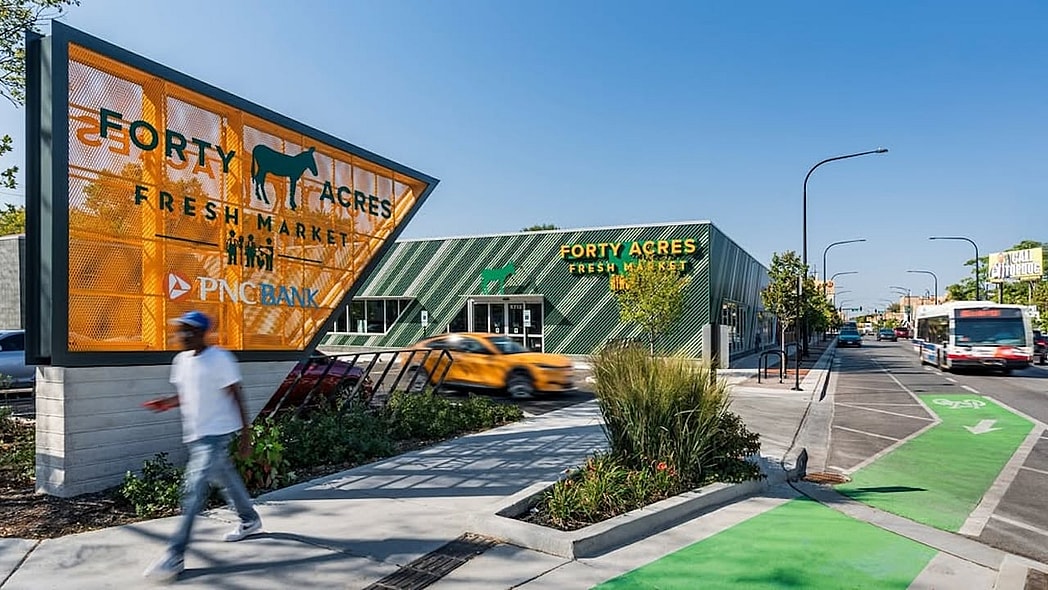
The building itself tells part of the story.
Before it became Forty Acres Fresh Market, the space was a Salvation Army thrift store — closed off, minimal windows, heavy concrete block walls. Abunaw said it felt like a prison.
She redesigned it to feel the opposite.
The exterior now features bold metal paneling and angular windows that flood the space with light. Inside, the aesthetic blends a modern general store with the charm of a 1950s ice cream shop — nostalgic, but elevated. The goal was simple: make it feel welcoming and timeless.
And here’s what makes the opening so significant — it’s currently the only full-service grocery store in Austin.
For years, residents had to drive to other neighborhoods or even into the suburbs to shop for groceries. Something as basic as buying potatoes or cilantro required a car, gas and time.
Now, it’s walkable.
Abunaw didn’t step into this blindly. She previously worked at General Mills, where she learned the operational side of food retail.
She’s clear-eyed about its success and its complexities. It requires managing countless moving parts simultaneously. Still, she believes it can be a powerful tool for food access, local jobs, and keeping dollars circulating in the community.
She also pushes back on the idea that Black-owned means niche or overpriced. If her store is charging the same prices as larger competitors, she says, that means it’s competitive. That means it’s working.
Importantly, Abunaw has acknowledged she’s not the first Black-owned grocer. She sees herself as building on a legacy that came before her.
But at a time when conversations about racial wealth gaps, food inequity, and community investment are front and center, Forty Acres Fresh Market stands as a visible response.
