
Black people have to work twice as hard just to get half as much. This isn’t a new concept. And for most Black people, especially Black women, it’s not a revelation. It’s a reality we learn early, often as a response to our first encounters with prejudice and injustice. But every so often, society offers up a case so blatant, so undeniable, that it demands to be named, documented, and added to the ever-growing list of proof behind that truth.
Most recently, ABC’s “The Bachelorette” provided just that.
The network’s response to Taylor Paul’s casting, and subsequent scandals, has reignited a familiar conversation about who gets grace, who gets protection, and who is deemed “too risky” from the start. The “Mormon Wives” star’s journey for love on the long-running reality show was cut short after a video surfaced showing her assaulting her ex, Dakota Mortensen. As reported by NBC News, the video was tied to a 2023 incident that led to Paul’s arrest, which had already been public record. Still, it was the footage’s resurfacing that ultimately led ABC to scrap the season amid backlash.
“In light of the newly released video just surfaced today, we have made the decision to not move forward with the new season of ‘The Bachelorette'” at this time, and our focus is on supporting the family,” Disney Entertainment said in a statement reported by the Associated Press.
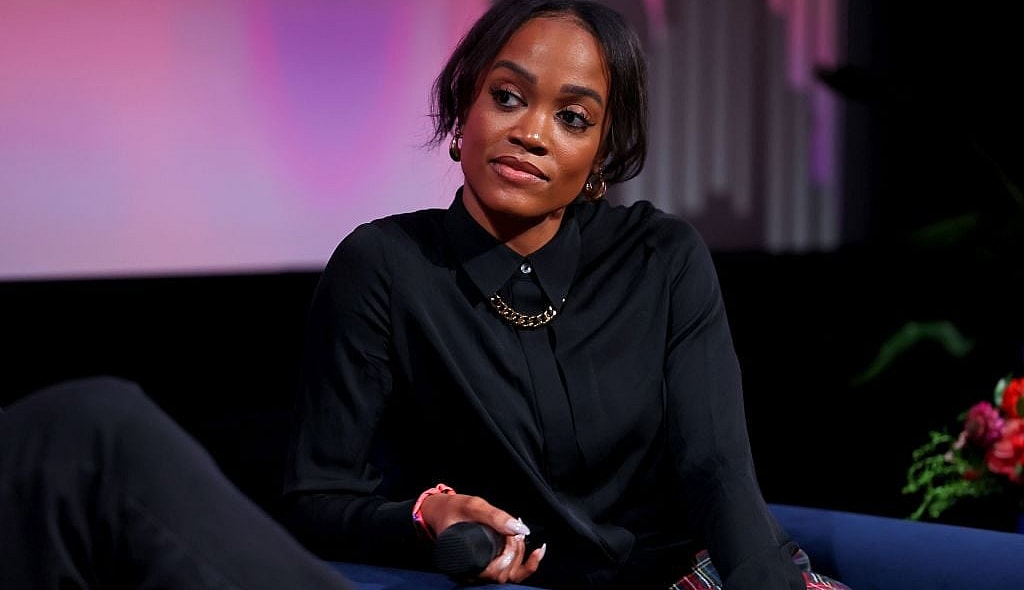
For Rachel Lindsay, the franchise’s first Black Bachelorette in 2017, the contrast in how the network navigated her season versus Paul’s isn’t just noticeable; it’s telling. Speaking on a recent episode of her podcast “Higher Learning,” Lindsay unpacked the glaring double standard.
“It was funny to me that the show wanted to take this risk, but for you to have a lead of color, that was too risky, right? When it came to ‘hey, we’re going to have our first lead of color,’ which took 15 years, that person had to be damn near perfect on paper because that had to make sense to your audience. They had to be digestible to your audience,” she noted. “So, it was funny to me that this is okay. The ideal bachelorette, that they have presented to us over these 20-plus years, was not this– not someone with two baby daddies, divorced, three kids, a soft swinging scandal, and a felon.”
She continued: “As a person who’s been through it and has experienced it, I thought, seriously, after everything that I’ve been through with this franchise, as [a person] of color, this is the risk you want to take?”
Lindsay has long been candid about her experience within the franchise—from navigating on-air microaggressions to enduring the toxicity of its fandom. In a 2021 op-ed, she described the emotional toll of constantly defending herself against what she called the “Bachelor Klan.”
“The franchise has spent 19 years cultivating a toxic audience. They have constantly given it a product it wants: a midwestern/southern white, blonde, light-eyed Christian. Not all viewers are like that,” she wrote in the piece. “There is a Bachelor Nation, and there is a Bachelor Klan.
The Bachelor Klan is hateful, racist, misogynistic, xenophobic, and homophobic. They are afraid of change. They are afraid to be uncomfortable. They are afraid when they get called out.”
Behind the scenes, Lindsay says the pressure to be palatable was just as intense.
“Having been through it, it was ‘so you can’t act like this.’ ‘We’re not going to air this scene because the audience will name you an angry Black female.’ ‘You can’t go confront your men because you’re frustrated with something you’re hearing, because that won’t look good.’ It was so risky for me to be opinionated or have a personality,” she shared.
Even with those precautions, the label of the “angry Black woman” followed her—along with blame for broader issues within Bachelor Nation.
“There are people or fans out there, particularly fans of this franchise, who will always find a way to blame the Black woman without ever holding the other ones accountable,” she noted.
And that’s the crux of it.
Reality television has never been a neutral playing field for Black contestants. From “The Bachelorette” to “Love Island” to “Summer House,” these predominantly white spaces have made slow, often performative strides toward diversity. But the burden placed on Black cast members, paired with the scrutiny of deeply loyal, and at times hostile, fan bases, reveals a disconnect between what audiences say they want and what they actually allow.
At its core, this isn’t just about two women or one franchise. It’s about a pattern. One where Black women are expected to be exceptional just to be considered, while others are allowed to be flawed and still be chosen.
Rachel Lindsay carried the weight of being the first. And years later, the contrast in how “risk” is defined makes one thing clear: in reality TV, much like in real life, the standard was never equal to begin with.
